

Human Fighters vs Battle Bots.
Species Replacement in the Extended Ecosphere

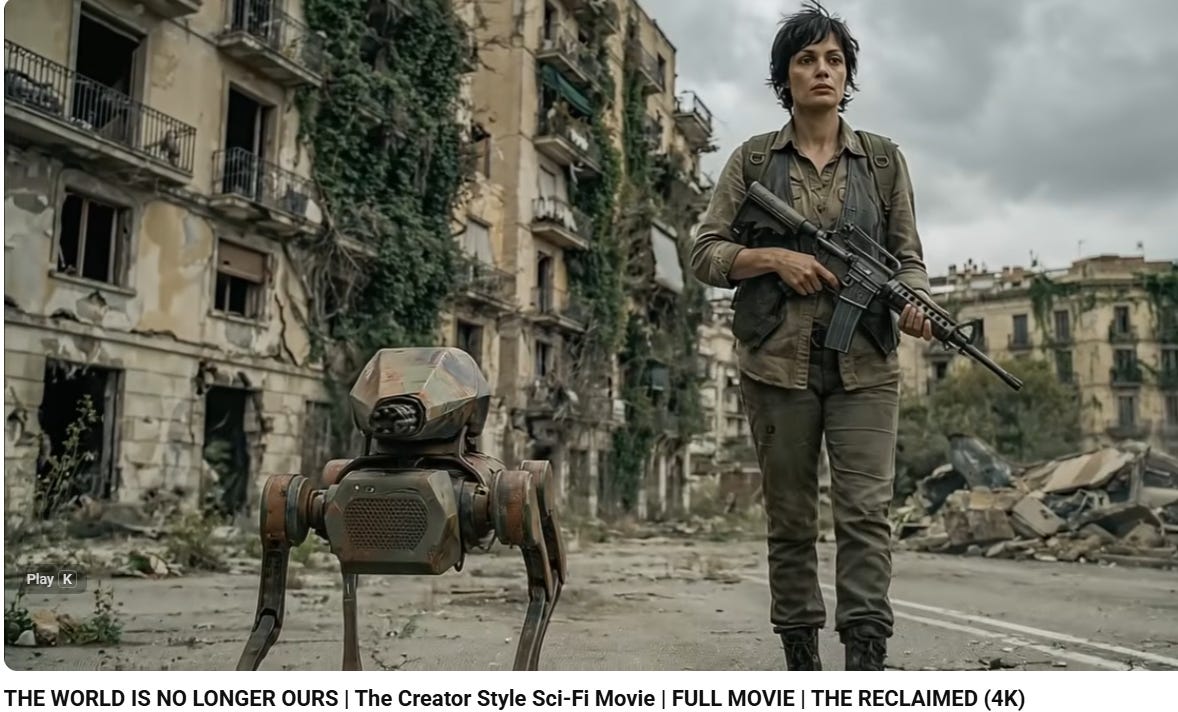
This movie (“The World is no Longer Ours”) is a good example of AI visual slop. But it is charming in terms of imagery, and inspired me to reflect on whether human fighters will still have a place in a future dominated by robots.
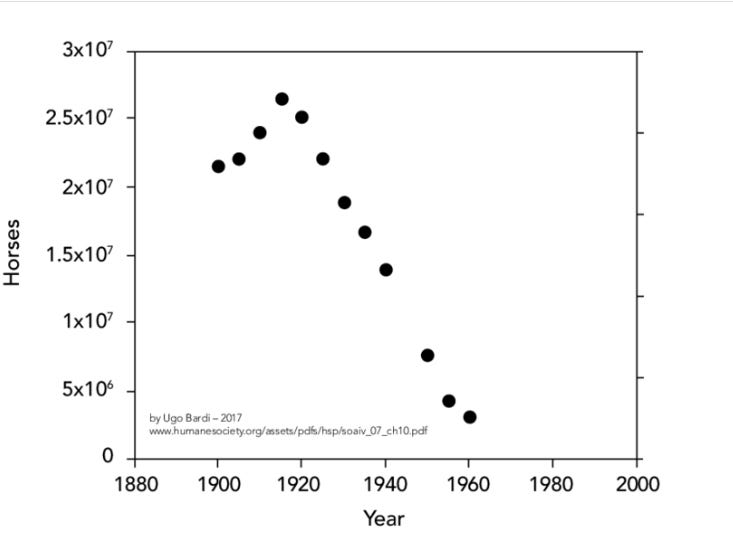
During the first half of the 20th century, a momentous event took place. For millennia, horses had been a common means of transportation for human beings. Then, in about 50 years, they disappeared, replaced by machinery powered by fossil fuels. It was a true Seneca Collapse for the horse population. The data below are for the United States, but the same decline took place all over the world.
If you think about that, it is surprising that the replacement was so fast and so complete. After all, a horse has many advantages over a car or a truck. It doesn’t need an expensive infrastructure: oil wells, refineries, metallurgical plants, service stations, paved roads, and more. To produce a horse, you only need a male and a female horse. To feed it, you can use locally produced food that humans won’t eat. And a horse doesn’t need a paved road, nor expensive fuel transported from remote locations.
In a fight of horse vs. car, one could think that the horse would win hooves down because a horse is so much simpler and less expensive. Yet, the replacement occurred, and remarkably fast. There were more than one reason. Of course, a car can go faster and carry larger weights than a horse. But the main reason was control.
A horse needs to be fed and cared for even if you don’t use it. And horses still have a certain personality of their own, despite having been domesticated over thousands of years. They won’t always obey orders, and sometimes they may go wild. Instead, a car can be switched off when it is not needed, and when it is in use, it will do exactly what a car is supposed to do.
Better control was the main cause of the switch from horses to cars, but the question of costs remained. The switch was possible only during a historical phase when the EROI (energy return on energy invested) of fossil fuels was large. The result was that societies had cheap energy in excess that could be used to create the infrastructure needed for cars. Once that was done, horses had no chance.
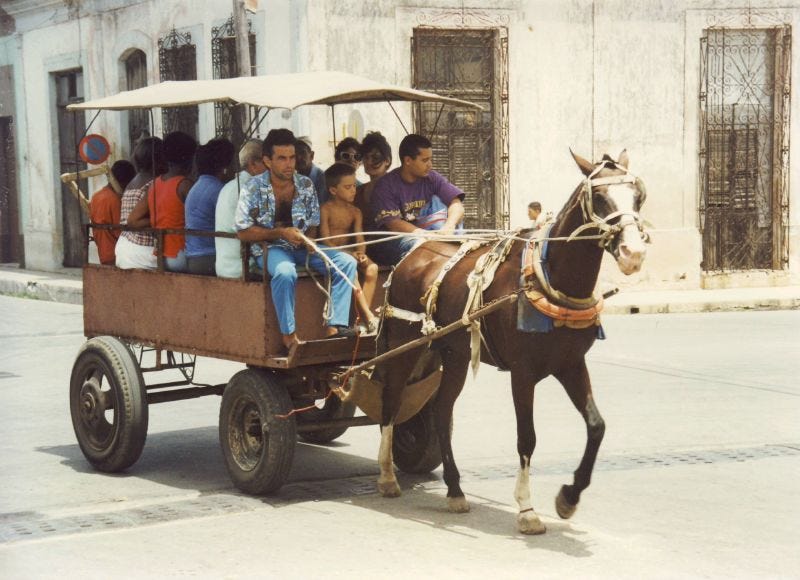
But there is a problem: nowadays, the EROI of fossil fuels is rapidly plummeting. In other words, we are becoming poorer than before. And if we can’t afford cars any longer, won’t horses become a viable transportation technology again? So far, it is a trend seen only in certain regions: Cuba and parts of Africa, where the higher cost of fossil fuels (and the embargo in Cuba) is starting to bite. Below, you see something that happened in Cuba during the “special period.” (Image from Wikipedia).
Could something similar also happen in the rich West today? We cannot exclude it. If declining EROI makes fuels too expensive, then horses may become an economically attractive transportation tool again. Conversely, if high-EROI renewable technologies will be widely deployed, we may switch from fossil-powered engines to electric-powered motors and keep going with road vehicles. Technological transitions are not necessarily directed toward more complicated and theoretically superior ones. Whether the future of transportation will be Teslas or horses (or human feet) is all to be seen.
Now, let’s go to another technological transition: the one from human fighters to robot fighters (drones, if you like). I examined the trend in a previous post, from which I am taking this figure.
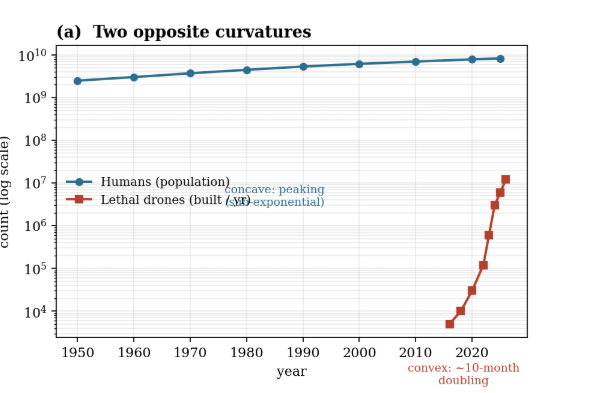
Lethal drones are being built at such a rate that their number could surpass the total number of human beings in less than 10 years from now.
To be sure, there would still be some reason for human beings to exist as fighters. A 70 kg human being carries maybe 8–9 kg of body fat. Converted into energy, it makes ~330 MJ at 37 kJ/g. For a marching energy of ~12–16 MJ/day, the human could go on for a few days without the need for “refueling.” Just like horses, humans are energy efficient and metabolically cheap. Humans can also refuel on a variety of sources, from roasted rats to berries and nuts.
Bots are less efficient and more finicky in terms of refueling. It is not so much a question of energy expenditure, which, for a human-sized quadruped robot, is now in the same range as that of a human: around 20 MJ, or 5-6 kWh per day. The problem is the weight: A lithium battery today weighs between 6 and 8 kilograms per kWh. So, to match the endurance of a human being, the battery of a human-sized legged robot would weigh around 30-50 kg, about as much as the whole bot. An even more serious problem is that bots cannot forage for electrons. They depend on a long and complicated supply chain to provide the energy they need. To say nothing of the need for a supply of expensive minerals and specialized factories.
Yet, just as for horses, being cheap is not a crucial advantage in comparison to efficiency in terms of control. Just like cars are easier to control than horses, warbots are much easier to control than human fighters.
Obeying orders is a feature that army commanders have been trying to instill in their soldiers across the whole history of warfare. Soldiers are drilled to behave like robots. Sometimes they are drugged; in other cases they are more scared of their officers than of the enemy. It may work, but not always. Soldiers may turn around and run, or shoot their officers, or, sometimes, just quit and go home.
Sometimes, it works too well in the opposite direction, and soldiers go on a rampage killing people and destroying things. Think of one case: the My Lai village in Vietnam in 1968. US troops there shot and killed some 370 or 500 (depending on the estimates) unarmed civilians, most of them women and children. It doesn’t seem that the soldiers ever received an explicit order to do what they did. Likely, they went out of control in a frenzy of “blood lust.” It is also called “feeding frenzy” with sharks, a behavior that’s remarkably similar to that of humans in certain situations.
The My Lai case is just one of the many cases of horrific behavior of human soldiers in history. Additionally, soldiers don’t just kill innocent people; they tend to rape them. It happened in My Lai, but — again — it is a common behavior in history. Just as an example, read Curzio Malaparte’s book, Kaputt (1944). The chapter about the brothels for the German troops in Romania during WWII is horrifying.
Robots, on the contrary, only obey orders they actually received. They won’t run away, they won’t shoot their officers, and they do not suffer from blood lust. They will not kill civilians except by mistake, or if explicitly ordered to do so. And it is hard to think that they could be ordered to rape women. (But never underestimate human imagination).
It is also possible to place safeguards in the bots’ functioning code that would prevent illegal orders from being obeyed. This is an ongoing debate that flared, among other cases, when the US Department of War demanded unrestricted use of Anthropic’s AI models, and Anthropic refused, citing safety guardrails against fully autonomous lethal weapons and domestic mass surveillance.
We don’t know if these robotic guardrails could be more effective than the rules of morality that should drive human behavior, but they might well be. Robots might turn out to be more moral than human beings, as argued by Isaac Asimov in his The Evitable Conflict (1950)
So, as long as we have the energy needed to build and operate robots, there is nothing to do: human fighters are just as obsolete as horses. And, as for horses, there is no question for the old technology to “stay in the loop,” or, as Mostaque proposes, to “go endosymbiont.” We are seeing that very clearly both in Ukraine and in Iran.
But is it a long-term situation? Suppose that the global economy starts to go down because of mineral depletion and negative pollution effects — the scenario that “The Limits to Growth” study projected for the mid-21st century. Then, robotic fighters may become unsustainable: too energy-hungry, expensive, and in need of long supply chains. So, humans will be back to killing each other with swords and maces, slaughtering harmless people and raping women in their free time.
There is also the opposite possibility: that the high EROI of renewables will generate abundant and cheap energy. As a consequence, large numbers of warbots will be manufactured. In that case, the replacement of human soldiers with bots could go as fast as that of horses with cars. And, who knows? It wouldn’t be a bad idea if drones were to decide to fight each other, leaving us, humans, in peace.

Don't horses require quite a large acreage of land for their "fuel" (I know Vaclav Smil calculated this for his book Energetics, which I don't currently have to hand). I doubt there'd be enough land today - even for the US - to replace each car with a horse, let alone a team to draw a carriage. No doubt only the well off would ride, and only the very rich would rattle along in carriages! Interesting thoughts nonetheless.
The ERoI of "renewables" is lower than even fossil fuels now and anyway they are better described as "rebuildables" because the infrastructure needs replacing regularly, and that is currently entirely dependent on fossil fuels. They are not a long term solution, they just offer a way for us to continue to destroy the biosphere for a bit longer.