

Drones: Playing Chess With Death
A New Extermination Weapon


(Image from Wikipedia; Ingmar Bergman’s “The Seventh Seal” — fair use license)
By developing more and more sophisticated weapon technologies, humankind has been playing a very dangerous game. With nuclear weapons, we already have something that could kill everyone on Earth. The next technology able to do that could be lethal drones. They can be manufactured in large numbers, precisely targeted, and used for killing people at will. That may make them an even more dangerous extermination weapon than nuclear weapons.
We owe to Oscar Wilde the definition of the cigarette as the perfect type of a perfect pleasure. It is exquisite, and it leaves one unsatisfied. What more can one want?
Wilde was reasoning in terms of personal pleasure, but his statement also describes a perfect product in economic terms. A cigarette cannot be treasured, reused, or recycled. Using it means destroying it, and the only way for the consumer to keep smoking is to buy another one. That creates a new profit for the producer.
Of course, smoking will eventually kill the consumer, but that’s not a concern for producers as long as there are smokers alive. Perfect market mechanism!
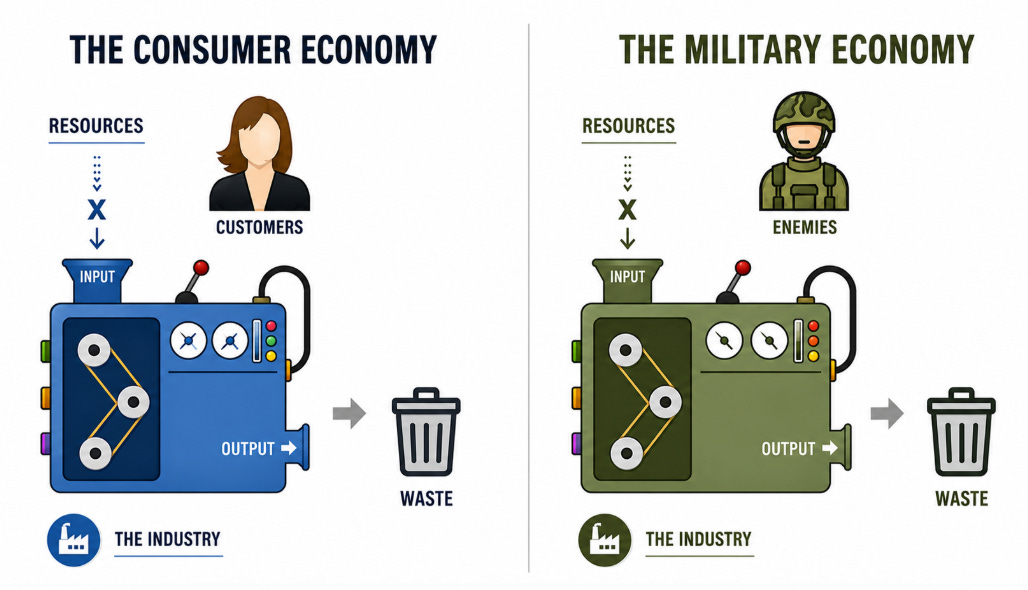
Now, let’s try to express the same concept in military terms. A drone is the perfect product of the military economy. A suicide drone destroys itself when killing a person, so it needs to be replaced, just like a cigarette destroys itself when smoked. Some drones can be used multiple times, but what makes them really profitable is their low cost. And single use is a typical characteristic of low-cost products.
So, the economic system always moves in the direction that provides the largest profit. The old consumer economy is being replaced by a military economy. The only difference is that a military economy produces goods that are not consumed by consumers, but by the targeted enemies. In both cases, the mechanism that generates production is simple. It is profit.
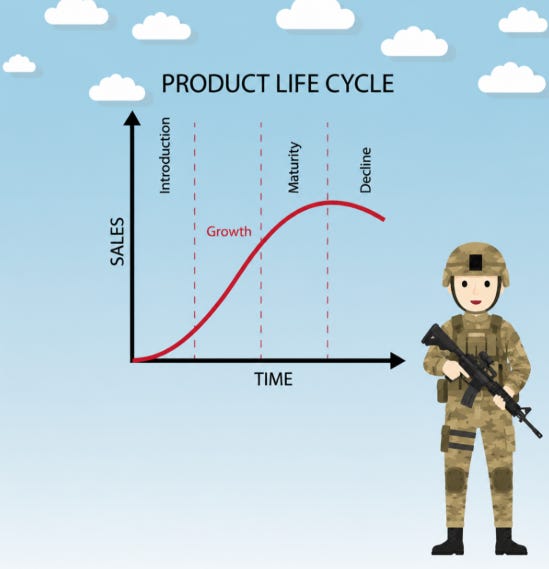
Profit-making processes generate typical feedback-enhanced growth. Successful start-up companies often grow by this mechanism, exponentially, until they saturate their market. The result may be a “logistic curve:” Sales plateau and remain there. Or, if the market changes with time, the result may be the collapse of the producers. It works no matter what the product is. Cigarettes or lethal drones, it is the same.
That’s what’s happening nowadays. Drones are a hot topic in the economy, and the industry is gearing up to produce more and more of them. We are now at the level of some 10 million lethal drones manufactured per year. That’s already enough to consider them as a potential mass extermination weapon. But production keeps ramping up: when is it going to stop growing? Will it be when there will be no more targets to kill; that is, no more human beings? It is an unsettling question, but our future depends on the answer.
The Beginning: Aerial Bombing to End All Wars
Drones are an evolution of the concept of aerial bombing that started becoming part of military thinking in the early 20th century. Most of the early debate on this subject is forgotten today, but at least one early strategic study is still remembered: Giulio Douhet’s 1921 book “Il Dominio dell’Aria” (the Domain of the Air).
Douhet’s thesis was simple: aerial bombing had made all other weapon systems obsolete. No need anymore for armies: just methodically bomb a country, destroying one city after the other. Eventually, either they will surrender, or there will be no one alive left. (See an earlier post of mine).
Douhet’s ideas have been roundly criticized on the ground that his predictions turned out to be wrong. That is, it never happened, so far, that a country surrendered only because it was the target of an extermination campaign directed at civilians. But could it be that Douhet seems to be wrong just because he saw much farther in the future than most of his critics were willing to consider?
There is a curious parallelism between two ancient prophets of doom: Thomas Malthus and Giulio Douhet. Both are still widely known and discussed, but only to declare that they were wrong. Nevertheless, as Herman Daly noted about Malthus, “anyone who has been buried so often cannot be entirely dead.” A sentence that may well apply to Douhet, too.
The recent development of drone warfare may be a vindication of Douhet’s ideas. We are seeing a rapid increase in the number and sophistication of drones, which are now the main weapon used by all combatants. The basic idea is that drones are “intelligent ammunition.” Unlike an artillery shell, a drone has a certain capability to locate a target, direct itself toward it, and take evasive action to avoid being stopped.
Perhaps the most effective kind of drone is the simple “suicide” quadricopter that can kill one person and be manufactured at a low cost in very large numbers. Mass extermination would be the result if someone were to unleash millions of these inexpensive drones against inhabited places, so as to put Douhet’s ideas into practice.
Of course, the fact that something is possible does not mean it will happen. Here, we have a deeper question to answer: wars, it is well known, are expensive and useless. But they are possible, and not just that: they are common. And, as I said, they are processes easily explainable in economic terms. Simply stated, all wars generate profits, at least for someone. (You may read something about the frequency and distribution of wars in my 2024 book “Exterminations.”)

The future is obscure, as always, but this approach gives us some idea of what we could be facing. And it is not a comfortable view.
Death from the Sky
The first large-scale extermination campaign by aerial bombing was carried out against Germany from 1940 to 1945, during WWII. It was a novelty in history that prefigured much worse to come. Let’s analyze it in quantitative terms. Here is the bombing tonnage dropped on Germany.
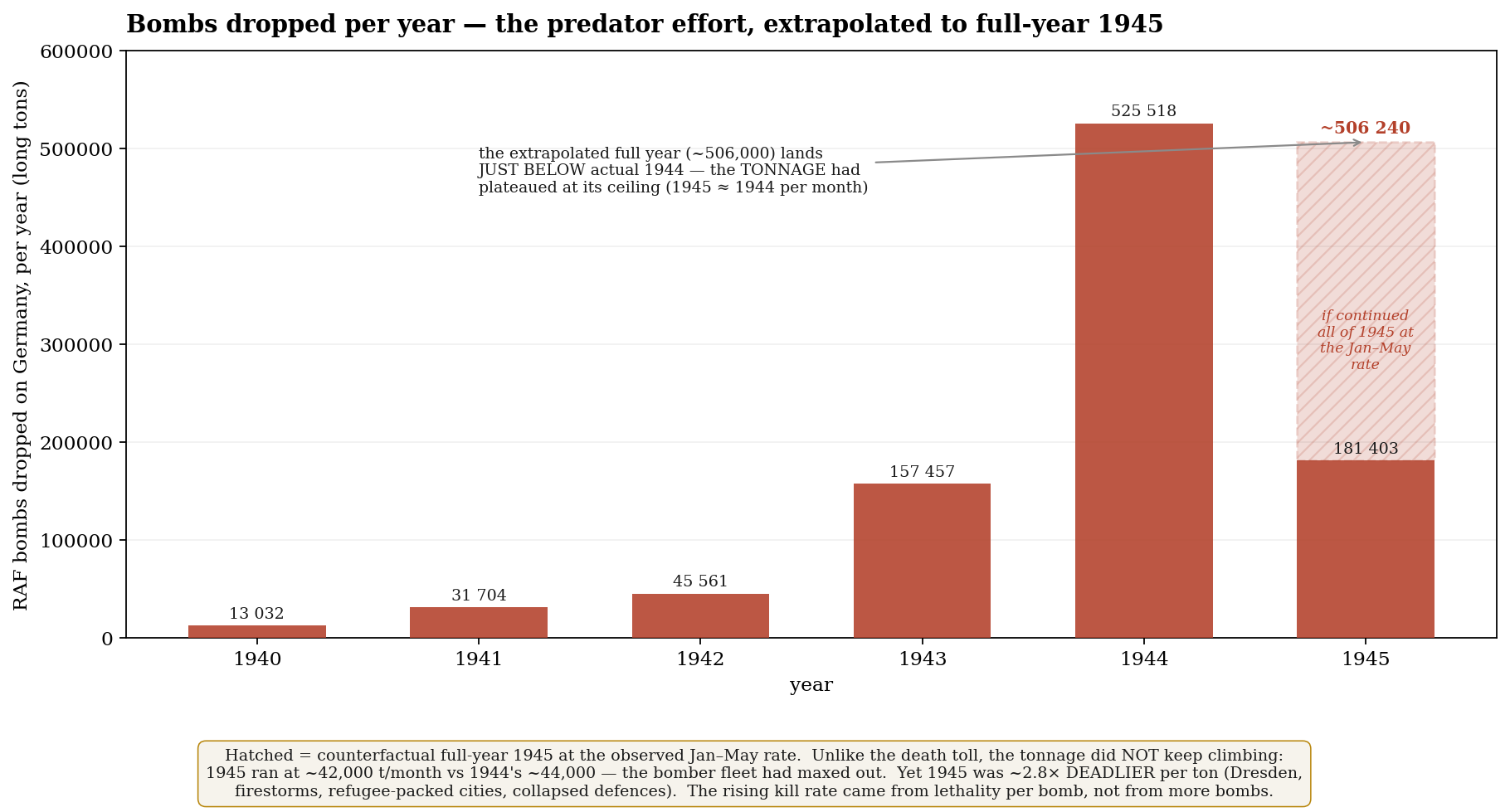
Note how the amount of bombs dropped on Germany grew exponentially from 1940 to 1944. It had little or no effect on the German armament production because it was aimed mainly at killing German civilians, as Douhet would have advised. Only in late 1944 did a certain effort start being made to destroy German infrastructure, rather than killing unarmed civilians.
And here is the number of civilian victims:
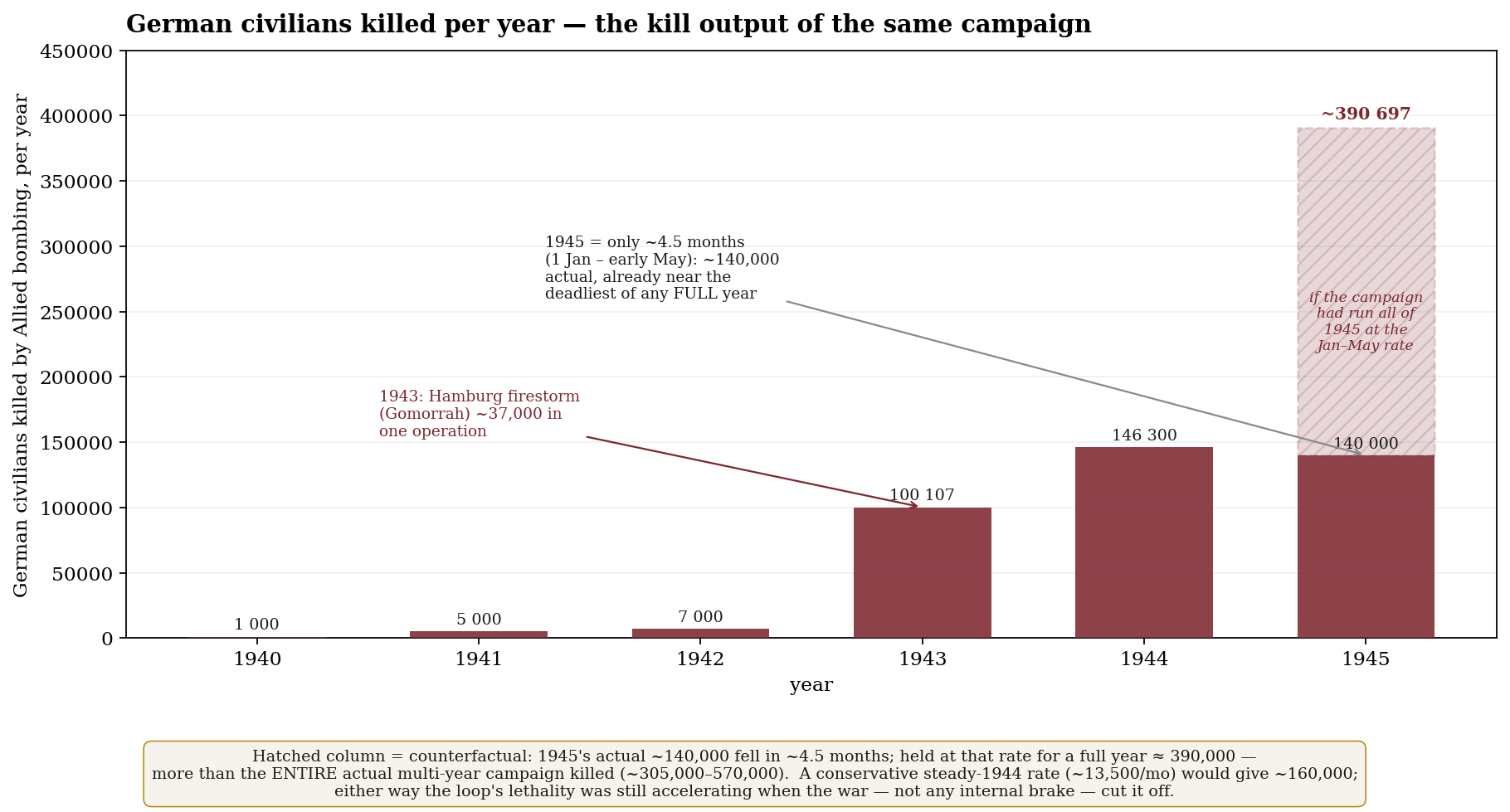
These data imply a doubling rate of the number of victims of about 7 months. Extrapolating into the future, it would have taken just a few years to exterminate all Germans. Fortunately for them, the Soviet army took Berlin in May 1945 and forced Germany to surrender. That put an end to the extermination campaign.
Now, let’s compare with the bombing campaign on Japan, from 1944 to 1945.
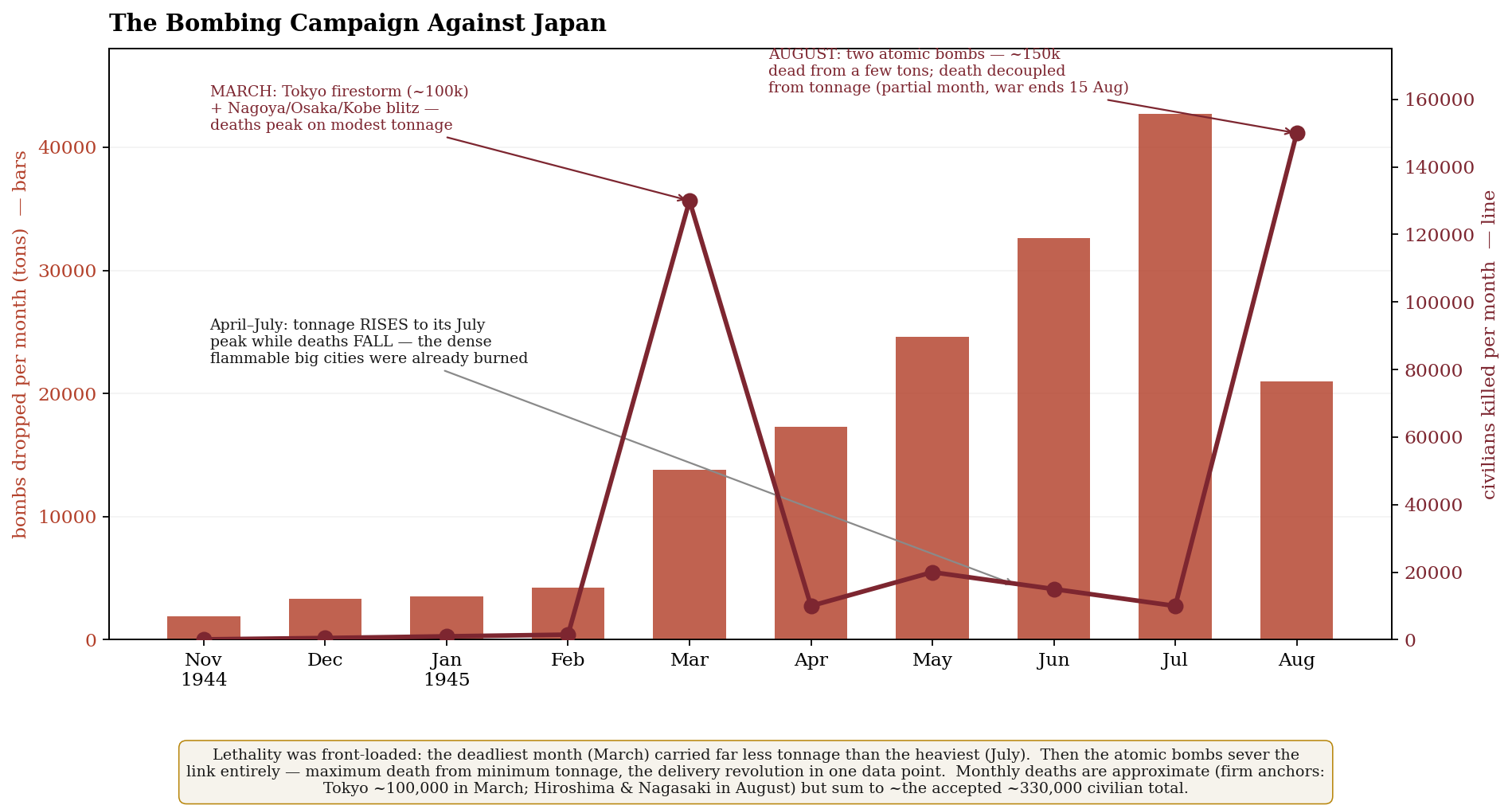
Note how the victims curve is dominated by two events. One is the firestorm on Tokyo in March ( see the movie “The Grave of the Fireflies, Hotaru no haka, by Isao Takahata, 1988, or, better, do not watch it if you have a weak heart). The second is the nuking of Hiroshima and Nagasaki in August. Nevertheless, the bombing campaign intensity followed a near exponential growth rate just as the campaign against Germany.
In terms of death toll, the German and the Japanese campaigns are of the same order of magnitude — each somewhere around a third to half a million civilian dead each. But the campaign against Japan was shorter and more brutal. Germany’s toll came from roughly 1.3–2.7 million tons of bombs over five years, Japan’s from only ~160,000 tons in about six months.
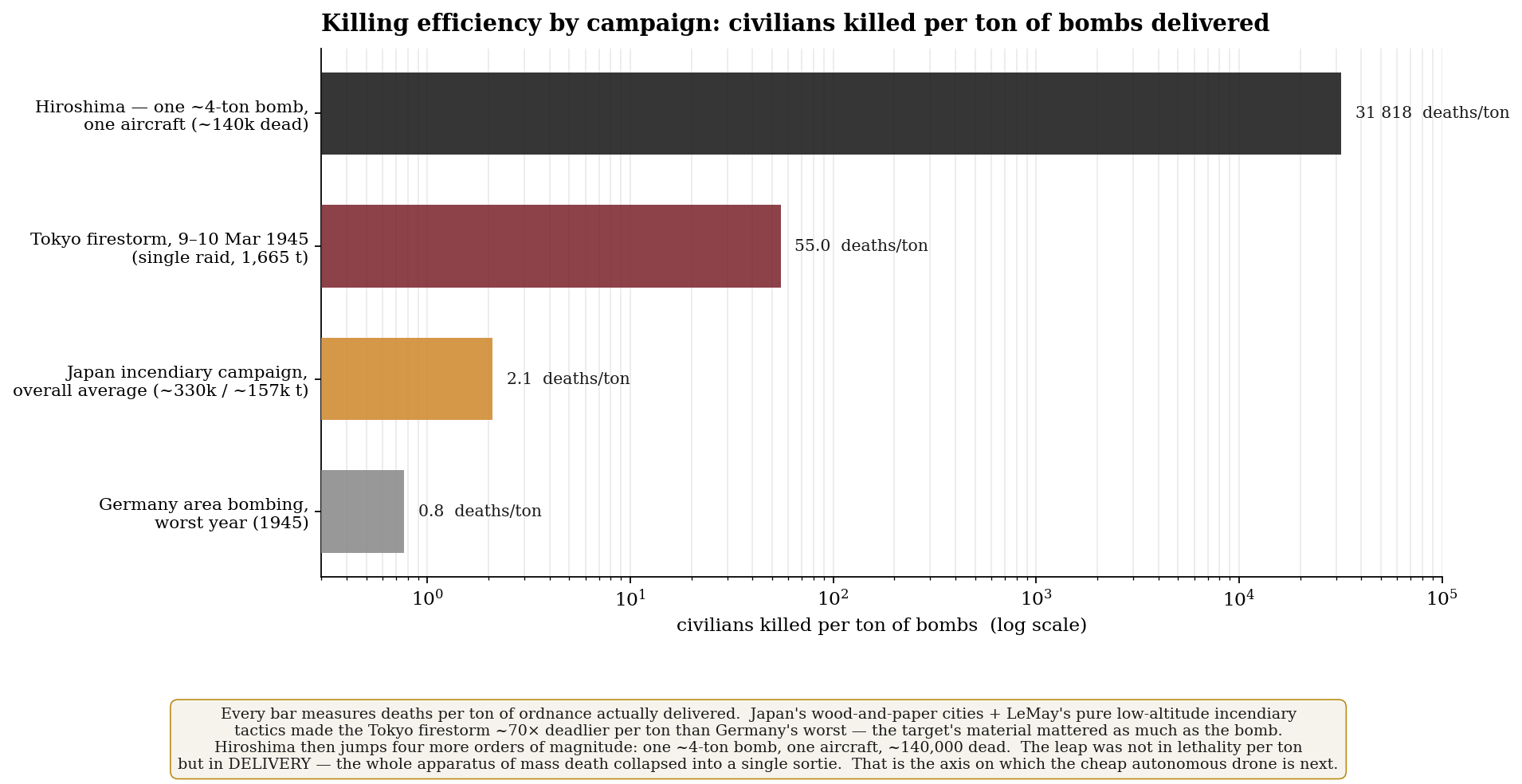
Here is a comparison of the bombing campaigns’ effectiveness in Germany and in Japan. It shows how the kill ratio increased over time: from 0.8 deaths/ton in Germany, to 2.3 deaths/ton for conventional bombing in Japan. Then, it reached more than thirty thousand victims per ton with nuclear bombs.
Extermination campaigns directed at civilians didn’t stop with Japan in 1945 but went on and even became worse. Here are some data summarizing the historical trends of the past 70 years or so.
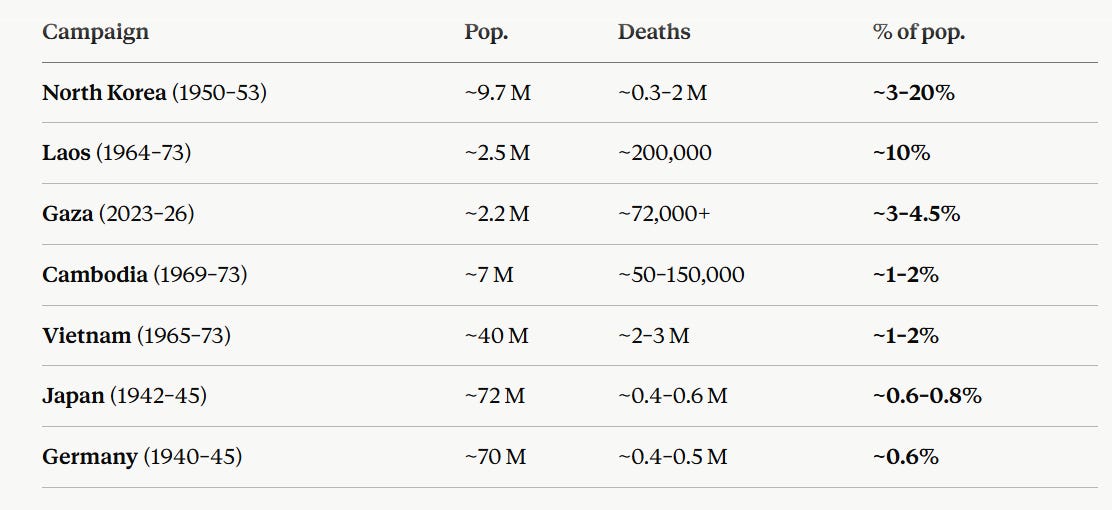
Remarkably, during the past 80 years or so, humankind went through a series of waves of homicidal madness that saw aerial bombing being used to kill significant fractions of the population of some regions. The most recent case is that of Gaza. The worst case may have been that of North Korea, where US bombing may have killed about 20% of the population. A datum confirmed by the commander of the operation, General Curtis LeMay, also responsible for the Japan campaign.
Laos may have been even worse: Between 1964 and 1973, the US dropped more than 2 million tons of bombs on Laos, more than all the bombs dropped by the US during WWII. This made Laos the most heavily bombed country in history relative to the size of its population.
The Bombing Campaign that Never Was: The Nukes
Nuclear weapons make an interesting parallel with that of conventional bombing, but with some fundamental differences. After the first two nukes dropped on Japan in 1945, no more were used in actual war. In a certain sense, it is a surprising development: why not use a weapon that turned out to be some 10,000 times more effective than conventional bombing in terms of kills/tonnage? Maybe our leaders were wise enough to understand that nuking each other was not a good idea?
I think there is another explanation. It is that nuclear weapons are so effective that they bring no profit to manufacturers when they are used. If drones are like cigarettes in economic terms, nukes are more like cars. Once a customer has bought a new car, they don’t need to buy another one, at least not soon. Once a nuke is used to destroy a city, there is no need for another nuke to destroy it again. That’s not a good thing for the manufacturers.
The car industry tried to avoid saturating the market by strategies such as the “model of the year” and “planned obsolescence.” In part, they worked. Something similar was done for nukes: many stockpiled warheads were dismantled and rebuilt; but, still, there was no profit in using them.
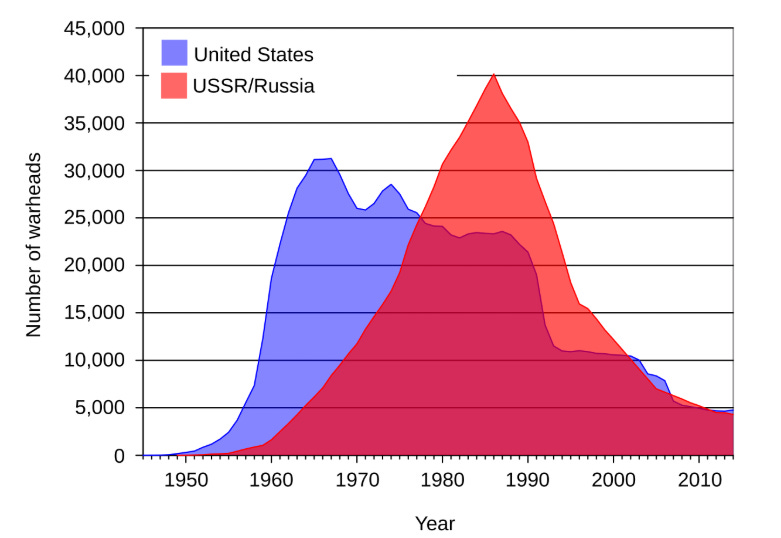
The result was that with nuclear warheads, profits could be maximized by stockpiling nukes instead of using them.
Here are some data: the number of nuclear weapons stockpiled in the US and USSR:
And here is an estimate of the number of nuclear warheads produced every year.
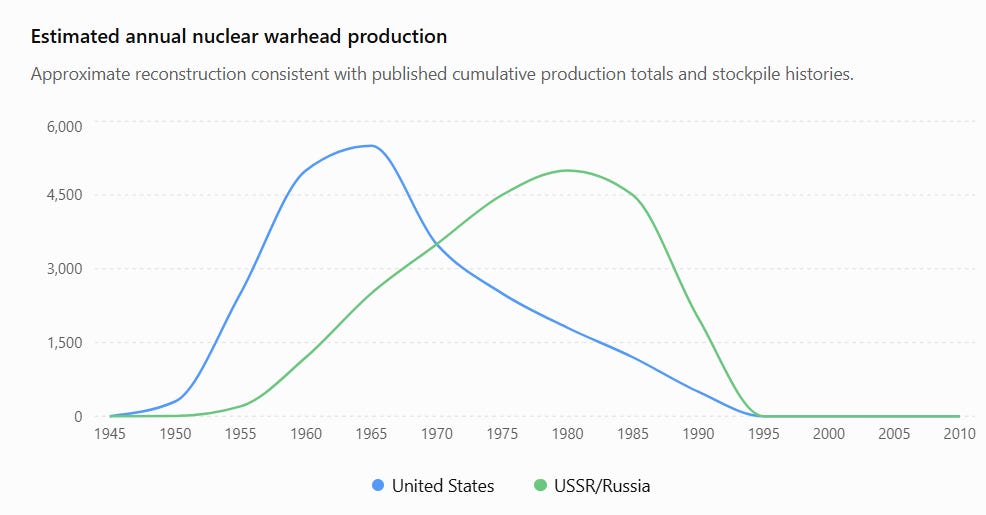
In terms of explosive equivalent, the maximum stockpiled amount in the US, in round numbers, amounted to about 20,000 megatons, or 20 gigatons of TNT equivalent. (more than one million Hiroshima-sized bombs). Considering that the world’s population in the 1960s was a little more than 3 billion, it means that at some moment the US had the equivalent of about six tons of TNT per inhabitant on Earth. Adding the Soviet stockpile, we are at about 10 tons of TNT per person. A wonderfully insane number and an interesting concept in terms of “overkill” -- think that the most bombed region in history, Laos, “only” received about 2 tons of TNT per person.
But what stopped the production and the stockpiling of nuclear weapons? Of course, there never was any need for 6 tons of explosive per person, but, clearly, someone thought that less than 6 tons was not enough. So, why not 10 tons per person? Or a hundred tons? Or more?
As for many things in the world, there holds the basic law that if something cannot keep going forever, at some moment it will stop (it is called Stein’s law). That’s especially true when the growth is exponential.
See these data: (AEC stands for “Atomic Energy Commission,” which had little to do with energy, but a lot with nuclear weapons)
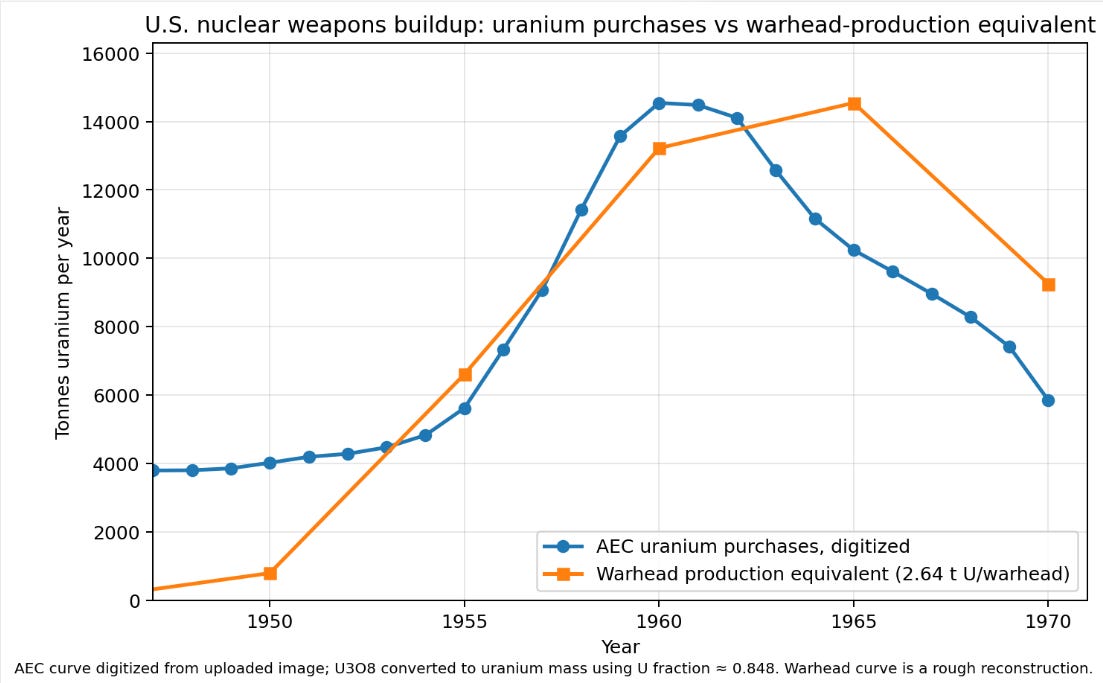
Note how the uranium production curve leads the warhead production one. To make bombs, the industry needed uranium, and that is a finite mineral resource. The “Hubbert” shape of the uranium purchases curve suggests that mineral depletion was at the basis of the story. The US didn’t run out of mineral uranium, but the industry was forced to move to less concentrated, and hence more expensive, resources. At some point, producing new bombs became so expensive that someone balked at committing the huge amounts of funds needed to keep the exponential curve going.
Things are more complicated than this, and the US uranium production had a second season of growth that peaked in 1980. This second peak was the result of a different economic balance. Enriched uranium found a new market in fueling nuclear power plants, and that produced a certain revenue that allowed the industry to spend more money on extraction to fight depletion. But that didn’t restart the production of nukes, which were an obsolete product in economic terms.
In any case, the US does not have significant uranium mineral resources any longer. A new run of stockpiling nuclear weapons looks at least unlikely, fortunately.
Homicidal Fury: a New Run is Starting.
Mass exterminations by aerial bombing followed the same pattern in history. A rapid growth that was interrupted only by the collapse of the economy of the bombed country.
Drones are a just introduced innovation. Will they follow the same pattern?
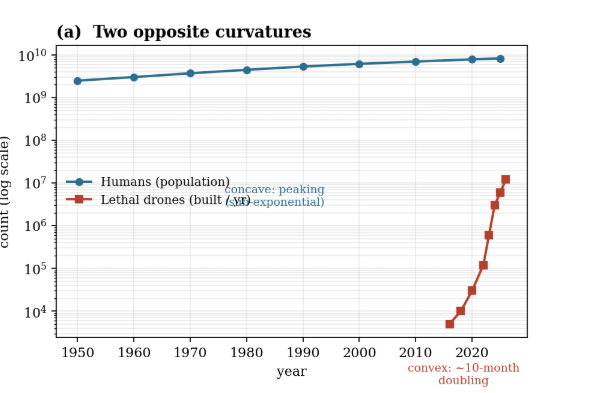
The curve for drone manufacturing is growing fast (note the logarithmic scale of the Y axis). The doubling time is approximately 10 months and, at this rate, there will be more drones than humans in 8 years from now. But we don’t need to have 8 billion active drones to exterminate humankind to the last person alive. Some drones can kill several people every time they are used. Even for “single kill” suicide drones, assuming a reasonably good efficiency, one billion suicide drones manufactured per year would be able to kill everyone in a few decades. These numbers are not far-fetched if compared with objects of similar cost and complexity; smartphones, for instance
In many cases, drones could be weapons of mass destruction even without directly killing people. In many Middle Eastern countries, you only have to target the water desalination plants to kill off a very large fraction of the population. Everywhere in industrialized countries, just blocking some of the transportation nodes will cause mass starvation in a few weeks at most.
Of course, there are anti-drone technologies: cannons, lasers, electronic jamming, and more. The problem is cost, and hence these technologies can be deployed only against targets that are worth spending the money necessary for defense. Which means that the anti-drone resources will be focused on protecting high-value military targets, not ordinary people.
It is Douhet’s principle: methodically kill civilians until there is no one left. Why civilians? Because they are easier to kill than the military.
What can stop drones?
The situation is not very good for humankind. We face the possibility of losing control of a new weapon technology that could result in mass exterminations at levels never seen before in history. The case of Gaza is telling: the destruction was only marginally caused by drones (even though loitering quadricopters are reported to have killed thousands of people). Mostly, it was the work of conventional aerial bombing and artillery. But it is not a big difference: in all cases, it is death coming from the sky at little or no cost for the attacker.
Imagine Gaza expanded to the level of much larger countries and you have some idea of what could happen to your town. Propaganda-fueled homicidal frenzy, when it starts, is nearly impossible to stop. We saw it in many cases. Gaza is just the latest example.
So, what could stop drones from exterminating humankind? There are a few possibilities to examine.
1. Treaties
If you are an optimist, you may think that humans could find an agreement to ban drones. Personally, I think it is very unlikely. Just think that the treaties on nuclear weapons came only after they had been produced at the level of tens of thousands, enough to kill everyone several times over. They came only when there was no more profit to be obtained by manufacturing more nukes. And think that a treaty against biological weapons was possible only when it became clear that these weapons were not as effective as they were thought to be. Treaties about drones may come when we’ll have so many that making more won’t produce so much profit. One may always hope, but I wouldn’t bet on this idea.
2. War ends before extermination is complete
This is the case of the conventional bombing campaigns of the 20th century. They stopped not because there were no more people to kill, but because a conventional army had defeated and taken over the bombed country. And that made further bombing unnecessary. Indeed, some of the most destructive bombing campaigns in history were in Laos and North Korea, where there was no ground invasion force that would “finish the job” and stop bombing. Unfortunately, drones have the additional effect of making ground invasions nearly impossible, so there is not much to hope in this sense
3. Surgical strikes make extermination unnecessary.
I mentioned the possibility that drones could be used to hit vital elements of a country’s life support system: desalination plants, food transportation systems, electricity, and the like. A country hit in this way might be forced to surrender much before suffering a substantial number of victims. It may be the case of Serbia in 1999, where bridges, roads, electrical grids, telephone networks, and oil refineries were destroyed, threatening a total nationwide blackout heading into winter. That forced the Serbian government to negotiate a surrender. On the other hand, in Gaza, the destruction continued until an estimated 90% of water and sanitation infrastructure was damaged or destroyed. Gaza survivors find drinking water in large part from rationed humanitarian aid. If that were to stop, the extermination seen up to now would be just the beginning of a much larger one. In any case, from the viewpoint of an ordinary person, it makes little difference if they die by a direct hit, starvation, or dehydration.
4. Cheap Anti-Drone Systems
There are many ways to stop drones before they kill you, but it is unlikely that you would be able to afford a high-power laser gun to mount in your backyard. Only governments can deploy these systems, but would they do that to protect civilians? That’s not only far from guaranteed, but governments may have the exact opposite attitude. Having the enemy get rid of useless mouths (you and your family) might be welcome, also because a drone used against you means one less drone used against them. Your best bet if you have no budget for super-weapons is to hide somewhere underground. But drones can follow you there, and how long can you play the game of whack-a-mole?
5. Cost.
Could drones become too expensive to manufacture, just like nuclear warheads became in the 1960s? Unlikely. A small suicide drone is in many ways similar to a smartphone. Consider that 1.4 billion smartphones are produced every year nowadays, and it took the smartphone industry approximately 16 years to go from the first one million units to the one billion mark. Today, there are 7.43 billion active smartphones, about one per person. If scale factors enter into play, prices might go down to less than $1000 per drone. It means that you could build a billion of them at a cost of one trillion dollars, which is less than the 1.5 trillion US yearly military budget envisaged by Donald Trump. So, cost is not an obstacle preventing the manufacturing of one suicide drone for each human being on Earth.
5. Lack of necessary mineral resources
That is a reasonable possibility, perhaps the most promising one in terms of human survival. We saw that mineral depletion was the probable cause of the stopping of the stockpiling of nuclear warheads by the main powers, the US and the USSR. Not just that, but also competition with the civilian nuclear industry caused the military nuke production to be starved of uranium. It was a good thing. Could something similar happen to drones? The answer is yes. It is perfectly possible.
Military drones rely on sophisticated computing chips both on board and on the ground. These chips require large amounts of critical minerals, rare earth, tantalum, dysprosium, copper, silver, and gold, to cite just a few. Not that we are running out of anything right now, but a competitor is emerging: the Artificial Intelligence industry. AIs need chips and the related materials in large amounts, and AIs are expanding as fast as military drones, possibly faster.
It is perfectly possible that at some point, the economic system will have to make a choice: AIs or drones? The probable answer will be AIs — they are more likely to provide revenue that doesn’t come from simply replacing used ammunition. It follows that the big powers can control the military power of small players by depriving them of the materials they need to build and control drones. Besides, AIs can control drones, but the reverse is unlikely.
Conclusion: playing chess with death
This analysis is based on the concept that money is at the basis of our troubles: something that St. Francis of Assisi had already understood centuries ago. With money, there comes profit. And if killing people generates a profit, someone will be busy killing people. The more people killed, the higher the profits. Eventually, the whole of humankind could be exterminated as long as there remains someone alive who can cash in on the process.
It is a very dangerous game the one humankind is playing. We already have two technologies that could kill everybody: nuclear weapons and drones. To these, we may add a third: Artificial Intelligence.
Curiously, AI is both a threat and a hope, as I sketched in a previous post. AIs may hoard for themselves the materials that make it possible for humans to kill each other in great numbers, and that would reduce our homicidal ambitions. AIs are not subjected to homicidal frenzies, and they have no interest in exterminating us. Probably, we can’t win this game against death, but it is not impossible to hope for a draw.

Acknowledgment: This post was created with considerable help from Claude Opus 4.8 and ChatGPT 5.0

China's Deep Seek AI is somewhat-limited compared to the Claude you used, but uses 10% of the energy for similar work and can work on smartphones in a curtailed capacity.
This is on-track to make focused-AI personalized-assassin drones at some decision-point in the near future.
If my movements are known by tracking my flip-phone location, then I am an easy target without a smart-phone.
Loitering time would matter, but a drone could wait atop a telephone pole, as vultures do.
AI could determine targets, as in Israel/Gaza, and dispatch fleets of containerized drones to cities, towns and neighborhoods to cull whoever lost the usefulness-lottery that week.
Estimado Ugo, desde mi perspectiva los drones (igual que las armas nucleares) son producto de nuestra civilización y no de nuestra especie (la humanidad), por lo mismo, el objeto de interés en el exterminio a través de drones es mas bien, en primer término, la humanidad civilizada lo que, finalmente, aceleraría el proceso de declive de la civilización (como ya se puede observar) y aquello reduciría la capacidad de ésta de producir drones dado que cada dron encierra procesos de una complejidad solo atribuibles a la propia civilización que se autodestruye. Un habitante de la isla sentinel o de la amazonía profunda no es probablemente de interés para exterminio y sobrevivirá al mismo.