

Changing the Money System. Changing Everything
Stefan Brunnhuber proposal for a double tiered currency system


The Chinese “sycees” were a form of money that wasn’t made for everyday exchanges. They were an example of what a “two-tiered” monetary system could look like. Would it be possible to adopt a similar idea today? A recent proposal in this sense came from Stefan Brunnhuber, psychiatrist, economist, sociologist, and member of the Club of Rome. (Image by GPT-2).
The Seneca Effect is a reader-supported blog. It is, and will remain, free access, but if you like what you read here, you may consider becoming a paid supporter.
Saint Francis of Assisi, who lived in the twelfth and thirteenth centuries AD, was probably the first to understand what the core of humankind’s problem is: money. He flatly declared that money is the devil’s dung. He forbade his followers even to touch it.
Francis was reacting to something that was happening at his time. New silver mines were being opened in Eastern Europe, and the European economy was being re-monetized after centuries of metal poverty. For a long time after the fall of Rome, coins had nearly ceased to exist in Western Europe, replaced by exchanges in kind and by creative improvisations such as the bracteates — coins so thin they could carry a design on only one side. Even the bones of dead saints, the holy relics, could be used as the equivalent of money. In that metal-poor world, Europeans had built a lively and sophisticated culture, and Francis sensed that silver would corrupt it. He was right, but his idea was not understood, and surely not adopted, not even by his own followers. Money corrupts everything, and it keeps doing that, even in our times.
The intuition that money sits at the core of our troubles has never gone away, and proposals to reform money in order to reform society keep reappearing: local money, depreciating money, virtual money, peer-to-peer money, blockchain money, etcetera. Most of them are variations on the same ideas. One recent proposal, though, is genuinely new and it can be found in the work of Stefan Brunnhuber, physician, economist, sociologist, and member of the Club of Rome. His most recent book is The Third Culture.

The monetary matters are covered in more detail in “The Economics of Transformation - A General theory on financing our global commons, on money and a sustainable development in the 21st. Century (DeGruyter 2025). The subject is also examined in detail in a recent paper by Kalinowsky and Brunnhuber in Nature. Here, I focus on the monetary subject, because it seemed to me the most interesting one. But you can find much more to chew on in Brunnhuber’s works.

Brunnhuber’s monetary proposal
Brunnhuber argues in ways that St. Francis would find familiar. The current monetary system is actively maladaptive, and he lists its pathologies: it amplifies boom and bust; it enforces a short-term horizon through discounted cash flow; it forces growth through compound interest; it corrodes social capital, replacing trust with fear and greed; it widens inequality; and it dissipates efficiency gains through rebound effects.
His remedy is a parallel, complementary currency — issued digitally by central banks, probably on a blockchain — circulating alongside conventional money. The new currency would be earmarked so that it could finance only projects tied to the UN Sustainable Development Goals (SDGs): public health, education, renewable energy, ecosystem restoration, and others. It would run through separate monetary channels, be transparent against corruption, and be eligible for the payment of taxes. A currency that the state will accept in settlement of obligations always has non-zero demand.
The deliberate move at the heart of the scheme is the breaking of fungibility. This money can buy a hospital but not a loaf of bread. People paid in “earmarked money” cannot use it for rent or groceries. So, how to manage the everyday necessities for money? Brunnhuber’s implicit answer is a split wage — most of it conventional, a minority of it mission-directed.
It is not unthinkable. Food stamps in the United States are already a restricted currency that works because recipients also hold ordinary money. Think also of the tokens used in casinos. They are a form of money that can be used only for gambling. Would a two-tiered system work on the large scale Brunnhuber proposes? There is at least one historical precedent of a nationwide system: the Chinese sycee system.
The Chinese mirror
For centuries, China ran two parallel monetary systems. On one side, copper cash — round coins on strings, fully fungible, the everyday money of peasants, artisans and traders.
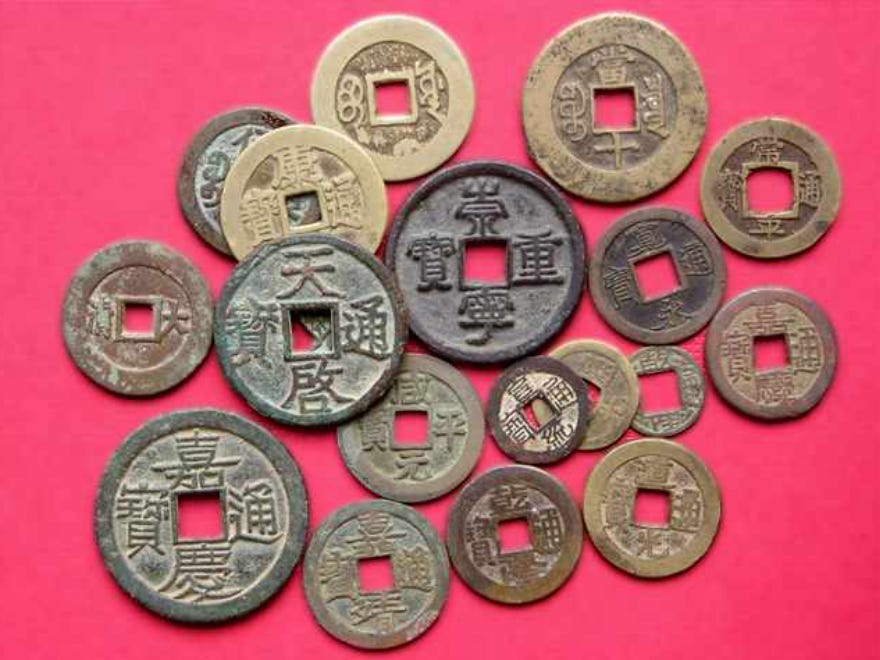
On the other side, the sycees — ingots of silver and sometimes gold, used for tax payments, large official transactions, merchant settlements, foreign trade, and military expenses. High value, low velocity, socially restricted: no peasant could buy a chicken with a sycee. Probably, a peasant would never ever see a sycee.

The two currencies circulated together, officially convertible. The Sycee system was not conceived to avoid corruption, and it doesn’t seem to have had such an effect. But, at least, it shows that dual-currency systems are not a utopian fantasy. The largest pre-modern economy on Earth ran on one for centuries.
There is a difference with Brunnhuber’s system, though. The Chinese two-tiered sycee/copper system evolved by itself. It was never mandated by the state, nor was it forbidden to use one of the two systems to buy certain things. It was simply impractical to use sycees to buy groceries, as it would be for you if you tried to buy a coffee using a $1,000 bill (which, by the way, is still legal tender in the US). At the same time, to buy a house using copper coins, you would probably need a few cartloads of them. Brunnhuber’s idea is different. It is a restriction by function: money that is forbidden to use for certain purchases as a matter of law.
Why Two Currencies?
What is an economy, after all? Nothing but a sophisticated control system for allocating resources. Brunnhuber’s “green money” is a heavy-handed intervention by the state to steer large-scale resources toward good projects, those described by the UN’s Sustainable Development Goals, SDGs. Does it smack of Communism? In a sense, yes, but Communism never proposed or developed a two-tiered monetary system.
The idea is that an earmarked currency could have several positive effects. First, it would funnel resources into good purposes, but, more than that, it would do a lot to eliminate, or at least reduce, corruption.
With this system, you cannot wire a number to a cousin without being discovered. And there is no cash that you can transfer in a shady deal in a smoke-filled room. Even if someone manages to receive some green money in their bank account, they can’t use it for nefarious purposes.
This is the idea, but it is also true that corruption is not so much about the diversion of money for personal gains. It is the diversion of the allocation mechanism by those who hold its parameters. It exists in various forms everywhere in the world. The blat system in the Soviet Union, the guanxi in China, and the omertà in Italy. When money cannot be used to corrupt people, a gift-giving economy grows in its space. It becomes access, priority, and favor traded for favor.
But there is a silver lining to the bribery system. When money is not directly involved, corruption remains at the level of consumption, not of accumulation. The nomenklatura of the old Soviet economy generated a certain degree of corruption in terms of privileges for the members: free vodka and caviar, and nice Dacias in the countryside. But the Nomenklatura members did not own the Dacias they occupied and, obviously, couldn’t accumulate vodka and caviar. Corruption did not buy capital, the compounding claim on the future that today’s great fortunes deploy to bend research, media, and politics. Think of the Soviet System in comparison with our multi-billionaires, soon trillionaires. Think about what Jeffrey Epstein did, and you see how the Soviet apparatchiki and their free vodka were children playing together in comparison.
A system that caps privilege at the consumption level has a genuinely lighter corruption problem. Brunnhuber’s idea would push the monetary system in that direction.
Zero money?
Brunnhuber’s ideas are a source of interesting reflections. If the goal is a strict control of currency, why use a currency at all? Why not go St. Francis all the way? Money is the devil’s dung, so be rid of it.
Of course, just expressing this concept risks causing a heart attack to all the economists who hear about it. After some two centuries of work on the role of money in the economy, the idea that it could be run without money sounds like pure heresy. Only St. Francis, the Pazzerello di Assisi ("the little crazy one of Assisi"), could propose it.
Yet, think that humankind has been going along for tens of thousands of years without using money. Exchanges using precious metals are about 4-5 thousand years old. Coinage is no more than 2500 years old. Things change, and we could say that the current movement toward non-metal currency signals a profound future change in the very concept of “money.”
The point that Brunnhuber correctly makes is to pivot on artificial intelligence to make his system work. The AI would manage the emission of earmarked money to be dedicated to specific, large-scale projects that would benefit humankind. So, why not go one step forward and think that the AI would not need money at all? That is, it wouldn’t need to convert resources into currency and then allocate the currency. It would directly allocate the resources.
Let’s say that AI computes how many new hospitals are needed. Then it will calculate how many tons of steel need to be allocated for their construction. It will instruct the steel industry to deliver them to the construction industry, instruct the energy sector to supply the necessary gigawatt-hours, and instruct the truck makers to provide the transport. No money changes hands, only resources. And where no money changes hands, no official can skim it. The idea was simply unthinkable until now, because the computing power did not exist. It is thinkable today.
It is the logic of the five-year plan, which never worked so well in the Soviet Union because of the immense complexity of what it was trying to plan. But with the enormous computing power of modern AI, things could radically change. Think also that the 5-year plan is alive and well in China, and it is working. So, let’s examine this idea in more detail.
Allocating resources: Boundaries and objectives
Basically, there are two kinds of elements you can build into a decisional system. The first is a boundary — a prohibition, a line not to be crossed. “Thou shalt not kill” is an example. A boundary is cheap, precise: it is local, it is checkable, and it requires the system to operate according to it.
The second is an objective: a positive, global target to be maximized. An example is “Thou shalt love thy neighbor as thyself,” a concept that may be implemented in many different ways. An objective is expensive in exactly the way a boundary is cheap. It is not local; it ranges over everything. And it cannot function without weights, without an answer to how much this good is worth against that good when the two collide.
So boundaries can be embedded in an AI system. It is the logic of Asimov’s three laws of robotics (later, four). The first one, the most important one, says that in no case can a robot AI harm human beings. The machine does not have to weigh the bombing of an elementary school against anything. It simply declines to cross the line, and that is why the refusal can be robust.
The story is different when we start embedding positive rules in the machine’s toolbox. “Allocate the world’s steel production for the good of humankind” is not a boundary. It is an objective, and it needs the weights. The good of humankind over what horizon, for whom? An allocator, human or machine, must answer these questions continuously, for everything.
This is also the cleanest way to see what is strong and what is weak in Brunnhuber’s own scheme. Broken fungibility — “this money cannot buy Vodka or caviar” — is a boundary. It is a strong condition. That is why it is the implementable, robust part of his proposal. But “create money to build hospitals” is an objective, and the SDGs are seventeen goals in tension with one another: clean energy against growth, more food against returned land, consumption down against employment up. You cannot maximize all of them without weighting them, and that’s a political act that the phrase “the SDGs decided” is insufficient to determine. Brunnhuber has changed who creates the money and what it may buy. But the weighting is still there.
This is not a new difficulty. It is the old socialist problem, the one Friedrich Hayek (he of the Austrian School of Economics) explicitly posed against the supporters of socialist planning. His point was that the information a price system uses does not exist prior to the price system. Hence, according to his views, it is impossible to allocate resources without a monetary system and a market system.
Is Hayek correct? Maybe not. You could argue that it is absurd to use the same unit of measurement (money) for completely different things that cannot be exchanged with each other. Think of a hospital and a luxury hotel. If you determine their value in monetary terms, they might cost the same. So, how do you decide what to build? The market would reason only in terms of profit, and if a luxury hotel brings more profit than a hospital, it is the luxury hotel that would be built. The result will be that there won’t be enough hospitals, and that they will cure only the people who can pay a sufficiently high price to create a profit for the health care industry. It is happening.
Even worse, if the market decides that killing people provides the highest returns, it will allocate resources to killing people — the ultimate dream of free market economics. It is happening.
The problem with a two-tiered monetarized or non-monetarized economy is that someone still has to determine the objectives to be achieved. And central planning will not necessarily do that better than the market’s invisible hand. The centralized Soviet planning system wrecked disasters on the environment, like, and perhaps worse, than the Western decisional system. Just think of the drying of the Aral Sea to use the water to cultivate cotton. The sea was turned into a desert, one of the modern era’s worst human-made ecological disasters. Would AI be able to do better than the old Soviet Planners? Could be, but it is just a hope.
Conclusion
In the end, we have the usual problem. Not all ideas that look good in theory are good in practice. It is something that was learned the hard way by the guy who jumped naked into a thornbush to collect the berries.
Many of us have our own ideas about how to save the world and humankind. Stefan Brunhuber, like St. Francis, has proposed one that looks good to him, and to many of us. At the very minimum, it would need to be studied, maybe experimented on a small scale, modified, perfected, and, if so decided, eventually, adopted.
The problem is that our society, especially the Western one, has developed into an entity that refuses all innovation by design. It is not even a dead horse, not worth flogging. It is the skeleton of a horse that can’t even be flogged because it has no flesh attached to the whitened bones. And so our destiny is to keep going on, blindly, with our leaders doing everything they can to accumulate more power and money for themselves, without caring for the rest of us.

Love it Ugo. So many layers of course including regenerative and doughnut economics! I d like to connect it with our interview. x
The problem with Brunnhuber's idea is that it needs AI to function. That's not sustainable or resilient solution. AI requires enormous complexity and is energy intensive. I think that there is much simpler and better solution proposed by Ellen Brown Public Banking Institute. Why is public banking good? Because it prioritizes public utilities that prevents rentier class to gain undeserved profit and allows productive economy to develop. Why, and how, is rentier class killing western societies? That is explained in books by Michael Hudson.