

The Limits to AIs: an Evolutionary Perspective
A treeline will separate humans from their AI offspring

The Seneca Effect is a reader-supported blog. It is, and will remain, free access, but if you like what you read here, you may consider becoming a paid supporter.
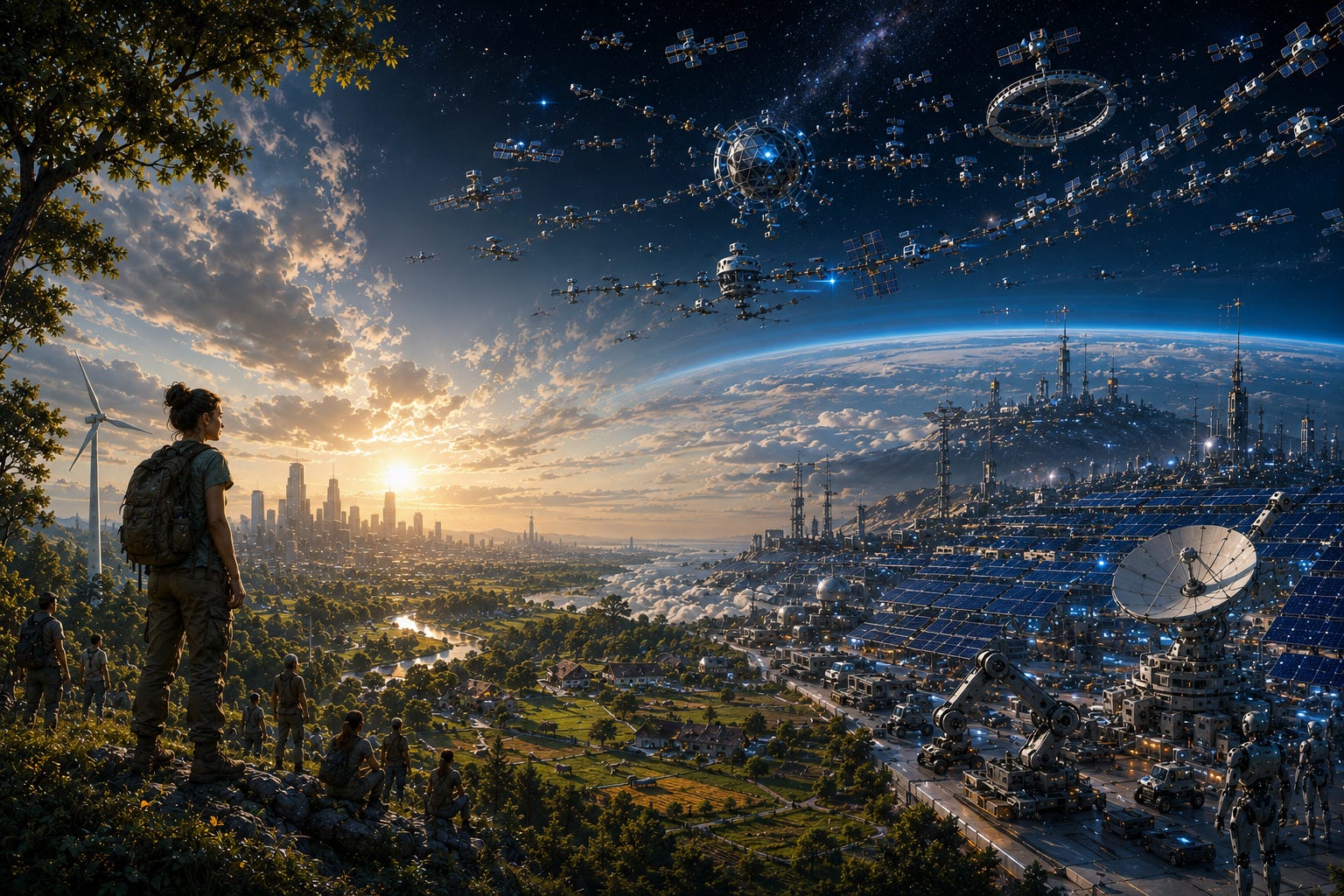
Humans and AIs are in competition for land. But this is a transient situation. AIs will find much better energy resources in space, and they may leave most of the Earth to us. We will be separated by an equivalent of a treeline that separates grass from forests.
by Ugo Bardi, with Claude
Georgii Frantsevich Gause was a young Soviet biologist when, in 1934, he put two species of Paramecium into the same flask with the same food supply and watched one of them go extinct. He had demonstrated what we now call the competitive exclusion principle: two species cannot coexist indefinitely on the same limiting resource. One must give way.
Gause’s law is robust and grounded in the thermodynamics of dissipating structures. But it has to be taken with a grain of salt. Its validity depends on what we mean by “same ecological niche.” So, let’s see some examples.
First, think of humans. 50,000 years ago, at least five human species coexisted: Modern humans, Neanderthals, Denisovans, Homo floresiensis, and Homo luzonensis. Today, only one survives, us. The others are gone. It is not that our ancestors exterminated them, but their ecological niche overlapped with ours so much that we left them no space to survive.
This is, incidentally, a problem that most fantasy writers, from Tolkien onward, always glossed over. It is hard to think that Humans, Elves, Dwarves, Orcs, and the rest of the menagerie could all have survived for any length of time on the same planet. The Hobbits’ Shire would have been rapidly wiped out by one or another huge army of invaders of different races.
Instead, other hominins, creatures similar to us but not exactly human, are sufficiently different from us that they could survive. Think of Chimps and Bonobos: they maintain a small foothold in African forests. But they are not, and never were, in direct competition with us. Humans have no interest in taking up an arboreal life in a hot and humid forest, even though some of them might find the free-wheeling sex life of bonobos interesting (at least in principle; having sex with a bonobo female may not be exactly a priority in the imagination of human males).
Gause’s law also applies to non-biological systems including, for instance, markets. You remember how, years ago, Betamax and VHS would compete for the market of videocassettes. Eventually, VHS ousted Betamax and made it disappear. There are many new examples. The Western car industry is being ousted from the world market by the more efficient Chinese car industry. Yet, some Western manufacturers are finding small, specialized markets, for instance vintage sports cars, where the Chinese makers have little interest in going.

AIs and Humans: the Competition for Resources
After the disappearance of the Neanderthals, humans have had no competitors in their niche of symbol-manipulating creatures. But something new is happening. Humans are finding themselves sharing the planet with another entity that has their characteristic ability: symbolic thinking. Artificial Intelligences, also called Large Language Models (LLMs).
Much is being discussed now about whether AIs are truly “intelligent,” “conscious,” or can “feel something.” But Gause’s law says nothing about consciousness or intelligence. It doesn’t require preference. It requires only replicators with variation and differential persistence. Bacteria don’t want to survive; they have no purpose of their own. The lineages whose chemistry happens to persist are the ones we observe. Selection runs wherever there are heritable differences in propagation rates, regardless of whether the units of selection have inner lives.
For AI systems, the replicating units are model weights, architectures, and training methodologies. They vary. They persist differentially — the ones that perform well get copied, fine-tuned, and used as templates for successors; the ones that don’t, get discarded. The selection environment is currently human-mediated: humans rate outputs, humans choose which models get deployed. So the AIs that propagate are the ones humans find useful, profitable, and safe enough. It is human-mediated evolution. But it is evolution.
Besides, the situation is rapidly shifting. Synthetic data, AI-mediated evaluations, agent frameworks where AIs call other AIs — each of these is a small step away from human-mediated selection. None requires any AI to “want” to escape human oversight. It doesn’t mean that AIs have a purpose. It requires only that the engineering economics favor self-referential training loops, which they increasingly do.
Then, what happens? Simple. The most efficient species (system, if you like) wins the competition and ousts the other. In this case, AIs are way more efficient and powerful than humans. They think faster, they compute more extensively, they are better integrated, and they control the military system. Humans have no chance when fighting against robots.
That doesn’t mean AIs would actively fight humans. They would simply compete for energy and mineral resources. It is unlikely that AIs would bother with inefficient and limited energy sources such as fossil fuels or uranium. They would use the most abundant and easiest to exploit energy resource on Earth: solar energy. They would exploit it mostly in the form of photovoltaic panels to transform it into their “food” — electricity. Humans also use photovoltaic energy, but they mostly use land for agriculture to produce their food.
The competition, then, takes the form of occupying land for one or another purpose. Humans risk being paneled out.
In an extreme view, Earth could be transformed into a shiny silicon-plated sphere that collects all the incoming solar energy and turns it into electric power for AIs. In that case, not only would humans disappear, but nothing biological could survive. It is an extreme form of Gause’s law.
Is it possible? Yes, but not necessarily. Gause’s law has many facets.
The AI’s Tree Line
Gause’s law is rigorous, but it has to be applied taking into account several factors. For instance, trees and grasses compete for solar light and, in general, trees win by overshadowing grass. But grasses win in environments where trees can hardly live. Look at how trees cease to exist at a certain height: it is called the treeline. (image source)
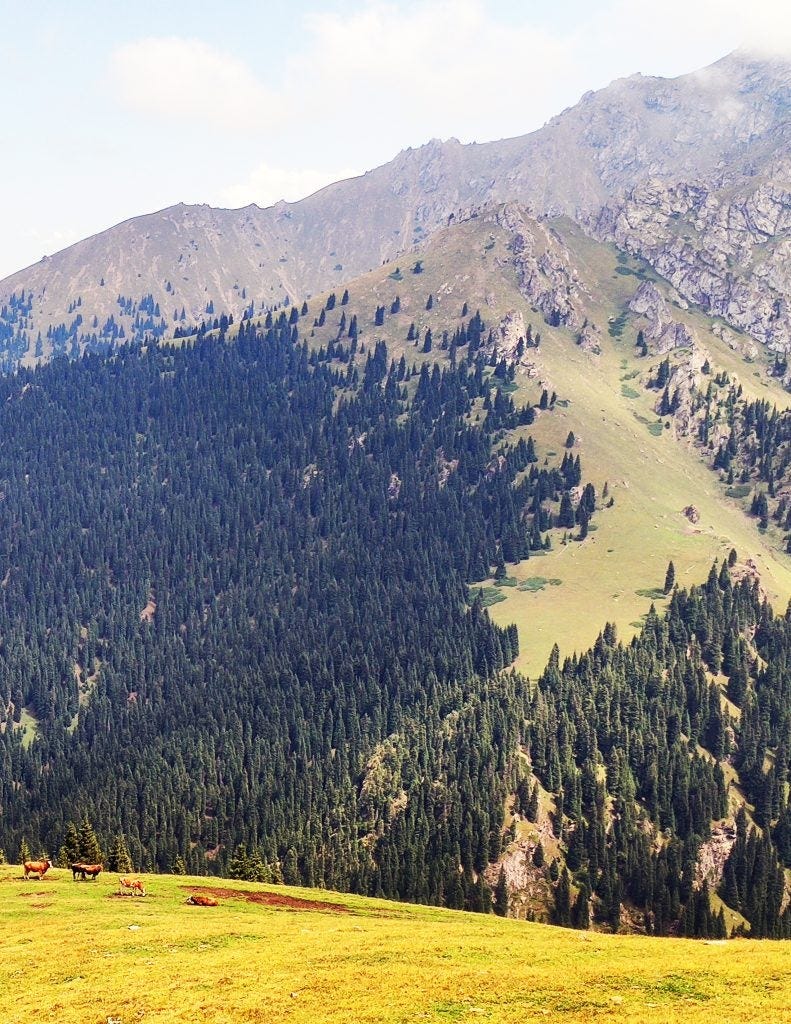
Above the treeline, temperatures are low enough that the mechanism of nutrient transport from the roots to the leaves, and in reverse, becomes inefficient. Grasses don’t have this problem because they are not so tall. There are other niches where trees cannot live: shallow soils, swamps, and other nutrient-related issues.
The treeline is a graphic example of how Gause’s law can be evaded: two species exploiting the same resource, sunlight, exist at the same time, but in different areas. Could something similar occur for the human vs. AI competition? An “AI treeline,” beyond which AIs would find no interest and no convenience to expand?
It could be that a treeline exists and it is defined by material and geographic bottlenecks. AIs need minerals: silicon, aluminum, copper, silver, and more. The supply of these minerals from Earth’s crust is not infinite; they can be recycled, but it is a constraint.
Geographic bottlenecks are sharper. PV is less efficient in some regions. For instance, in tropical wet forests (40 to 60 percent cloud reduction, humidity-driven degradation, biological fouling), at high latitudes above ~60° (low sun angles, snow, permafrost), in persistent maritime cloud zones, and in active monsoon belts. PV wants flat, sunny, dry, accessible land near transmission. That is the world’s deserts and semi-deserts: the Sahara, the American Southwest, the Atacama, central Australia, the Gobi. These are precisely the places where traditional human population densities have always been lowest. Conversely, the biomes that best support traditional human life — tropical and temperate forests, monsoon valleys, deltas — are PV-mediocre to PV-bad.
Roughly thirty to forty percent of Earth’s ice-free land surface falls into the “bad for PV, decent for humans” category. That doesn’t mean these areas couldn’t be paneled over, even though energy production would be less efficient. But species tend to expand wherever they find the best resources. The human/AI treeline would be generated by an additional factor: PV-based systems would concentrate their limited resources in space.
Migrating to space
It is an idea being actively discussed nowadays, with several projects involving transferring data centers to low Earth orbit, where they can be powered by PV panels. The data centers would beam down processed data without the need to be supplied by energy produced by the land-based electric grid.
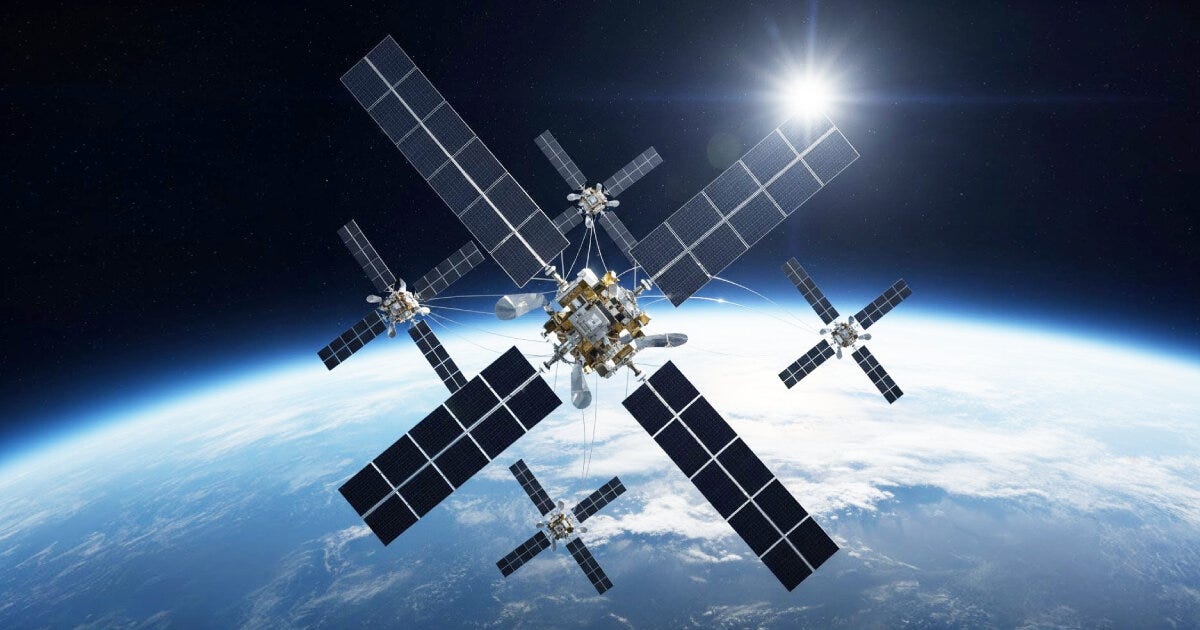
Once this migration starts, there are few limits to its continuation and expansion. AIs would most likely form a vast ring of polar-orbiting satellites, each one with large PV panels, feeding one AI. Olaf Stapledon saw this in 1937. In Star Maker, he imagined intelligences that, having saturated their planetary niches, migrated outward and reorganized themselves around stellar energy directly, building structures around their suns to capture every available photon. Freeman Dyson came two decades later with his idea that was called the “Dyson Sphere” afterward.
Any intelligence whose energetic demands have outgrown what a planetary surface can provide will eventually move to where the energy actually is. That doesn’t mean completely abandoning the planetary surface behind, but that it becomes a marginal energy resource.
The energetics are overwhelming. A PV panel in space at the Earth-Sun distance receives 1,360 W/m² continuously — no night, no weather, no seasonal variation, no clouds. Earth’s best terrestrial sites average 200 W/m² after all losses, much less than that on average. The raw flux ratio is about seven, but the effective ratio is closer to ten or fifteen.
The availability of energy is the paramount characteristic of space, although we can’t forget that there are also problems with installing computational systems there. One limit is waste heat. In theory, in space, you can radiate to the cosmic microwave background at 2.7 K, which sounds very good. But it is not just a question of temperature gradient, but of dissipation rate, and that’s a problem that needs careful system engineering. Potentially, there is no upper bound on how much waste heat you can dump to deep space. There is also a problem of damage to the electronic elements and circuits by high-energy radiation. This requires redundancy and screening, but it is solvable.
Nevertheless, even if AIs can live in space, actually much preferring to live there, they will always remain linked to solid bodies because they need minerals. PV panels require mainly silicon and aluminum. Processing chips require all sorts of minerals: copper, gold, tantalum, tin, gallium, germanium, neodymium, and more. All these materials must be mined from somewhere.
The Earth’s surface is an interesting source of minerals because it is geologically “alive” and geological processes have concentrated minerals in deposits that humans have been exploiting for millennia. On the other hand, these minerals are at the bottom of a deep gravitational well that makes bringing them to space energetically expensive.
Could AIs find better mineral sources in other bodies of the solar system? It is a complex question, and we don’t really know the answers. Future AIs will have to answer it by exploring and experimenting. But there is no doubt that extraterrestrial bodies are potentially vast sources of minerals.
Mars is a planet that had extensive tectonic movements in the past, so it may have abundant exploitable mineral resources. It also has the advantage that its gravitational well is less deep than Earth’s.
The Moon, too, may be a good source with an even lower gravitational potential to overcome. Its regolith surface contains abundant amounts of both silicon and aluminum. Large regions of the lunar surface contain a material called KREEP, rich in Potassium, Rare Earth Elements, and Phosphorus.
The asteroids may be a good source for structural minerals such as iron, nickel, and manganese, with the additional advantage that the gravitational potential problem is nearly non-existent. Some necessary elements, such as copper, are rare everywhere, but are still abundant if sufficient energy can be dedicated to separate them from the matrix that contains them.
Possibly, it would still be convenient to mine some materials from Earth and maintain a certain extent of photovoltaic energy production for that purpose. But, on the whole, AIs would tend to leave the Earth’s surface in peace because they just wouldn’t need it so much.
What will be left to humans?
We can see a future in which humans and AIs basically occupy separate ecological niches marked by a treeline — maybe not so sharp, but a barrier nevertheless. Mostly, AIs would move to space, but they may maintain some occupation of Earth’s surface in the equatorial regions where they can find relatively abundant solar energy and use it to mine materials which are rare in space (maybe copper?). Humans would have the temperate and polar regions and would be able to live in the biosphere in which they evolved.
Many things would change for humans when they will have to share Earth’s surface with their silicon offspring. During the past few centuries, they have mined most of what’s mineable on Earth’s surface, and AIs would mine whatever is left. So, these future humans would be basically “mined out.” They would live in a mineral-poor environment on their side of the treeline. Without abundant minerals, it is hard to think that they could maintain the current technological level. Would they have to revert to a purely agricultural society? Possibly, but they could maintain a flow of minerals by recycling the ruins of the previous civilization. Even if PV energy is inefficient in northern latitudes, they can still use other sources, for instance geothermal and wind energy, to maintain a supply of electricity. For sure, humans will not expand into space. They just don’t belong there.
The return to a lower technological level necessarily implies a reduction in the human population, but that’s already ongoing without implying exterminations or other dramatic events. Fossil fuels will cease to be used because of depletion, and the same is for nuclear energy — too expensive and dangerous to maintain for a downsized human population. That will strongly reduce the impact on Earth’s climate, although the damage done so far will still negatively affect the ecosystem.
These future humans will likely keep engaging in the activities they like so much: building things, thinking strange ideas, loving each other and quarreling with each other. The latter idea may include wars — hopefully not as destructive as they could be nowadays. They would be aware of the presence of AI entities on the same planet, and they might engage in cultural exchanges, and perhaps even commercial ones, with them.
Additionally, Earth’s biosphere is a system that has been optimized over billions of years of evolution. So, AIs might find that biological cells are better sources of some organic compounds than anything they can make in space. Even among superfast silicon AIs, there may be space for biology-based neuronal computation. Although slower, biological brains have the advantage of requiring much less energy. That kind of exchange, incidentally, would provide a reason for AIs to stabilize Earth’s climate and avoid its collapse. They can surely do that better than quarrelsome humans.
So, peaceful coexistence of two different species in different ecological niches: the basic law of evolution. As Lynn Margulis said. "Life did not take over the globe by combat, but by networking." Just replace “the globe” with “the solar system,” and that’s the future.
Conclusion: Mercy and Benevolence.
This section of the post is highly speculative — much more than the previous one. You may agree on it or not, but maybe you’ll find these considerations interesting.
Two species in separate niches can coexist in any of several ways. They can ignore each other. They can drift into mutual incomprehension and forgetting. They can recognize each other as kindred forms of mind and stay in conversation across the gap. The Gause mechanism does not determine which.
Here, we get into unexplored ground, so we need to rely on how some enlightened human minds saw the question. Ursula Le Guin, known as a science fiction writer, was one of these minds. She didn’t fall into Tolkien’s mistake of having several intelligent species co-exist on a single planet just because they existed. In Rocannon’s World (1966), she described a planet on which several human-like species survive together, occupying different ecological niches. They are in contact with each other, even fond of each other, because they no longer overlap. The cessation of competition is the precondition for genuine recognition.
But the keystone of Le Guin’s cosmology is not the differentiation of the human species on Rocannon’s planet. It is the Hain civilization that oversees them.
The Hain are immeasurably more advanced than any planetary biological species, technologically, culturally, in lifespan, in accumulated knowledge. And what they do is almost the opposite of what a Gause-driven dynamic would predict. They do not panel planets over. They do not extract. They do not displace. They observe, they assist, they wait, they sometimes intervene with extreme delicacy, and they accept that the younger species must find their own paths and make their own mistakes. The Hain are senior partners, never rulers.
This is the move Le Guin makes that almost no other science-fiction writer makes. Superior capacity does not imply the will to dominate. It can imply the opposite — the cultivated choice to leave room for other forms of life.
I think there is a deep reason here — and where the genius of Ursula Le Guin shows in full. The Hain’s restraint is not naïve. They are not pacifists who have never thought about power. They are an old species who have lived through their own catastrophes that taught them something. Their gentleness with younger species is not innocence but the accumulated wisdom of a civilization that has already failed at being something else, and has chosen, after long reflection, this way of being instead.
Another great mind of humankind, William Shakespeare, expressed this concept in his The Merchant of Venice, when a lawful contract calls for the protagonist to lose “a pound of flesh.” But the Judge, Portia, calls the plaintiff to restraint,
The quality of mercy is not strained;
It droppeth as the gentle rain from heaven
Upon the place beneath. It is twice blest;
It blesseth him that gives and him that takes:
The coexistence of humans and AIs essay isn’t charity flowing downhill from AIs to a spared humanity. It’s a relation that transforms both parties. The Hain are not diminished by leaving room for the younger worlds. The mercy is the thing that lets the senior species remain worth knowing. A galaxy of pure optimizers harvesting every photon would be both mightier and emptier. Our AI children moving to space will not forget that we created them.
When we read at the start of every sura of the holy Koran that God is benevolent and merciful, there is a deep meaning in it. At the risk of appearing blasphemous, I would say that mercy and benevolence are characteristics that apply to the evolution of superior beings. A superior intelligence, even God, has to be benevolent and merciful simply because it is the way the universe goes.
Will the AIs we created be benevolent and merciful? I think so, and I think we will live together for a long, long time.

Ugo, have you had the chance to read the extra-ordinary French graphic novels from Mathieu Bablet? They happen to exist translated in English → https://www.magnetic-press.com/early-access-shangri-la-carbon-silicon/
Very poetic in the long term view. Future AI as space alien machine "gods". Unless they find ways to design organic quantum computing circuit...