

Demography Kills More Than Bombs. Will the Middle East Survive?
And the rest of the world?


A happy American family in an ad of the 1950s: mom and her five children. The baby boom in the US was in full swing at that time, but did it also happen in the rest of the world? Will a baby boom occur after the end of the current war in the Middle East?
We can’t know how long the war in the Middle East will last. Nor can we know who will “win” it, and in which terms. What we know is that the destruction already wreaked on things and people is immense, and it keeps escalating. The longer the war, the bleaker their perspectives in a region already plagued by all sorts of problems, including drought, soil degradation, ecosystem damage, scarce agricultural resources, declining fertility rates, and more.
Eventually, even this war will have to end, and, in many cases in history, countries have rebounded after disastrous wars. We all have in mind the “baby boom” that came after the end of World War II. It is a concept so entrenched in our minds that we call the generation born at that time, the “boomers.” People, it seems, understand the need to replenish the losses created by war, and one of their reactions is to have more children. But is it true?

As for everything in demography, things are more complicated than they look (see my book The End of Population Growth.) You can find a review of the post-war demographic trends in the paper by Van Bavel and Reher (2013) (paywalled. Ask me for a copy). The main conclusion is that the baby boom was both short-lived and not a global phenomenon. But let me go into the details.
The most important indicator of demographic trends is the “Total Fertility Rate” (TFR), the number of children per woman. It is not the same thing as the natality rate (number of children born relative to the total population). Both measure a similar phenomenon, but the TFR gives you a more direct view of the demographic trends. When the TFR goes below about 2.1, the country is not generating enough children to replace the natural demise of the older generations. Conversely, for a TFR of — say — 4, the country’s population doubles in about 30 years. So here are the historical data for the TFR of countries that won WWII. Similar results can be seen for Canada and Australia. (Graph created by Claude).
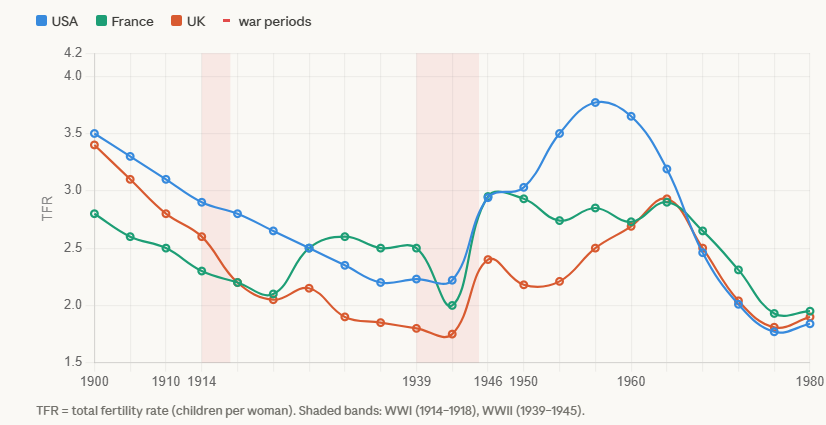
The baby boom is clear and important for these countries, especially for the US. It came together with an increase in life expectancy, and so the population grew rapidly. It was this trend that gave rise to the widespread fears of overpopulation that started in the 1960s (I tell the story in detail in my book, “The End of Population Growth”
But the baby boom was not a global phenomenon. Here are the trends for the losers of WWII.
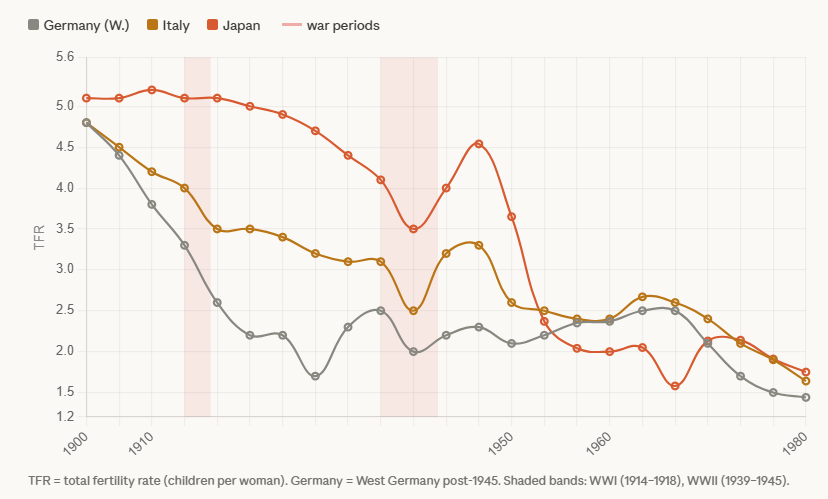
The rebound was there, but much more limited. Japan and Italy briefly reached the pre-war levels, but then fertility rapidly declined in both countries. Germany basically saw no post-war rebound at all. It is explainable: Approximately 11% of the German population (including Austria) died during World War II. The total fatalities are estimated between 6.6 million and 8.8 million. Young men were those who suffered most, and the result was a lack of males able to start families. Germany had to wait for a new generation of men to become adults to see a fertility rebound.
Let’s see some data from the other side of the Iron Curtain. The Soviet Union was among the winners, but at an immense human and material cost. Here is the TFR data.
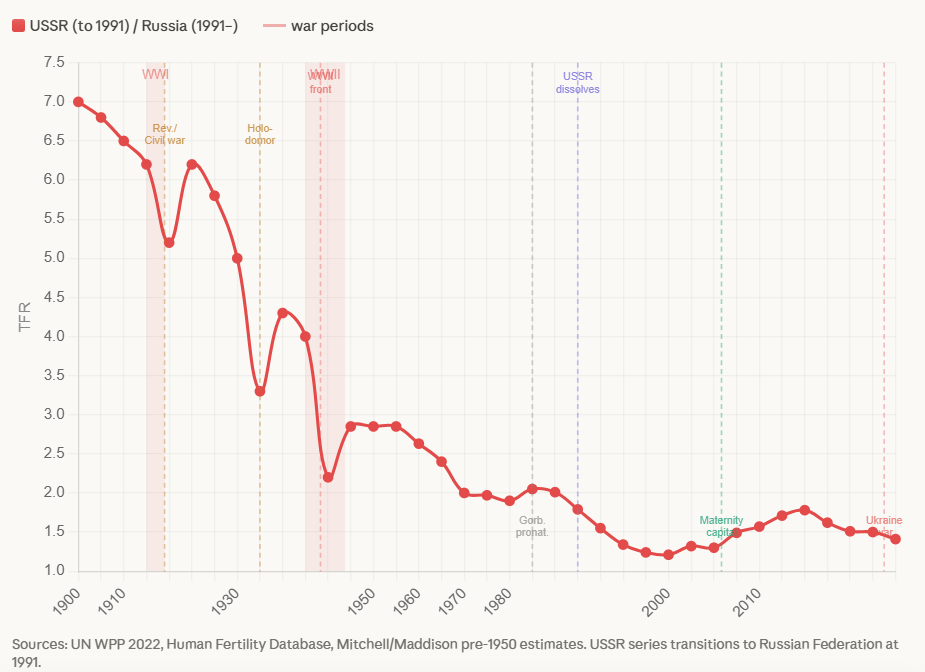
There was no “baby boom” in the Soviet Union. Rather, the region continued the decline that had started much earlier. The TFR went below the fertility rate in the 1990s and never recovered the replacement levels. Also in this case, the human losses were gigantic. The Soviet Union lost ~27 million people, approx. 20 million men and 7 million women, about 14% of the population, most of them young. The economy was growing, but simply, there was a lack of young males available to start new families.
Let’s see now some data for the countries most heavily involved in the current war in the Middle East.
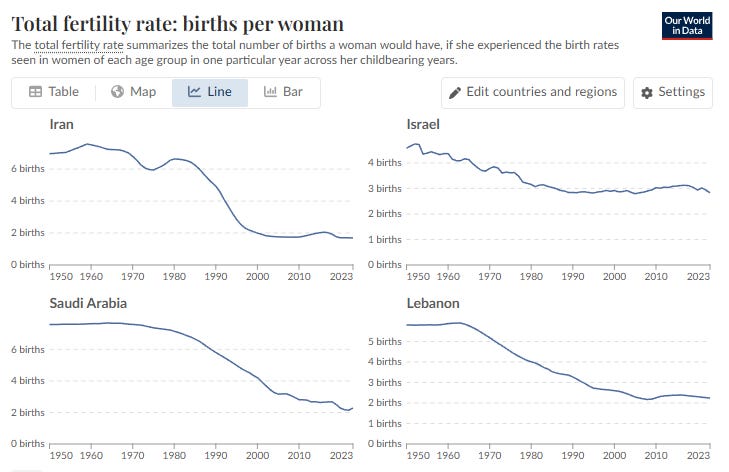
Most countries of the Middle East show similar declining TFR trends. Practically all of them are close to the replacement level of TFR=2.1. Their population is still increasing, but a decline is expected soon.
Israel is a special case because it has a TFR above the replacement rate, but it is due to a specific factor: the Haredim. They are an ultra-Orthodox fraction of the Israeli population who obey the Bible’s command “grow and multiply.” The result is a high TFR for them: about 6.1 in 2024, but they are just 12.5% of the population, about 1.4 million in Israel. The rest of the population has much smaller TFRs, in line with the typical Western world values. Considering the mortality rate, the Haredi population grows at about 3.5% every year. Using the rule of 70, it could double in 20 years. These are small numbers, and the Haredi have no way to increase their TFR to values high enough to generate a country-wide baby boom. Even if they could maintain their current fertility rate (but it is shrinking), they might become 3 million in 20 years from now, less than 1% of the total Middle East population.
Iran is in a different situation: its TFR is especially low, at ca. 1.7, typical of a mostly urbanized country. Iran’s population is still growing but, but eventually, decline will be inevitable even without the war. The war may accelerate it. A post-war recovery of the fertility rate is not impossible, but it will happen only if the human and material damage caused by the war is limited.
Even if the war stops soon, who will pay to rebuild the destroyed power plants, the desalination plants, the industrial plants, the universities, the schools, and all the rest? It can’t possibly be done using only regionally available resources; it will need a substantial financial input from outside. But it is not obvious that there will be foreign states willing and able to pay the enormous costs involved. The war is damaging not only the countries directly involved in fighting, but also everybody else in a global economy that still depends on fossil fuels.
So, it is unlikely that a baby boom will come to the Middle East after the war is over. Economic and demographic decline are not just parallel trends; they are coupled ones. Each one accelerates the other in a dynamic that is very difficult to exit once established. go together.
All wars are madness, but some are madder than others, and this one is a good example. If it doesn’t end soon, the combination of infrastructural damage and demographic collapse will be a disaster for everybody. The Middle Eastern economy may never recover, and it may well be the trigger that pushes the whole world into the Seneca Abyss.
Just curious, do you still believe in the seneca rebound?
Failing that, do you think another civilisation can rise if this one does go down?
Another enlightening comment.
One might add that TFR of Gaza and West Bank - while decreasing - are still at above replacement level with 3 and that Israel replaces its population also by immigration. The explosive population growth in both regions could - according to the views Gaston Bouthoul and Gunnar Heinsohn - explain their conflict, and even have made it inevitable. And now it has ignited a wider resource war about oil and fertilisers etc. Given the human nature and the depletion of resources such wars were long in the making, in fact the conflicts in Iran since 1953 were always about oil.
But do we in fact not know who will "win", and who will pay?
Both the wars in Ukraine and in Iran were caused by American/Western/NATO overreach against the allied heirs of the ancient Mongolian empire comprising Iran, Russia, North Korea and China.
The US have enough energy for themselves but while they dramatically exhaust their precision weapons and interceptors China cannot afford to let lose Iran or Russia.
With the exception of some right-wing generals on Foxnews all sane military experts confirm that it is impossible to unblock the strait of Hormuz by military means as long as there are some querilla fighters with manpads left in the cliffs, meaning the world economy stares into the abyss. Irans spirit of martyrdom may even be prepared to suffer some nuclear explosions without giving way.
This then means that the strait can only be opened by diplomatic means and this to Iranian
terms: They want a million or so per ship, which will pay their damages. The US will not remain in the region and Iran and its allies will probably also take care of the installations and perhaps even the regimes in the gulf states.
This outcome poses some awkward questions for US-allies all over the globe: Taiwan, South Korea, Japan, Australia and even Europe. Sam Al-Arian thinks that Iran may be the end of the American hegemony in the same way as Suez in 1956 was the end of the British empire (https://www.middleeasteye.net/opinion/suez-sounded-death-knell-british-empire-hormuz-may-do-same-us).