

Dead man walking - The Seneca Abyss is in Front of Us
Antonio Turiel on the Current Crisis

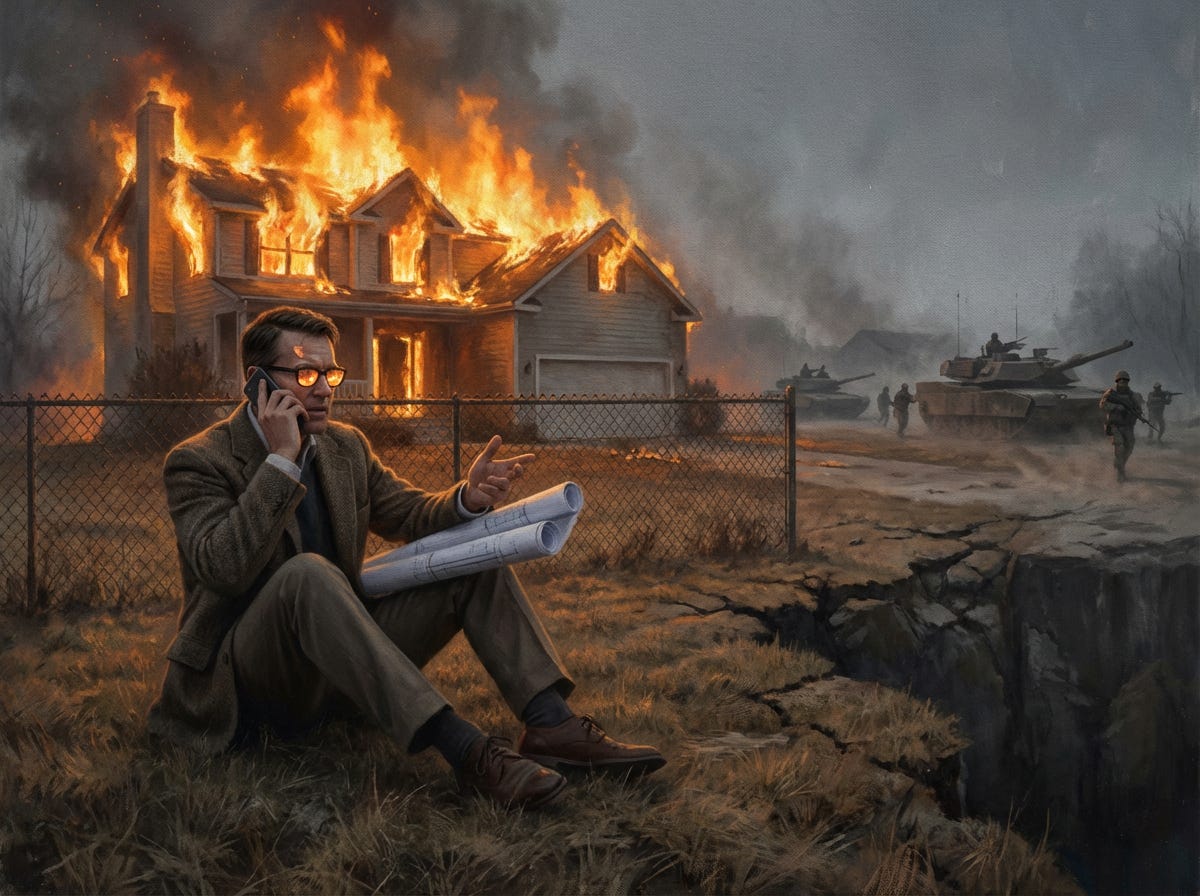
Those Westerners who hate Donald Trump seem to be happy to fight him to the last Iranian. And those who push for renewable energy seem to be happy to see the Middle East destroyed, since they believe that it will force the energy transition on us. Few people realize how dire the situation is. Antonio Turiel is one of the sharpest minds on this planet, and he is not shy about telling how things stand. He correctly says, “Given the current situation, suggesting that the answer is a renewable energy transition is like a house fire breaking out and thinking it’s a good time to call a builder to install fire doors.” To say nothing about having handed power to a band of criminal psychopats devoid of even a shred of moral restraint. Unless some kind of miracle occurs that stops the war now, we are facing the Seneca Abyss.

Dead man walking
From Antonio Turiel’s Blog - 23 March 2026
Dear readers:
The Iran conflict enters its fourth week. Once again, to avoid panic and a widespread stock market crash at the opening of Monday’s session, a fabricated story has been concocted to calm the market. In this case, Donald Trump has declared a five-day truce (only on the American side; Israel is proceeding independently), supposedly thanks to fruitful talks with Iran over the weekend (talks already denied by Iranian authorities).
We’re in extra time. In the coming weeks, the last ships that left the Strait of Hormuz before the closure will arrive, and when they do, the shortages will become painfully obvious. In fact, things are already going terribly wrong. The list of countries experiencing fuel supply problems or even imposing rationing measures ( Japan , Australia , New Zealand , India , Thailand , etc.) is growing by the day. China has restricted fertilizer exports , and in the US, it’s estimated that this season will be short between 25 and 35 percent of the fertilizers typically used . The helium shortage will cause a sharp drop in chip production within weeks , not to mention the disastrous situation with aluminum and copper, to name just a couple of raw materials. But really, everything is affected. Unsurprisingly for regular readers of this blog, diesel is currently one of the most scarce things, and that affects absolutely everything, including the supply chain of all kinds of raw materials.
There doesn’t appear to be an easy solution. Iran won’t back down without a credible non-aggression pact from the US and Israel, guaranteed by major powers like Russia and China, and war reparations commensurate with the damage inflicted. It can’t settle for less, because it knows that if it gives in now, they’ll attack again in a few months, having rearmed. But these conditions are completely unacceptable to the US and Israel. There really is no easy way out of this impasse. Everything suggests that immense structural damage will be inflicted on the global economy.
Putting myself in the context of Spain and Europe, let’s be honest, unless something unimaginable happens right now (literally a miracle), we’re going to crash. No other outcome is conceivable. We’re going to suffer a very long-lasting, perhaps even permanent, loss of 25% or more of our energy consumption, and it’s going to happen over the next few months. We’re going to see a good portion of our industries collapse, never to recover. We’re going to see unemployment skyrocket. And in the advanced stages of this debacle, we’re going to see shortages of fuel and even food.
Perhaps the powers that be have mechanisms we can’t even imagine, perhaps they have ways to stop this war in its tracks and, with it, this disaster. I don’t know. I neither know nor can I know these things. What I do know is that, without a radical change of course, we are going to sink, and sink very deep. And even if that miracle were to happen, the damage already done would have severe consequences in the coming years. Although, of course, nothing compared to the current collapse.
Right now, we’re losing around 20 million barrels of oil and petroleum products per day, which is about 20% of global consumption and, more importantly for us, represents 40% of the oil available for export. There’s also a shortage of about 20% of liquefied natural gas, 30% of nitrogen fertilizers, 30% of helium, 30% of aluminum, and 30% of sulfur (which is needed to make sulfuric acid for industrial processes, including copper extraction). There’s an incredible backlog of containers in the area. The shortage of medium crude oil in the Persian Gulf region is particularly affecting diesel production, as well as kerosene. In fact, some airlines are starting to cancel flights. What will happen to tourism next, only time will tell.
This is not going to be just another crisis. This is going to be an economic catastrophe. Combined with the bursting of the enormous financial bubbles that have inflated over the last few years, it’s difficult to grasp the magnitude of what’s about to happen.
This is pure arithmetic. There is no good way out if Hormuz remains closed. Whether the world will plunge into an abyss depends solely on reopening that critical passage.
Certainly, the closure of Hormuz spells out the end of necroterminal capitalism, a destructive and voracious system we won’t miss. The problem isn’t so much the end of capitalism itself, but how this end will come about. Because instead of transitioning to a system of resilient networks prepared to support humanity, most of the planet will literally fall without a safety net.
This is probably the best thing that could have happened. With runaway climate change and a multitude of other environmental problems, we couldn’t delude ourselves into thinking there would be an orderly and controlled decline. Something like this, drastic, a violent halt, probably had to happen if there was to be any hope of building anything in the future. Even so, the biggest concern is how to ensure that the collapse of capitalism doesn’t become a cataclysm with millions dead (note of the translator: Turiel was a bit shy. He could have said “billions”).
Given the circumstances, the measures that should be enacted left and right should focus on food sovereignty, guaranteeing basic necessities, defining strategic sectors, subordinating all goods to the common goal of ensuring everyone’s survival, and adapting as quickly as possible to these times of tribulation and anxiety that are about to befall us.
But no. None of that is on the roadmap.
Yesterday I spent part of the afternoon reviewing the main points of the decree of urgent measures that the Spanish government has proposed to deal with this new Trumpian crisis . The truth is, I wasn’t expecting any surprises, and so most of the measures followed the expected path. On the one hand, there’s a reduction in energy taxes, a measure of little use and limited effect, since when the price falls, demand increases and the price rises again to adjust to the available supply, returning to the same starting price after a couple of weeks, with the difference being that companies end up with a larger profit margin and the State with a smaller one. On the other hand, there are measures to accelerate the energy transition, always within the framework of the Industrial Renewable Electricity (REI) model, although there is some mention of renewable gases— from bubble to bubble . Some pleasant surprises include the reinstatement of the 5 km distance for defining energy communities, which had been attempted in last year’s anti-blackout decree; and others that are not so much, such as the creation of Renewable Acceleration Zones, where the aim is to apply the steamroller to quickly deploy large-scale wind and photovoltaic plants.
I read the measures and thought: what for? What difference does it make? These past few days, while I was being interviewed by various media outlets, the topic of the energy transition kept coming up again, and how Spain’s greater renewable energy penetration has, for the moment, guaranteed it lower electricity prices than the rest of Europe. Lower prices now, before the shortage has even begun: we’ll see what happens when our European partners start fighting over gas. In most of the interviews, it was assumed that closing the Strait of Hormuz will favor the energy transition, without understanding that the entire system depends on a massive industrial machine that produces everything needed for the REI (Regional Electricity Infrastructure), from cement to methacrylate, aluminum frames, and the fiberglass for the blades, using enormous quantities of fossil fuels. And it is this same massive industrial machine that is now going to shut down, and we won’t even have the option of manufacturing a single screw.
Given the current situation, suggesting that the answer is a renewable energy transition is like a house fire breaking out and thinking it’s a good time to call a builder to install fire doors. That might have been useful at another time, but not now. There’s no time for that anymore. Now we really need to prepare for the impact. The system is still standing and moving forward, but it’s dead, and it could collapse at any moment. We should be preparing for that.
And if you, dear reader, are hoping for a miracle and the reactivation of the flow of energy and materials through Hormuz, consider that this would only guarantee an even worse fall later. In reality, what can no longer wait is to organize a future beyond extractive capitalism.
Greetings:
AMT
I already read it in Spanish, but I agree it should be available for a larger audience. Thank you Ugo
Merci de nous avoir fait connaître cet article. Nous venons de le publier en français.
Amicalement
https://faustotounsi.substack.com/p/marcher-vers-la-mort-par-antonio