

The Demographic Myth Behind the Attack on Iran
From Ethiopia to our times: The Eternal Folly of Demographic Expansion


In “The End of Population Growth,” I describe how many wars in history were generated by demographic pressure: growing populations tend to expand by military means. Is that the origin of the ongoing attack on Iran? That would seem to be absurd, considering that the countries involved, Israel, Iran, and the Arab regions, all show declining average birthrates, prefiguring the start of a population decline. Yet, there may be reasons related to demographic trends that may have led to this war, as I examine in this post.
It is still too early to understand what’s going on with the attack on Iran and how things will evolve. What I think can be said is that the Israeli leaders are locked in an obsolete overpopulation paradigm that leads them to dream of an impossible territorial expansion by military means.
There are two distinct uses of the term “Greater Israel,” one referring to Israel plus the West Bank and Gaza, and a second, much larger, stretching from the Nile to the Euphrates. Currently, these ideas seem to be gaining ground among Israeli far-right politicians. Recently, Mr. Netanyahu publicly declared his “absolute” support for Greater Israel. The idea that Israel needs space for an expanding population is rarely explicitly expressed, but it is often implied in the idea that Israel has a housing crisis and hence needs to build new settlements in the West Bank.
These ideas of expansion clash with the reality of the population dynamics of both Israeli and Arab populations. Israel’s average TFR (total fertility rate, that is, children per woman) stands at around 2.85 in 2024. It is still above the replacement level of 2.1, but it has been going down from higher values, and it is still going down, following the trend of all industrialized countries. Israel’s population is still expanding, but its growth is slowing down, prefiguring the start of a decline. Again, it is the same trend as in most industrialized countries in the world.
The TFR of most Arab states, and also that of Arabs living in Israel, is about the same, and it is declining everywhere. Iran has an even lower TFR, estimated as around 1.5 - 1.6. The populations of these countries are still weakly growing, but are going to start declining soon. So, the fear of being swamped by an Arab population wave, common in Israel years ago, is not justified today. A demographic-driven threat from Iran is even more unlikely. All wars are madness, but seeing populations with declining birthrates fighting for land is truly bewildering.
However, there is some method in this madness. Although the Israeli population is heading toward decline, there exists extreme internal stratification in it. The TFR among ultra-Orthodox (Haredi) women is about 6.1 in 2024, one of the highest in the world. The Haredim represent today only 12.5% of the population of Israel, yet they have a disproportionate influence on the Government. Netanyahu’s coalition depends almost entirely on Haredi parties.
The Haredi population is expanding in Israel, pushed by its high fertility rate. But for how long will it continue to be an anomaly in a world where fertility is declining everywhere? Indeed, the Haredi fertility rate has been substantially going down from the very high values of the 1980s-2000s (ca. 7.3-7.5). I argue in my book that one of the factors in the declining TFR worldwide is chemical pollution. If that’s as important as some data suggest, then no matter what the Haredim’s religious beliefs are, their fertility is going to decline further. And that will lead to their population starting to decline, too.
Besides, there are today just a little more than 1 million Haredi Jews in Israel. Even assuming that their growth rate will remain high, their numbers are destined to remain marginal. If their population were to double by the mid-21st century, if they were to occupy the whole area of the Greater Israel (from the Nile to the Euphrates), their density would be comparable to that of the inhabitants of the Australian outback. Demographic expansion is a problem of the past in most of the world, and that will eventually be true also in the Middle East.
Yet, at present, the dreams of a Greater Israel seem to be driven by the perception of an unavoidable demographic expansion. It is a situation similar to that of several European countries a century ago, which saw a rapid population growth and whose governments believed that they needed to expand into other countries by military means. It was a general perception, but Germany and Italy tried to put these ideas into practice more aggressively than other countries; disaster ensued in both cases. The story of how Italy engaged in the mad enterprise of conquering Ethiopia in 1935 is a good example that can still teach something to those who are willing to learn (if there are any left).
Here is an excerpt from a post that I published in 2020 on “Cassandra’s Legacy” (edited)
Benito Mussolini and the Italian Empire: How Leaders’ Absurd Decisions Lead to Collapse.
Benito Mussolini ruled Italy for 21 years after the “March on Rome” of 1922. Many things happened during those years, but you could see the Fascist rule as having two phases: one before and the other after the turning point that was the invasion of Ethiopia in 1935.
During his first 12 years of rule, Mussolini pursued a relatively moderate foreign policy, carefully avoiding major conflicts. He didn’t even increase the military budget after the previous government had slashed it down after WW1 was over. Things changed abruptly in the early 1930s. Maybe it was because of the financial crisis of 1929, maybe because the British coal production was starting to show signs of decline -- and Britain was the main exporter of coal to Italy. Or maybe it was something else that went on in the high ranks of the Fascist Party, or perhaps inside Mussolini’s head. In any case, the government started increasing the state budget, and that involved doubling the military expenses, which reached over 20% of the government budget. The government was putting the economy on a war footing.
Preparing for war usually leads to starting one. It happened with a bang (literally) when Italy sent a large contingent of troops to attack Ethiopia, in the Horn of Africa. It was no minor affair: we speak of more than half a million troops engaged in the campaign. After a few months of war, a few hundred thousand Ethiopian civilians were exterminated, and various war crimes were committed (all things we don’t do anymore, as we all know). Eventually, Ethiopia was defeated and annexed. The King of Italy, Victor Emmanuel III, declared himself “Emperor of Ethiopia,” and the “Italian Empire” was born.
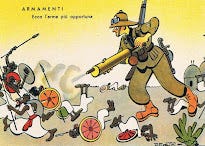
As you can see in the image, the Italian propaganda of the time wasn’t too shy in showing that chemical weapons were used against the Ethiopians, even though that was never officially admitted.
What’s written in history books acquires a certain aura of inevitability, and that’s true for Italy's conquest of Ethiopia. It happened, so there had to be a reason for it. But let’s pause for a moment to consider the logic of the event. Why exactly did the Italian government take this decision? That’s not an easy question to answer. Take a look at the map below, and see how the Italian Empire was arranged in the years that followed the Ethiopian conquest:
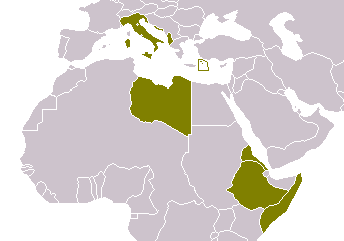
The first thing you note is how the Italian Empire was formed of two chunks of land not connected to each other. In between, there was the Sahara Desert, practically impossible to cross. By sea, Ethiopia was reachable from Italy either by going through the Suez Canal or by circumnavigating Africa, both impossible if opposed by the main naval power of the time: Britain. And it was not just a question of distance: the Italian colonies in the Horn of Africa were part of a puzzle of different regions controlled by potentially hostile, and surely more powerful, empires: the British and the French. Setting up a major colony in that region was risky, to say the least. More correctly, it was a completely stupid idea, as it was to become clear in a few years.
Let’s take a look at the situation from the viewpoint of Britain. At that time, the British Empire was the largest and most powerful in the world, but it was not unchallenged. The rivalry was especially strong with the French, who maintained a smaller empire and who never completely renounced their dreams of world domination. In the Horn of Africa, France controlled an area, French Somaliland, that was strategically crucial for the control of the maritime traffic in the Red Sea. That, of course, could negate the advantages that the British had with the control of the Suez Canal.
So, the Horn of Africa was a three-player strategic game involving Italy, France, and Britain (Ethiopia had no outlet to the sea). The British traditionally excelled in this kind of game, and their strategy, in this case, was to play Italy against France. It was a strategy that had already worked in stopping the French expansion into the Mediterranean Sea. For the British, the best way of ensuring that the ports on the Red Sea stayed out of French hands was by having the Italians move in.
One further reason for this attitude was that the British tended to see Italy as their traditional ally. Probably, in 1935, they couldn’t imagine that Italy would turn on them just a few years later, but they may have reasoned that even if that were to happen, it couldn’t have been a big problem. By far, the Italians were the weakest players in the game being played in the Horn of Africa. Their colonies there could continue to exist only as long as the British navy allowed them to be resupplied from the mainland. They were, at all effects, hostages to the British. That explains why, in 1935, Britain didn’t do anything to stop Mussolini’s plans of conquest, except engaging in a series of ineffective economic sanctions that only succeeded in enraging the Italian public and strengthening the Italian resolve to defeat Ethiopia.
Did the Italian government, and Mussolini in particular, realize that they were being played by the British as an anti-French tool? Probably not, but it is also possible that they did, but they greatly overestimated the advantages of the Ethiopian conquest.
Reviewing this story nearly a century later, it is impressive to see how naive and overoptimistic the Italian expectations were. Incredibly, Ethiopia was expected to produce precious metals and even crude oil (we don’t fall for that kind of cheap propaganda anymore, do we?)-- but it was pure illusion. Even more incredibly, Italy was sitting over the petroleum resources of Libya that years later were to become among the most abundant in the world -- but the Italian oil companies did nothing to exploit these resources at that time. As a further layer of incredibility, the existence of these Libyan resources was at least suspected in the late 1930s. It is an interesting speculation to think of what the history of the world would have been if the Italian government had dedicated to Libyan oil just one-hundredth of the resources it wasted in Ethiopia. The concept of the “Italian Empire” would have been completely different (and maybe you would be reading this post in Italian).
But the Italian government, and Mussolini in particular, were stuck in an obsolete view that saw Italy as the “Proletarian Nation,” perpetually in need of a “Place in the Sun” to host its burgeoning population. Even worse, most people in Italy seemed to be affected by a collective form of delusion that made them believe that, somehow, Italy was actually rebuilding the ancient Roman Empire. No joke: everybody loved the idea. The enthusiasm was nothing less than stellar, and the documents of that time are still widely available for us to look at and scratch our heads about.
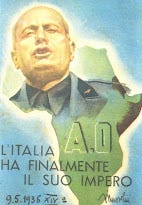
It goes without saying that Italian peasants never flocked to Ethiopia to build a new imperial province there. Even though the land may have been free, setting up farms in a foreign country requires economic resources to invest in the task, and those resources just weren’t there. The Ethiopian conquest remained a horrendous burden for the Italian state, which was forced to keep an army of more than 100 thousand troops to “pacify” the region, plus an even larger number of civilians to take care of the administration.
The whole madness came to an end when Italy declared war on Britain in 1940. Did the Italian government realize that they were condemning to death or captivity the whole army of Ethiopia? Didn’t they realize how badly they would have needed 120 thousand fully-equipped troops closer to home? One can only imagine that if these troops had been available in North Africa, maybe the Italian defeat at El Alamein wouldn’t have taken place (and, again, you might be reading this post in Italian).
As things stood, the British were surely happy to see that the Italians had abandoned in a remote place a sizeable fraction of their armed forces just when they badly needed them. The British could simply have starved the Italians in Ethiopia. But let’s say, in honor of the Perfidious Albion, that at least they allowed the Italian troops a chance of an honorable fight before surrendering. It was hopeless anyway: it was over in just a little more than one year. The Italian Empire disappeared just about five years after its creation. It only gained a place in the historical records as the shortest-lived empire ever.
What did Mussolini have in mind that led him to such a monumental mistake? What we can say is that the Ethiopian campaign was just one of the several mistakes that followed: afterward, Italy’s armed forces intervened in Spain, in Albania, in France, in Greece, in North Africa, in Russia, in England, and, in a final disastrous mistake, Italy declared war on the United States in 1941. Too many wars for a small country that dreamed of being an Empire, but wasn’t one.
What was going on in Mussolini’s head at that time? From what we know from the documents available, Mussolini was a lone man in power. He had no friends, only adulators. No collaborators, just yes-men. No disciples, only adorers. And no close family, except his lover, Claretta Petacci, to whose credit we have to say that she was the only person faithful to him up to the last moment of his life.
It may well be that, already in the 1930s, Mussolini had passed the “criticism barrier.” No one could contradict him, and what he said was supposed to be obeyed without questions. Over the years, that was enough to turn a shrewd politician, as the young Mussolini had been, into a bumbling idiot. I wrote in a previous post about Mussolini that:
There is the possibility that his brain was not functioning well. We know that Mussolini suffered from syphilis, an illness that can lead to brain damage. But a biopsy was performed on a fragment of his brain after his death and the results were reasonably clear: no trace of brain damage. It was the functional brain of a 62 year old man, as Mussolini was at the time of his death. . . . the case of Mussolini tells us that dictators are not necessarily insane or evil in the way comics or movie characters are described. Rather, they are best described as persons who suffer from a “narcissistic personality disorder” (NPD). That syndrome describes their vindictive, paranoid, and cruel behavior, but also their ability of finding followers and becoming popular. So, it may be that the NPD syndrome is not really a “disorder” but, rather, something functional for becoming a leader. . . . An NPD affected leader may not be necessarily evil, but he (very rarely she) will be almost certainly incompetent. . . . The problem with this situation is that, everywhere in the world, NPD affected individuals aim at obtaining high level government positions and often they succeed. Then, ruling a whole country gives them plenty of chances to be not just incompetents, but the kind of person that we describe as “criminally incompetent.”
Translating all this to our times, the impression is that we are watching a horror movie in which you don’t know exactly who can turn into a monster as the story unfolds. We elect leaders on the basis of what they did in the past and on what they tell us they will do. But of what they’ll decide to do once they are in power, what can we say? And the Titanic keeps steaming ahead in the night.
Monsieur,
J'ai beaucoup apprécié votre message dont la lecture est très instructive. J'ai souvent ri aux petites pointes ironiques qui émaillent vos propos. Bien entendu, je vois les événements décrits du même point de vue que vous.
Je pensais ces derniers jours à un ouvrage paru au siècle dernier: "Ces malades qui nous gouvernent" en me disant: Le prochain devra s'intituler : Ces malades mentaux qui nous gouvernent. Mais on devrait bien sûr proposer : "Ces chefs d'Etat atteints du Trouble de la Personnalité Narcissique" . Et quelqu'un y a pensé il y a déjà 8 ans : Ces psychopathes qui nous gouvernent.
Il faut que les peuples apprennent à ne plus élire des candidats atteints du NPD. Quand cela adviendra, ce sera un grand progrès pour l'humanité.
J'ai une grande admiraition pour Vaclav Havel, et j'aimais bien aussi ce président uruguayen qui ne voulait pas résider dans le palais présidentiel, et utilisait sa voiture "classe moyenne".
Bonnes salutations.
Your primary assumption regarding Israel running this show is incorrect. DJT and his inner circle seek to use wars to deflect the Epstein case and the declining economic well-being of the vast majority of Americans. Inflation and stagnation of real (chain-linked) wages are hammering the majority of Americans. They also seek to cancel midterm elections, declaring a national emergency. Venezuela and Cuba are additional distractions. Israel depends on US largess and support. They cooperate and follow the lead of the current administration.