

THE SECOND US CIVIL WAR
It is not science fiction. It has already started

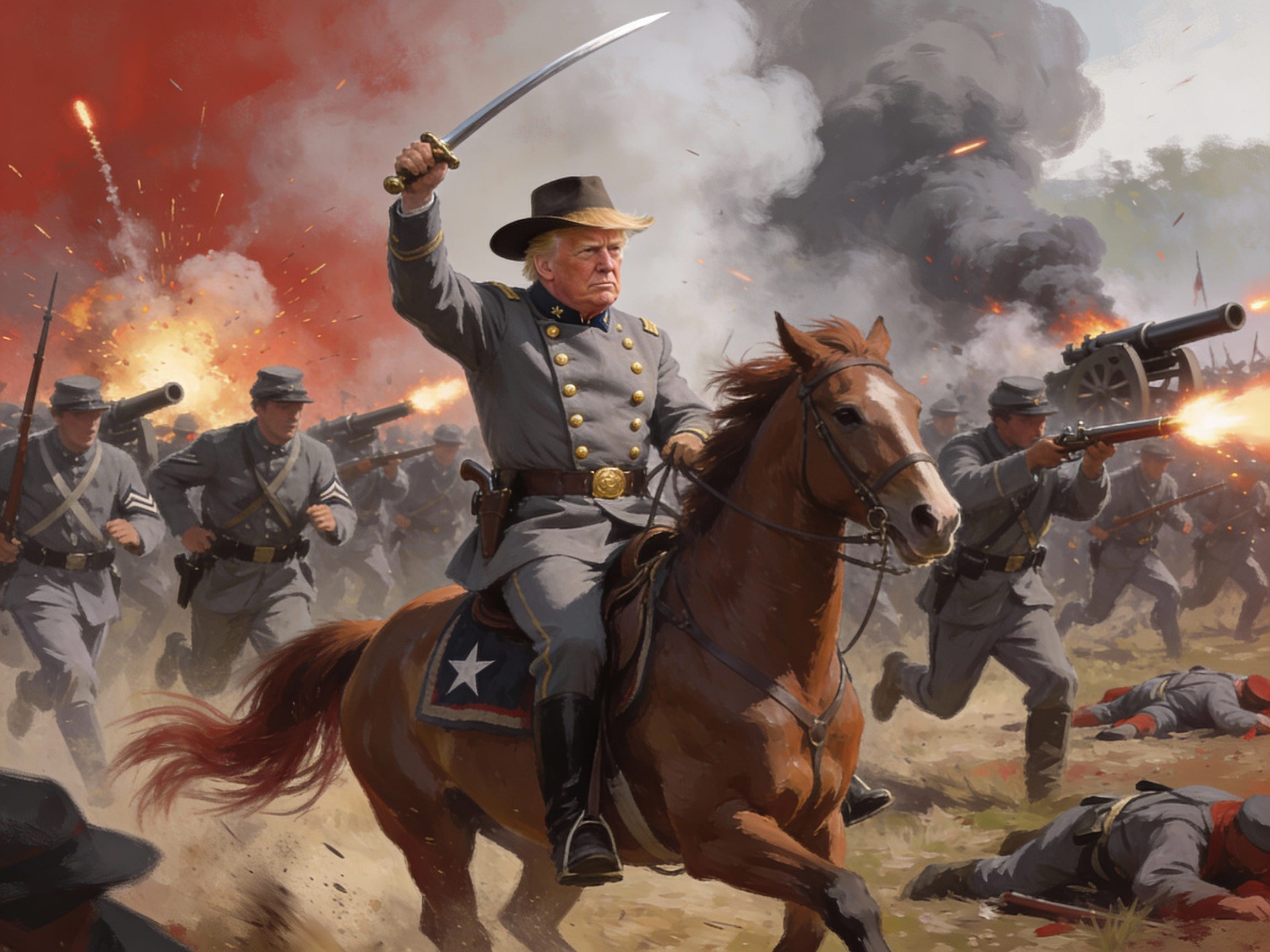
Donald Trump engaged in a re-enactment of the Battle of Bull Run, where he pretends to be Robert E. Lee. (image created by Seedream 4.5)
Guest post by Timothy Sha-Ching Wong
THE SECOND US CIVIL WAR
I. The warnings that the US is heading toward civil war (footnote 1) misunderstand the temporality of impending catastrophe (– see Jean-Pierre Dupuy (footnote 2) )
(See also Franco Berardi on the psychic resistance to acknowledge present and future catastrophe (footnote 3)
The 2nd US Civil War is occurring now: fragmented legitimacy, weaponized law, incompatible realities, and unequal exposure to state violence. Literature (e.g. Catherine Lacey’s “Biography of X”) has grasped this faster than political science.
The killing of Renée Good, the immediate public prejudging of the case by the US state’s highest authorities, ICE violence, the Gaza Genocide, the Venezuelan military intervention —these are not separate crises. They share a single logic: Schmitt’s friend/enemy distinction turned inward, proliferating without sovereign authority. Exception without legitimacy.
Once certain catastrophic possibilities become structurally available—once they are no longer unthinkable—they must be treated as necessary in the sense articulated by Jean-Pierre Dupuy. This is not fatalism. It is the recognition that motivation to delay catastrophe only exists if catastrophe is treated as real, not hypothetical. Possibility, at that scale, implies necessity.
II. Why Renée Good fits the framework of Schmitt’s bloody friend/enemy cut
That is why Renée Good matters, and why her killing fits this framework exactly. Not because the act itself was unprecedented, but because of how the state reacted: the speed of narrative closure, the loud and confident prejudging by the highest authorities, the insulation of the agent, the securitization of dissent, the immediate invocation of order and threat.
This is exception logic without sovereignty—Schmittian power stripped of its theological aura.
Here Carl Schmitt’s friend/enemy demarcation becomes decisive. The political, for Schmitt, begins not with law or morality but with the sovereign capacity to distinguish friend from enemy. In a stable order, this distinction is externalised: enemies are outside the polity. What is now occurring is its internalisation. The friend/enemy cut no longer runs along borders but through populations, neighbourhoods, and bodies.
Renée Good was not treated as a political subject or even as a citizen in the moment of violence. She was processed as potential enemy material —a threat vector to be neutralised. The subsequent ideological mobilization was not aimed at truth or accountability but at reasserting the correctness of the cut itself. This is how civil war logic appears before civil war spectacle.
Trump destroyed the remaining symbolic authority of the presidency. The sovereign who “calls the exception” no longer commands belief, awe, or fear in the classical sense. Exceptions proliferate, enforcement intensifies, but legitimacy does not regenerate. Power continues without conviction. This is not a failed state in the older sense; it is a fragile one—coercive capacity intact, consent hollowed out, consensual reality liquidating into bloodied terminal morbidity.
III. Venezuela, Gaza, ICE: one logic, three theatres
The Gaza Genocide; domestic American repression in the conditions of the 2nd Civil War; the Venezuelan military intervention, and are structurally commensurate.
In all three cases, violence is justified through abstraction while material context is refused. Security language substitutes for political cognition. Enforcement becomes detached from explanation.
This is not coincidence; it is scalar coherence. The same justificatory syntax operates across different theatres of action. The same friend/enemy grammar recurs, regardless of whether the enemy is named as terrorist, narco-criminal, foreign “authoritarian”, or domestic extremist. The object shifts; the logic does not.
Liberal responses fail because they insist on case-by-case adjudication while the system operates through continuous exception. They search for procedural errors where the problem is ontological. They ask whether norms were violated when norms themselves have become instruments.
What appears as a series of discrete crises is better understood as a single HyperObject composed of overlapping major destructive processes: ecocidal climate collapse, oligarchic class warfare, and permanent militarization without countervailing peace processes.
IV. We are already in the Second Civil War — Schmitt again, and why futurism misses the point
When I wrote that the United States is already in the Second Civil War, I was not invoking imagery of mass armies or formal secession. I was describing a condition: fragmented legitimacy, weaponized law, differential exposure to state violence, incompatible moral universes, and the absence of a shared future horizon.
This is where Schmitt reappears, but in degraded form. The friend/enemy distinction no longer stabilizes order; it metastasizes. Multiple institutions assert incompatible enemy definitions simultaneously. There is no longer a single sovereign decision, only proliferating micro-exceptions enforced by police, courts, agencies, and media ecosystems.
Much contemporary commentary insists the United States is headed toward civil war. Scholars such as Barbara F. Walter frame the problem as probabilistic and future-oriented: warning signs, risk indicators, trajectories. This work remains temporally misaligned. It presumes civil war is an event to be crossed into, rather than a condition already operative at the level of legitimacy, perception, and everyday governance.
Literature has been quicker to register this than political science. Catherine Lacey’s “The Biography of X” reads not as speculative futurism but as an alternative-history diagnosis of a society already split into incompatible realities, where violence is ambient, narrative authority is fractured, and political identity precedes fact. The novel does not imagine a coming civil war; it assumes one has already reorganized life.
This is precisely the error of liberal futurism: it waits for spectacle.
V. The final move: Schmitt against Schmitt
To paraphrase Schmitt against himself, (”on this day [30 January 1933], one can say that ‘Hegel died’) we can see that 2016 was the year Carl Schmitt died. Schmitt’s theory required belief in the sovereign. It required a recognizable decision-maker whose authority could suspend the norm in order to restore it.
What we now have instead is exception without transcendence.
Trump did not inaugurate fascist unity. He produced grotesque visibility, saturation without authority, repression without aura. Enforcement persists, but it no longer persuades. In that sense Schmitt did not triumph in 2016; his conceptual apparatus ceased to describe reality.
VI. Why We Should Become Deserters in Times of War
In Seneca-style collapse, breakdown does not begin with institutional failure but with the exhaustion of the energetic, affective, and cognitive surpluses that once made belief, reform, and compliance feel worthwhile.
This is why Desertion (Franco Berardi) (footnote 4) should be understood not as nihilism but as rational ethics in a phase of energetic decline. When sovereignty no longer commands belief, reform operates only as deferred fantasy, and enforcement proceeds independently of legitimacy, continued libidinal investment ceases to be reasonable. Desertion does not name passivity or retreat. It names a strategic withdrawal of affect, belief, and hope from systems that can now reproduce themselves only by extracting ever more psychic and social energy, accelerating precisely because their energetic base is failing.
Desertion, in this sense, does not abandon law but accepts its transformation into residue: a memory of obligation without power, a standard that no longer authorizes enforcement yet continues to indict it. What is withdrawn is not ethics or agency, but participation in a juridical order that has exempted itself from the very obligations it claims to enforce. Under conditions of systemic exhaustion, where legitimacy has drained away but enforcement persists, withdrawal of libidinal investment becomes not nihilism but a necessary stance—one that does not presume inevitability or predict collapse, but refuses to act as if continued acceleration were the only remaining form of action, or as if restraint, refusal, and selective non-cooperation no longer mattered in the present.
(Footnote 5)
-
Footnote 1 -
for a sample see
Peter Turchin, “End Times: Elites, Counter-Elites, and the Path of Political Disintegration” (University of California Press, 2024), discusses how accelerating elite fragmentation and sociopolitical polarization make major ruptures more probable in ostensibly stable polities — a framework that helps interpret the intensification of sectarian demarcations in contemporary U.S. politics.
Claire Finkelstein, “We ran high-level US civil war simulations. Minnesota is exactly how they start,” The Guardian (January 21, 2026) https://www.theguardian.com/.../jan/21/ice-minnesota-trump
Barbara F. Walter, “The Coming Instability And Why We Know It’s Coming” (Substack, Oct 01, 2025), argues that the pervasive sense of looming catastrophe — a temporality shared by communities under stress — is a political formation in its own right, where the “future” is experienced as an already present condition demanding immediate normativity rather than deferred reckoning.

Footnote 2 -
Jean-Pierre Dupuy, “The War That Must Not Occur” (Stanford University Press, 2015),
esp. chap. 2. Dupuy develops what he calls “projected time,” arguing that when a catastrophe of monumental scale becomes structurally possible, rational action requires treating it as necessary rather than merely possible. This necessity does not imply fatalism or determinism; rather, it is precisely what motivates sustained efforts at prevention, since a merely possible catastrophe lacks sufficient motivational force.
““Here possibility implies necessity … It is not a contradiction … to believe in both the necessity of the future and its indeterminacy.””
Footnote 3-
Franco Berardi, “After the Future” (AK Press, 2011).
Berardi describes a cultural condition in which the future no longer appears as an open horizon but as an already foreclosed space, producing paralysis, anxiety, and delayed recognition rather than decisive action — a psychic complement to Dupuy’s analysis of catastrophic temporality.
Berardi, “The Future Is Cancelled” (Verso, 2020). Berardi argues that late-capitalist media saturation and cognitive overload suppress the capacity to register slow or abstract catastrophes, reinforcing a collective tendency to wait for spectacle rather than act on structurally foreseeable breakdowns.
Footnote 4 -
Franco Berardi, Quit Everything: Interpreting Depression (Repeater, 2024). Berardi interprets depression not primarily as individual pathology but as a systemic signal arising when psychic, libidinal, and cognitive energies are pushed beyond sustainable limits. In conditions of social and energetic overshoot, withdrawal (“desertion”) becomes a rational adaptive response rather than a nihilistic refusal: a reduction of participation that mirrors material contraction and Seneca-style collapse dynamics, in which systems unravel faster than subjects can consciously adjust. Desertion, in this sense, names an ethical refusal to continue supplying affective and cognitive energy to accelerating systems that can no longer be stabilized or reformed.
Footnote 5-
Roberto Esposito, “Immunitas: The Protection and Negation of Life” (Polity Press, 2011), esp. chaps. 1–2; see also Bíos: Biopolitics and Philosophy. Drawing explicitly on Roman legal concepts (munus, immunitas), Esposito shows how political and juridical orders preserve themselves by exempting themselves from obligation in the name of protection. Law persists, but increasingly as form without binding force: a memory of obligation rather than a source of legitimacy. In conditions of systemic exhaustion, ethical action no longer consists in renewed commitment to institutions that govern without belief, but in selective withdrawal from forms of participation that serve only to extend their immunized survival.

THEGUARDIAN.COM
We ran high-level US civil war simulations. Minnesota is exactly how they start | Claire Finkelstein
He would never get that close to the action.
From a different perspective, the 2nd civil war was predictable: since ~2002 the US police has been trained by the Israeli army, in all of the techniques now summarized as genocide. It implies seeing every human as terrorist unless proven otherwise (that is, when given the opportunity). My late friend the therapist even showed the photos of US cops training to shoot women and children at first sight - without hesitation.
https://electronicintifada.net/blogs/rania-khalek/us-cops-trained-use-lethal-israeli-tactics
https://fpif.org/why-we-should-be-alarmed-that-israeli-forces-and-u-s-police-are-training-together/
Many more early-warning links on the issue exist, and as the US population is the world's best armed one, a tipping point could have been reached, motto, "enough is enough".