

Of Drones and CO2: New Technologies for Killing People
Artificial Intelligence has generated a step forward in assassination technologies.


In 1530, the Florentine ‘Condottiere’ Francesco Ferrucci was wounded while fighting against the army of Emperor Charles 5th of Spain. While lying on the ground, he was killed by Fabrizio Maramaldo, one of the commanders of the Imperial Troops. Ferrucci’s last words are said to have been: “Coward, you are killing a dead man.” These words may be pure legend, but the death of Ferrucci was a turning point in history, when the development of firearms forced leaders to stay away from the frontline. It is a trend still ongoing, with the leaders now hiding in underground bunkers, but hunted there as well, as we saw happening in Iran these days. (Painting by Sebastiano de Albertis, 1830)
If you follow my other blog, “Living Earth,” you know that I have been promoting the idea that excess CO2 in the atmosphere is a systemic poison that’s gradually eroding the capabilities of the human brain. There is no strong proof that the current atmospheric concentration has harmful effects, but higher concentrations in the open air translate into even higher concentrations indoors, at levels known to damage the capability of human brains to reason and operate efficiently. For details on the mechanism, you can see a recent paper by my coworkers and me. And note that CO2 is only one of the widespread pollutants that damage human health everywhere in the world.
What does it have to do with the recent drone strikes in Iran? Well, there is an unexpected parallel. Both drone strikes and CO2 are targeting everyone, including the rich, not just the commoners like us. This is going to have an effect on the way leaders behave and battles are fought. It is a long story, let me tell it step by step.
Killing the leaders in the past history
In ancient times, leaders had to show their troops that they were present and watching. They didn’t really fight on the front line as shown in adventure movies. But often they got close enough that they received a deadly dose of whatever was being thrown at their troops. Possibly, the last high-level leader killed in battle was Gustav II Adolf, king of Sweden, killed in 1632 at the Battle of Lützen during the Thirty Years’ War. Napoleon was one of the last leaders who followed his troops in battle, but he stayed well away from the frontline and, nevertheless, was wounded four times in his career.
In more recent times, leaders retreated even farther from the battlefield and accepted with enthusiasm the ideas of Giulio Douhet, the Italian aviation officer who wrote the influential book Il Dominio dell’Aria (1921) (the domain of the air). Douhet suggested that the proper way to win a war was the wholesale extermination of civilians by aerial bombing. Hence, during modern wars, leaders started spending their time well hidden in safe bunkers while their air forces slaughtered civilians. Remarkably, they often survived among the ruins of their countries. Adolf Hitler, for instance, spent the war he had started mostly hiding in a bunker, finally committing suicide. Benito Mussolini and Saddam Hussein were hanged by their own people, Muammar Gaddafi was shot while running away, and there are other cases.
Killing leaders today
Nowadays, leaders are no longer safe in their bunkers. The case of the assassination of the entire leadership of Iran a few days ago marks the emergence of a completely different strategy, already used to assassinate another Shiite Leader, Hassan Nasrallah in 2024. Consider also the attempt of assassinating Vladimir Putin in his residence in 2025, and the kidnapping of the President of Venezuela, Maduro. The life of leaders seems to have become much more dangerous than it used to be.
The traditional model of assassination, or “targeted killing,” relied heavily on surprise: strike before the target knows you’re coming. What happened with the Iranian leadership was structurally different. They knew they were targeted, and they surely were varying routines, using secure communications, and moving between locations. It didn’t make a difference.
Traitors inside the Iranian government may have played a role. But the way things went points to a system that can track a target’s location in real-time regardless of their countermeasures. It can only be a sophisticated AI system that tracks people and identifies them, no matter how hard they try to leave no traces. Even when people change routines, their patterns have deep regularities that are hard to suppress. Sleep cycles, eating habits, and the people they meet. AI can find these signatures across enormous datasets, invisibly.
AIs can also use compromised hardware to track people. Phones are an obvious tool, but anything connected to the internet may be a way to identify a person. The way you drive your car, the commands you give to your home controls, and even the way you type on a keyboard can identify you. Additionally, the AI doesn’t need to target you directly; it is enough to track other people in your circle of acquaintances. The intersection of different networks reveals your location.
We may even suspect a more active role of the tracking AI. Think about this: at least three of the high-level Iranian leaders, Khamenei, Shamkhani, and Pakpour, were in the same building, the leadership compound in Tehran. Some sources speak of 5-10 leaders all in the same place, although that’s not certain. Now, why would the Iranian government call a reunion of top leaders together, when they knew perfectly well that they were at risk of being wiped out by a missile? You know the old saying that goes, “never put all your hand grenades in the same basket.” Could the AI have hijacked the communication system and impersonated someone who could call the reunion? One of the many dark tricks that may be at play in this war.
Are there effective countermeasures to this kind of tracking? Hard to say, unless you are a specialist in this area. But the fact that the Iranian security service was unable to shield the government’s leaders indicates that it is extremely difficult. It represents a qualitative shift in what targeted killing means strategically. Here, the military importance of AIs is appearing in the open. AIs do not pull the trigger, but they aim the gun at the target.
No leader is safe any longer
Mr. Trump seems to be very happy about what he did. But killing people is a dangerous hobby, no matter how well you can argue that your victims deserved their fate. Does Trump understand the consequences of what he did? From now on, no country leader is safe in his palace, and not even in his bunker, and that includes Trump himself.
That doesn’t mean we should expect an Iranian missile to hit the White House anytime soon. But the US is not the only military system that controls powerful AIs. Besides, the worst enemies of leaders are usually in their entourage, and the most common way of dying for a King or an Emperor is to be assassinated by one of his followers. Or betrayed by one. Take a look at this data for the Roman Empire.
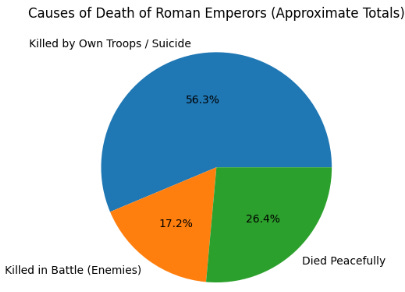
The situation is not so bad for American presidents; yet, about 9% of them have been assassinated while in office, and 44% were the target of assassination attempts. Usually, US presidents were targeted using guns, and that risk can be strongly reduced by tight precautions. But today, if someone wants to get rid of an American president, they can do that by taking control of a military AI. There is nothing to do; being a king, an emperor, or a president is a dangerous job.
Then, of course, leaders must be thinking very hard about countermeasures. But what to do, exactly? Even more robust and deeper bunkers? Hide in submarines? In flying planes? On the Moon? Or retreat in the shadows while front men (or women) pretend to be ruling? (or kagemusha, shadow warriors, according to ancient Japanese methods to protect leaders.) Not for nothing, it is reported that Benjamin Netanhiau flew from Israel to Germany to avoid all risks.
Knowing the way they reason, leaders may take much more aggressive measures. Things of the type, ‘ do unto them before they do unto thee.’ The ancient Roman Emperors were known to be extremely suspicious and to kill people on even the remotest suspicions that they could be plotting against them. Emperor Nero had his own mother killed because he suspected she was involved in a plot against him. We are probably going to see something similar in our times.
I don’t venture to say who could be next, but I could place some good bets.
CO2 — the silent killer
Now, a curious similarity exists between AI-controlled drones and increasing pollutant concentrations of the atmosphere (including CO2). Pollutants target everyone, rich and poor. The rich can take some precautions. They can avoid global warming by air conditioning and moving North or higher up in the hills. They can drink filtered water, eat clean food, and avoid the polluted air of cities. But there are limits to what they can do. Pollutants are everywhere, and it is likely that the rich have as much microplastics as the poor in their brains, and as much heavy metals in their blood. About CO2, it is well mixed in the atmosphere: we all breathe the same air. The best you can do if you are rich is to install expensive “CO2 scrubbers” indoors and seal the windows airtight. But that’s the equivalent of living in a submarine. Not something anyone would want to do forever.
So, what are the elites going to do once they realize what’s going on? Of course, the best idea would be to build an international peaceful alliance to move away from fossil fuels, abate pollution, and remove CO2 from the atmosphere by carbon capture and sequestration. Unfortunately, I have the vague impression that they will think of different things, a little more aggressive. But I won’t put what I think in writing.
Note, incidentally, that it is not unthinkable that the unhinged behavior of many of our leaders may be the result of the brain damage caused by CO2 and other kinds of pollution. If you wanted a good example of a self-reinforcing problem, this is one of the best.
Any hope for the future?
What’s happening in the world reminds me of what Freeman Dyson said about when he was working for the British Bomber Command during WWII. He found himself working in “an organization that had the purpose of killing people,” doing that by happily exterminating both German civilians and British airmen. That huge machine was completely out of control. Once it started, it became impossible to stop, and it continued to operate even when it was clear that the war was won, and there was no reason to keep killing civilians. (Do you remember the bombing of Dresden in 1945?)
Can you believe that what’s happening today is all the work of a man who’s soon turning 80 and shows all the symptoms of brain damage? The huge machine dedicated to killing people has returned, and it is out of control, just as it was in 1945. It has only changed its targets a little, and now they include leaders as well as civilians. What monstrous forces are stirring up? Demons of our minds? But can humans be so evil? Are there real demons somewhere? Or is it artificial intelligence turning out to be a demonic force?
The only hope that this runaway madness will stop lies in the upcoming natural population decline, coupled with the movement toward renewable energy. That will reduce CO2 emissions and, at the same time, de-emphasize the perception of the need to control the fossil fuel supply and for new lands for an increasing population. That will, hopefully, reduce the push for wars. And fewer killer drones would be a good idea. It is a dim hope, I admit, but it may work in the long run. I discuss this subject in depth in my book “The End of Population Growth.”

___________________________________________________________________
If you arrived all the way to here, you may like to take a look at my post from January, where I cited the case of the last Iranian Emperor, Yazdegerd III, who was assassinated in 651 AD in a historic defeat for Iran. After he died, Iran had no more an army and a government, and was completely controlled by a hostile power. Yet, about one and a half millennia later, Iran and Iranians are still there, alive and fighting.
Kill the King, Win the Game. The World as a Chessboard
The Dawn of a New Strategic Era
Jan 05, 2026

Saddam, Qaddafi, Assad, Maduro…. Who’s next? Maybe someone named Donald?
The last Sasanian King, Yazdegerd III, reigned from 632 to 651. He was killed, it is said, by a miller while running away, nearly alone, from the invading Arab armies. With him went the Sasanian Empire, forever lost in the mists of history.
The game of chess existed in Iran at the time of Yazdegerd III, but it was a novelty. So, we may imagine his death inspired the rule that gives a player victory when the enemy king is dead. In Persian, it is Shah Mat (شاه مات), “The King is Dead,” a term that has arrived to us as “Check Mate.”
It is difficult to be a king: you claim to have power over your subjects, but you yourself are always at risk. Another, more powerful king may checkmate you at any time. It is the destiny of Kings and rulers, no matter on which source they claim their power to come: a democratic vote, or a divine fiat. One moment you are at the top, the other you are at the bottom. And another king takes your place.
Thanks for a thought provoking article. If I read you correctly you are unaware of research on the cognitive impact of elevated CO2 levels. However the paper “Associations of Cognitive Function Scores with Carbon Dioxide, Ventilation, and Volatile Organic compound Exposures in Office Workers: A Controlled Exposure Study of Green and Conventional Office Environments” was issued at Harvard in 2016.
It studied 9 cognitive domains in the CO2 range from about 450 ppm to 1600 ppm. The findings included “On average, a 400-ppm increase in CO2 was associated with a 21% decrease in a typical participant’s cognitive scores across all domains”
Admittedly these were for an indoor environment but, significantly, you observe that indoor CO2 levels are likely to be higher than outdoors. It thus seems pertinent that current outdoor levels are edging close to the lower limits of the above study.
Additionally, had the study been extrapolated backwards, it would seem unlikely that the observed trends only started at the lower bound of the study. i.e. it would seem probable that we are already operating with CO2-compromised cognitive function.
And so the world turns with no thoughts given to the microscopic life existing on,in, and above it. Empire follows Empire, species thrive and fail. We specimens of the human species have the arrogance to believe we can control our destiny.