

The Swiss Referendum on Population: There are no Right Answers to Wrong Questions
Politics is trying to force a population to do what it is doing by itself.


Asking the wrong question is guaranteed to generate wrong answers.
The recent Swiss referendum about putting a cap by law on Switzerland’s population has been rejected. It matters little: it was a classic example of a question that has no good answer, even less so if it has to be answered with a yes/no vote. Complex systems, such as entire countries, cannot be managed using axes as tools.
This referendum was the offspring of an old debate that keeps returning. In its modern version, it started in the 1950s, when people discovered that the human population was growing exponentially. Where was that leading us? Would population explode to tens of billions, and would that lead to poverty, hunger, wars, and plagues? Something needed to be done, and the magic word was “population control,” although nobody knew exactly how to attain it.
In the West, the debate rapidly died out when it was discovered that human fertility was plunging like a stone: it was the “demographic transition” that consigned overpopulation to the dustbin of overhyped fears, together with the Red Scare and the Yellow Peril.
But the debate never completely died, and the Swiss referendum shows that the idea that some form of population control is necessary is still alive. Yet, history shows that it is a difficult task, perhaps impossible. A good example comes from the case of China, possibly the only country that tried a state-wide, long-lasting population control initiative. It is an instructive story, scarcely known in the West, and often distorted by propaganda reports. It is described in detail in my recent report “The End of Population Growth.”

In China, the great famine of 1958-1962 had been a shock for everyone, and a debate ensued within the high levels of the government. How to avoid a similar disaster in the future? The old guard remained anchored to old concepts: more people mean more wealth and more power. But the new generation of leaders that took over after the death of Mao Zedong had different views. They argued that too many people put both agriculture and the industrial economy at risk. Hence, it was a duty for the state to control population in such a way as to maximize wealth for everyone.
Chinese demographers developed sophisticated population models. Some of them argued that the ideal Chinese population was of the order of 600-700 million, and created roadmaps to arrive there smoothly, by gradually reducing fertility over about one century. The most visible result of these ideas was the “one-child” policy, enacted in the early 1980s. In practice, the policy turned out to be unnecessary and scarcely effective. The Chinese population went through its demographic transition in parallel with that of other Asian countries that had not enacted the same drastic policies. The one-child policy was officially abolished in 2016, but it had ceased to be enforced much before.
The case of China is telling in many respects; the main one is that having, or not having, children is a decision that people take individually or as families, and governments can hardly change that. Currently, the whole world is going through the demographic transition independently of the attempts of governments to push fertility up. Only some countries, especially in Sub-Saharan Africa, still see a population increase owing to large numbers of young people entering their reproductive age. But that will not last for long. Even Africa will soon see a population decline, at most in a few decades from now.
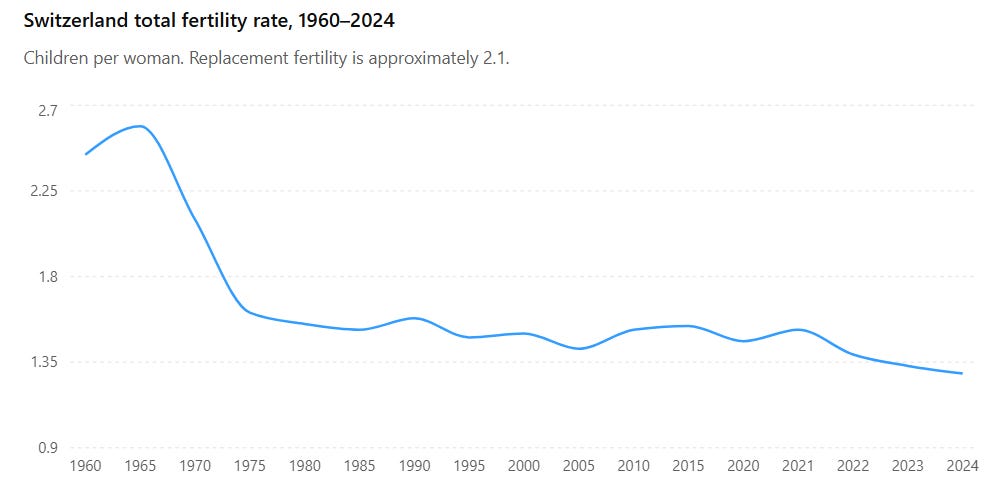
The Swiss referendum had in common with the case of China that it was an attempt by the government to force a population to do what it was already doing by itself. Switzerland hardly has an overpopulation problem — more likely, it will soon face the opposite problem. The total fertility rate (TFR), the number of children per Swiss woman, has gone below the replacement rate of 2.1 in 1970, and it is now around 1.3 — one of the lowest in the world (data from the World Bank).
The result is that, even for very optimistic hypotheses, Switzerland’s population will be plateauing in the coming decades. Some models project it passing the 10 million mark, others (e.g. the United Nations) have it staying well below.
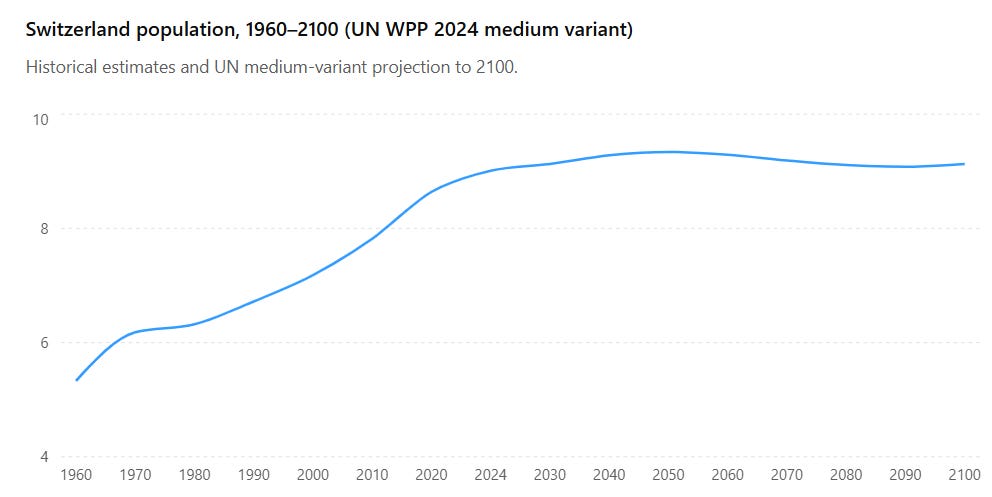
Take also into account that these projections are probably optimistic in the sense that they don’t take into account the possibility of a population collapse. As I discuss in my book, it is possible that the Swiss government will soon have to worry about rapid depopulation, the opposite problem than the one the referendum purported to solve.
At that point, favoring immigration will not be a solution, either. Consider that 81% of the immigrants living in Switzerland come from Europe, mostly from the EU. But all European countries are in the same situation: the demographic transition is in full swing, and none of them will have an excess population to export in the coming years. Only about 5% of immigrants to Switzerland come from the still growing regions of Sub-Saharan Africa. And the demographic transition is going to occur there, too.
Switzerland, just like all industrialized countries, will do better by adapting to an unavoidable population decline rather than trying to force the population to grow or shrink according to government plans.
The world’s human population is going through a gigantic cycle that’s reversing a trend of growth that had been ongoing for millennia. In many ways, this reversal is welcome, since it will ease the pressure on a badly strained ecosystem. But it is a road with an unknown destination: there is such a concept as too much of a good thing — in this case, population decline. As always, we march toward the future blindfolded, hoping for the best.

Completely agree that this is the wrong question. The research suggests a global multi-species fertility collapse. Yes, human fertility is decreasing too, commonly ascribed to lifestyle choice of the parents. But lifestyle choice cannot be the whole answer because birthrates are also collapsing for fish, birds, reptiles, all sorts of species. Fish don't postpone reproduction over lack of confidence. Birds don't think about lifestyle.
In species that regulate with hormones, one result of these endocrine disruptors seems to be these multi-species reproduction problems. Here's a recent study: https://phys.org/news/2026-04-invisible-fertility-crisis-chemicals-climate.html
If it's helpful, I have collected some of the more notable studies on my climate site https://barrysmiler.com on my Research page and in the fertility/endocrine section of my Scenarios page.
The population peak could happen as soon as 2030:
https://www.sciencedirect.com/science/article/pii/S0378437125000640