

The One and the Many
The value of various standards that possess their own authority and influence.

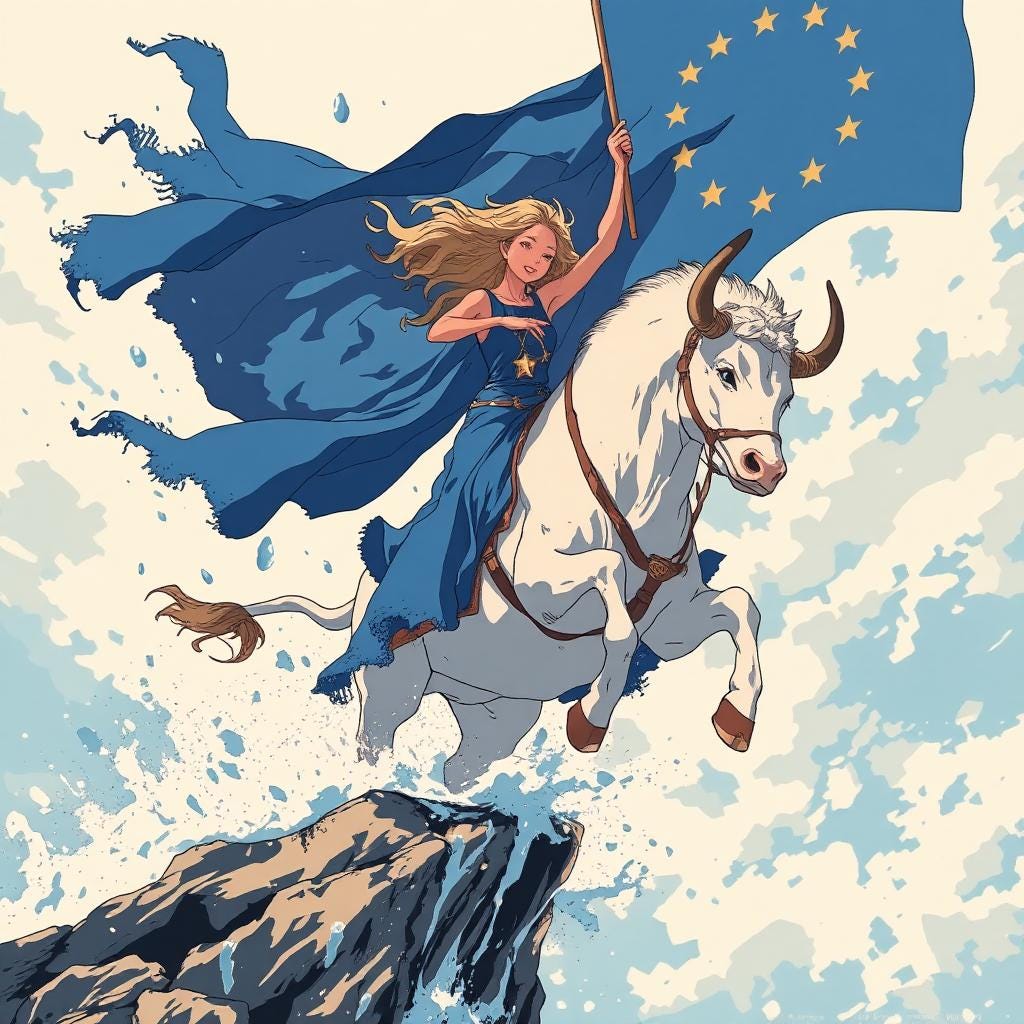
Europe happily committing suicide
Guest post by Olle Hollertz
The American philosopher Irving Babbitt (1865 – 1933) began his reflection on democracy and leadership (1) by observing that “the economic problem will be found to run into the political problem, the political problem in turn into the philosophical problem, and the philosophical problem itself to be almost indissolubly bound up at last with the religious problem.”
There is a connection between diversity and creativity. Diversity entails not merely competition between economic systems, power centers, and the political division of power, but also the existence of distinct spheres, each with its own standards for assessing an individual’s status and worth that are not subordinate to economic laws. Representatives of these spheres can defend their domains and exert influence; they have secured status and the prerogative of interpretation regarding matters concerning their respective fields. I am referring here to practitioners of the arts, the sciences, sports, and—not least—religion, as they existed before everything was subordinated to—and at times corrupted by—money acting as a standard of value and a mechanism of governance and regulation.
In direct contrast to Irving Babbitt’s conclusions regarding what matters in life, it is increasingly asserted in various contexts that the economy is the decisive factor. The economy is an appealing yardstick because the unit of measurement is relatively simple to quantify and comprehend; counting money requires no higher-order cognitive functions.
How and when can a state of diversity—in which the constituent parts possess integrity and self-determination—be reconciled with a sense of unity, where cooperation and mutual understanding arise naturally?
The social environment encountered on trains and at railway stations—across countries with distinct cultural characters during an InterRail journey through Central Europe in the hot summer of 2026 -- prompted my reflections on the complementary concepts of differentiation, globalization, and the focus on the individual. It becomes evident that, on a psychological level, Europe lacks a unifying pan-European project. While Europe’s geography has fostered distinct social spheres, unique cultural traits, and a creative diversity, the absence of a unifying fabric—such as a shared project—means we tend today to become individual projects pulling in different directions. We lack a common force and direction. Plato had already identified this problem, and his description of it concludes the dialogue *The Statesman*.
”Stranger: We may thus say that the supreme means for the weaving of statecraft—a proper interweaving of the characters of courageous and temperate people—is achieved when the royal art unites their lives in concord and friendship, thereby completing the most magnificent and excellent of all fabrics; and with this fabric, it envelops and holds together everyone in the state—free and slave alike—thus governing and guiding the state without neglecting anything that might serve its happiness.
Socrates: You have now presented to us, in an excellent manner, the royal man—the statesman.”
Today, one can clearly observe the throngs of isolated individuals in cities and at railway stations, most with their eyes glued to their mobile screens. A sense of social cohesion is hard to discern; instead, everything dissolves into a formless, aimless hum. It becomes evident that a well-articulated, unifying Pan-European project would provide much-needed guidance on the direction and energy with which we should all move forward—not as an undifferentiated mass, but as creative individuals who believe in a shared future. This is not a future governed solely by economic considerations, but one where individuals can be measured against various standards—sometimes competing and challenging, yet at other times overlapping and complementary. Such a project would facilitate integration and development by offering alternatives to political decisions and societal initiatives that are currently often predicated on the notion that everything ultimately comes down to money. It would also clarify the expectations and requirements placed on those wishing to join the European community, regardless of their reasons for doing so. Furthermore, it would foster a diversity that stimulates creativity across various spheres of human life and sectors of activity. Political challenges and decision-making would become more manageable if there were a unifying vision of the path ahead. The challenge lies in finding, articulating, and implementing a Pan-European project that leaves room for diverse individual, religious, cultural, and national variations. I believe the Middle Ages offer an example of a time when this was, to some extent, realized. Similarly, the United States in its heyday served as another model demonstrating the creativity, energy, and constructive dynamics inherent in such an approach. A constitution that guaranteed the separation of powers and states with room for self-determination, alongside a success story— “the American Dream”—that served as a unifying force for people of diverse ethnicities, classes, religions, and social backgrounds. This resulted in heightened creativity across various spheres—culture, music, art, literature, film, sports, technology, and science—with these fields fostering mutual cross-pollination.

Medieval Europe was also characterized by a multitude of power centers that allowed creativity to flourish within the aforementioned spheres; simultaneously, the legacy of antiquity—symbolized by Socrates, Plato, and Aristotle—combined with Christian doctrine to form the intellectual glue and emotional foundation. These cornerstones established order, structure, and a shared conceptual framework that facilitated dialogue. The Catholic Church and the Latin language served as a common fabric, easing communication across the continent.
These examples can serve as a model when we observe the world fracturing and structures dissolving. Understandably, both leaders and citizens look back to a bygone era—a golden age—but instead of revitalized energy, the result is a stale, insular atmosphere that leads to stagnation and various political aberrations.
When the establishment—the so-called wise and sensible, whether young or old, yet anxious, narrow-minded, and complacent—views necessary changes, such as those in Europe, with skepticism, we see clear signs of a stagnating civilization.
2026-07-08 Olle Hollertz
Democracy and Leadership; Irving Babbitt, 1924
Scanning, scrolling and clicking smartphone screens in train stations is the unification of Europe... for what it may be worth, while it may last.
Good that the two commenters so far see the population connection to social cohesion issues. When a large mammalian species increases 800% in 8 generations, while its technologies abet an estimated tenfold increase in p/capita energy throughput, finite resources are increasingly competed for. Mix in mass migrations, and tribalism can exacerbate the situation. At the same time cultural histories can be perceived as threatened. This combination exists in some nations and has been growing this century. It's no surprise that a circling of the wagons mentality has developed.