



The fate of climate scientists? Some recent research of mine confirms the trend.
In 2012, on this blog’s predecessor, Cassandra’s Legacy, I wrote that climate science seemed to me headed for the same fate as The Limits to Growth. That is, after an initial phase of acceptance, a well-organized campaign of demonization would move it to the dustbin of “wrong” ideas, and keep it there.
In time, this impression of mine was reinforced by what I read in the media: Trump’s election, the organized anti-science campaigns, the suppression of research and scientific centers, the diffusion of the meme “CO2 is food for plants,” and more.
Even people in the skepticosphere perceived this situation. A few months ago, Judith Curry declared victory for her side in the climate battle and closed her blog, claiming that it was not needed anymore (a little like Trump claiming victory in Iran).
This impression was confirmed by recent measurements. As I discussed in a previous post, a recent study by Storani et al. (2025) shows that the presence of skeptics on social media has significantly increased in recent times. However, their analysis was limited to 2022 and didn’t include the recent hubbub on the matter; the series of events that allowed Judith Curry to claim victory.
So, I thought I could find some more data to clarify the question. Let me tell you a summary of the story. I am preparing a full paper to be submitted to Qeios or some other journal.
Climate skepticism as a memetic virus
To verify how common the attitude we call “denialism” or “skepticism” is, the natural thing is to track how many people are expressing views contrary to standard climate science interpretations in the media. But that’s a difficult condition to pinpoint: it is impossible to examine the zillions of articles, posts, and comments on climate and decide, one by one, who is a skeptic and who is a believer. Nevertheless, a lot can be done using proxies: specific terms indicating that a certain conversation involves skepticism about climate science.
I used three denialist terms: “climate hoax,” “climate scam,” “climate fraud” — against the baseline term “climate change,” both worldwide and for the United States. I used Google Trends, a free service that counts the number of times that a certain term is searched for in the Google search engine.
These are indirect measurements, and the presence of a certain term does not indicate that those who use it are skeptics. But if someone uses those terms, that has to be within a discussion that involves, directly or indirectly, skepticism.
Google Trends doesn’t give you real numbers — it gives you a relative index, rescaled to 100 for whatever the biggest number in your search happens to be. A huge term like “climate change” swamps a much smaller one like “climate fraud,” and the smaller term gets crushed down near zero. So, the two terms need to be visualized in different searches. Then, a scaling factor can be found; I’ll describe how I did it in detail in the paper I am preparing. Here, let me just note that its exact value is not important when searching for trends.
The fever chart
Let’s start with the worldwide values for the last five years, extending the work by Storani et al. that, as I mentioned, stops at 2022. From late 2021 through mid-2025, the ratios of denialist search terms to “climate change” oscillate but do not show an evident trend; although they may be slowly increasing.
Then, in August 2025, the ratios jump up. Within a single month, “climate fraud” and “climate scam” start climbing, and by December 2025 they’ve risen twenty- to twenty-eight-fold from baseline before easing back — but not all the way — through the following year. “Climate hoax,” oddly, barely moves; it’s “fraud” and “scam” doing almost all the work.
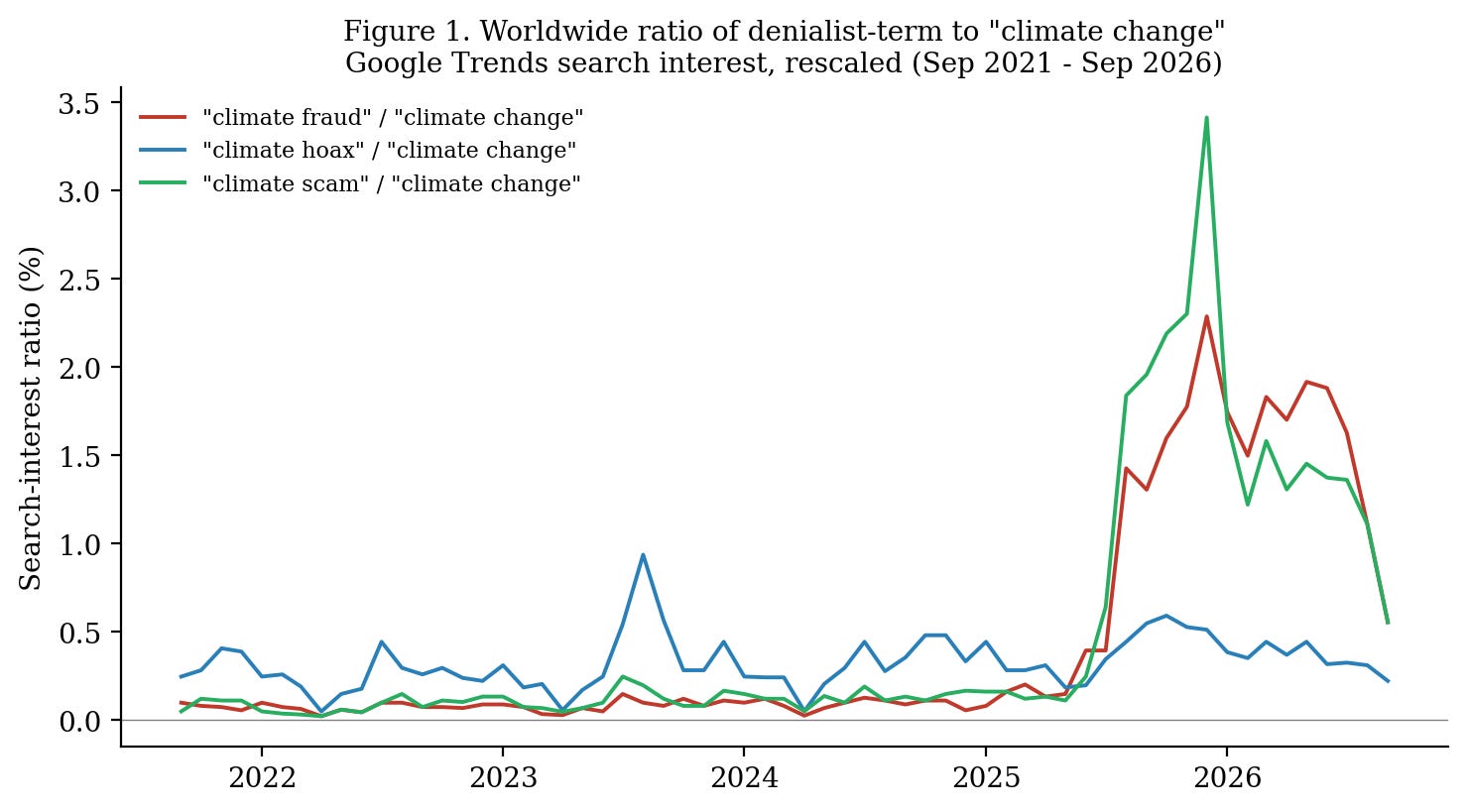
A survey of separate countries shows that the trend is the same over the two main anglophone countries, the UK and the US. It is the same also in countries where English is widely used by people engaged with scientific and international affairs. Non-anglophone countries such as China, Arab countries, and Africa show zero results for these terms in English. There may be locally used terms for the same concepts, but they are difficult to identify. Additionally, in China Google is not normally used as a search engine. About India, although a country where English is commonly used, it shows zero hits for skeptical terms.
Let’s see the US as an example of the trend in an anglophone country — actually the leading country in the West in terms of cultural trends. The results are similar to the global ones, but even starker. Fraud and scam move together.
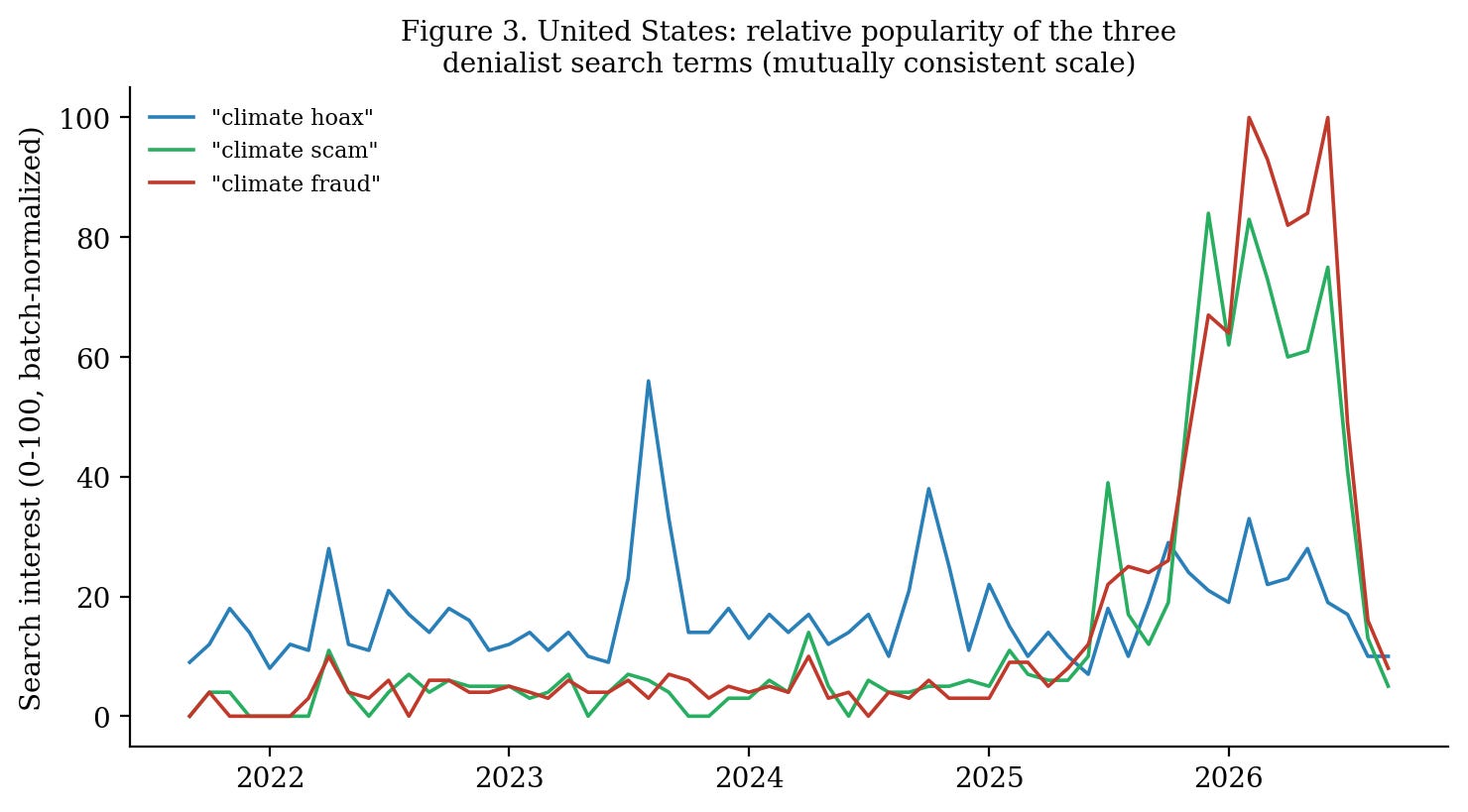
Google Trends can’t tell you why a number moved, but a calendar can. Late July 2025 is when the EPA proposed to withdraw the 2009 “endangerment finding” — the legal foundation underneath essentially all federal greenhouse-gas regulation. It corresponds perfectly to the point where the graph spikes up.
The fever stayed high for a year afterward, rather than fading. It looks like the result of a sustained campaign of reinforcement: “scam” at CPAC in February 2025, “the greatest con job ever perpetrated on the world” at the UN in September, and finally, in July 2026, an explicit accusation of “climate fraud” leveled by the US president himself at the National Academies of Sciences. This is already a very interesting result, and it shows how sensitive the “memesphere” is to propaganda.
Extending the search
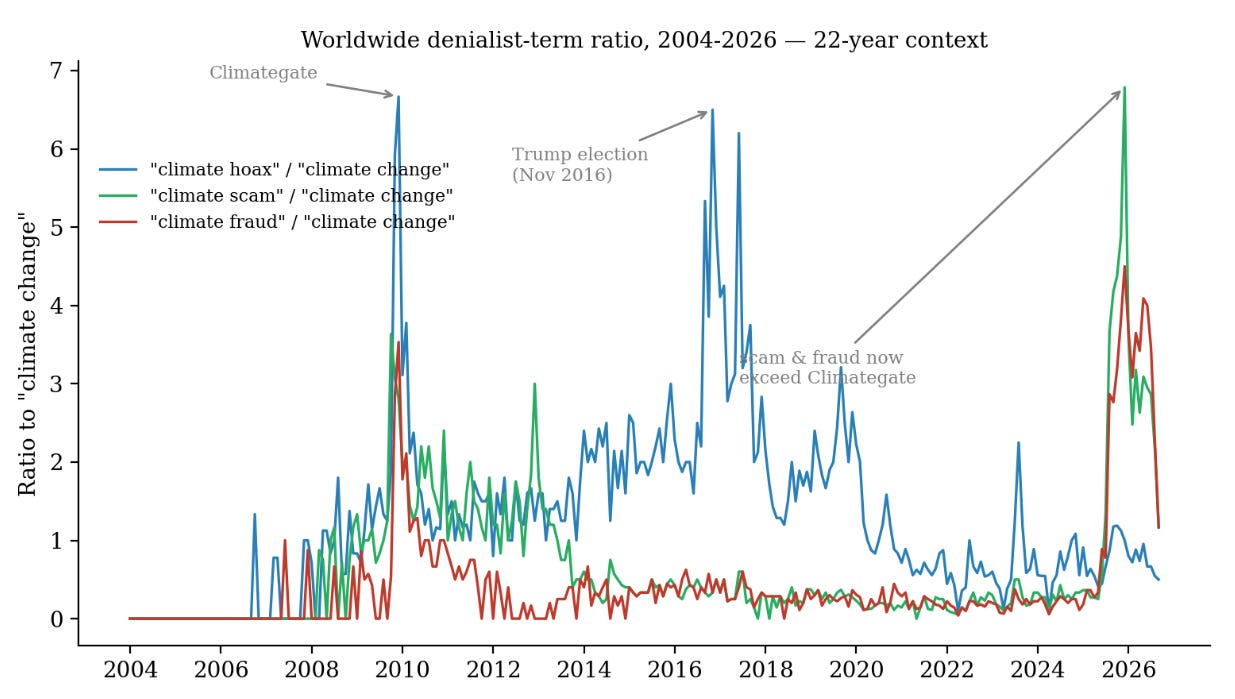
Going back twenty-two years instead of five we see more changes. Here are the global results.
Let’s also see the results for the US.
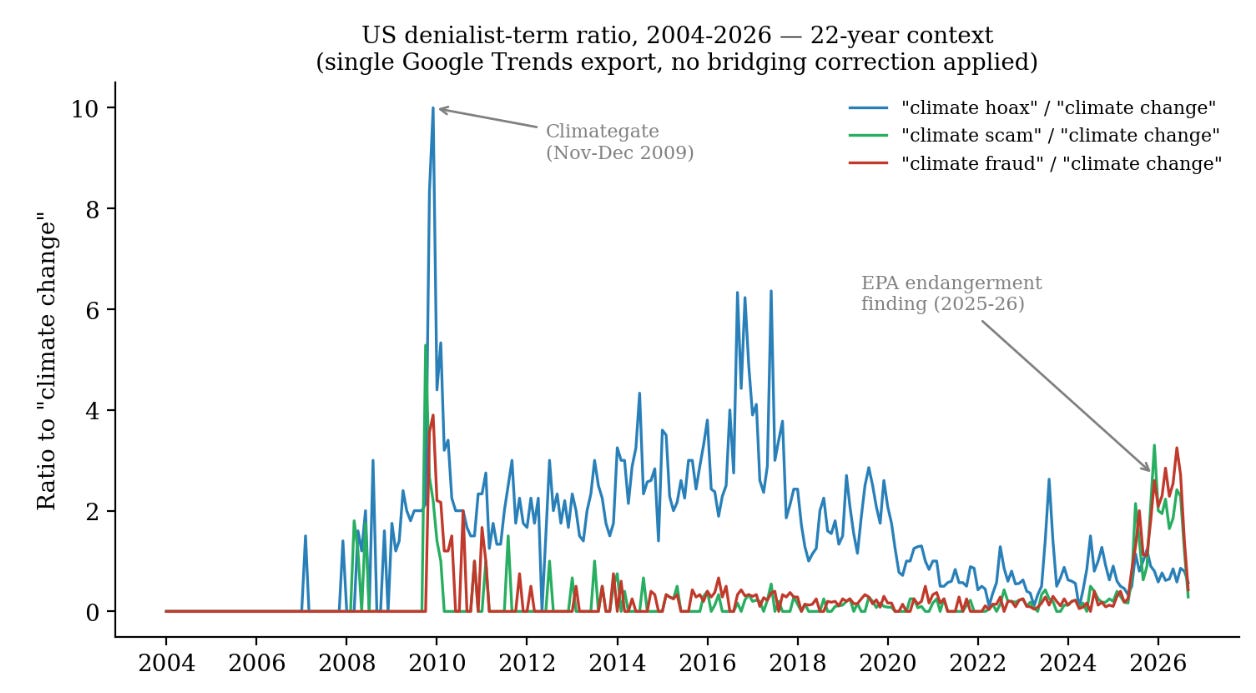
“Climate hoax” has a real, sustained peak in this dataset in November-December 2009. It was “Climategate,” a propaganda campaign that started when hacked emails from the University of East Anglia’s climate unit were used as proof of a conspiracy.
Worldwide, the hoax-to-climate-change ratio hit 6.67 that December; in the US alone it hit 10 — meaning “climate hoax” was searched ten times more than “climate change” itself, the month the scandal broke. And unlike a one-week news cycle, it didn’t fade — the ratio stayed elevated, averaging roughly 2 across the entire 2010-2020 decade, with a clear second peak (6.5) right around Trump’s election in November 2016. Only in 2021 did it finally drop to something like true quiet.
These results are similar for “hoax” and “fraud/scam,” although with some difference. Climategate was described essentially as a “hoax”, while, recently, scam and fraud have been more commonly used by skeptics in recent times. The vocabulary changed a little, but not the essence of the story.
I tried two more terms — “net zero scam” (which attacks the policy response rather than the science) and “climate alarmism” (which concedes the phenomenon is real but claims it’s exaggerated). Net zero scam gave results similar to those of climate scam and climate fraud. “Climate alarmism,” instead, produced a single, bizarre spike that dwarfs everything else in 22 years — in February 2015. It was the “Snowmageddon,” the worst single month of Boston’s winter on record, 64.8 inches of snow. It was the kind of extreme cold that reliably produces a burst of “so much for global warming” commentary. And then it vanished within a month, never to return to that level.
The results for skeptical occurrences don’t seem to be connected to real-world trends. Or, if they are, they are connected in the wrong way; see the case of Boston’s snowmageddon. If you search for terms opposite to the denialist ones, e.g., “climate crisis,” you would look in vain for traces of events such as large hurricanes, droughts, or heat waves. Here are the results for the US for the past 10 years.
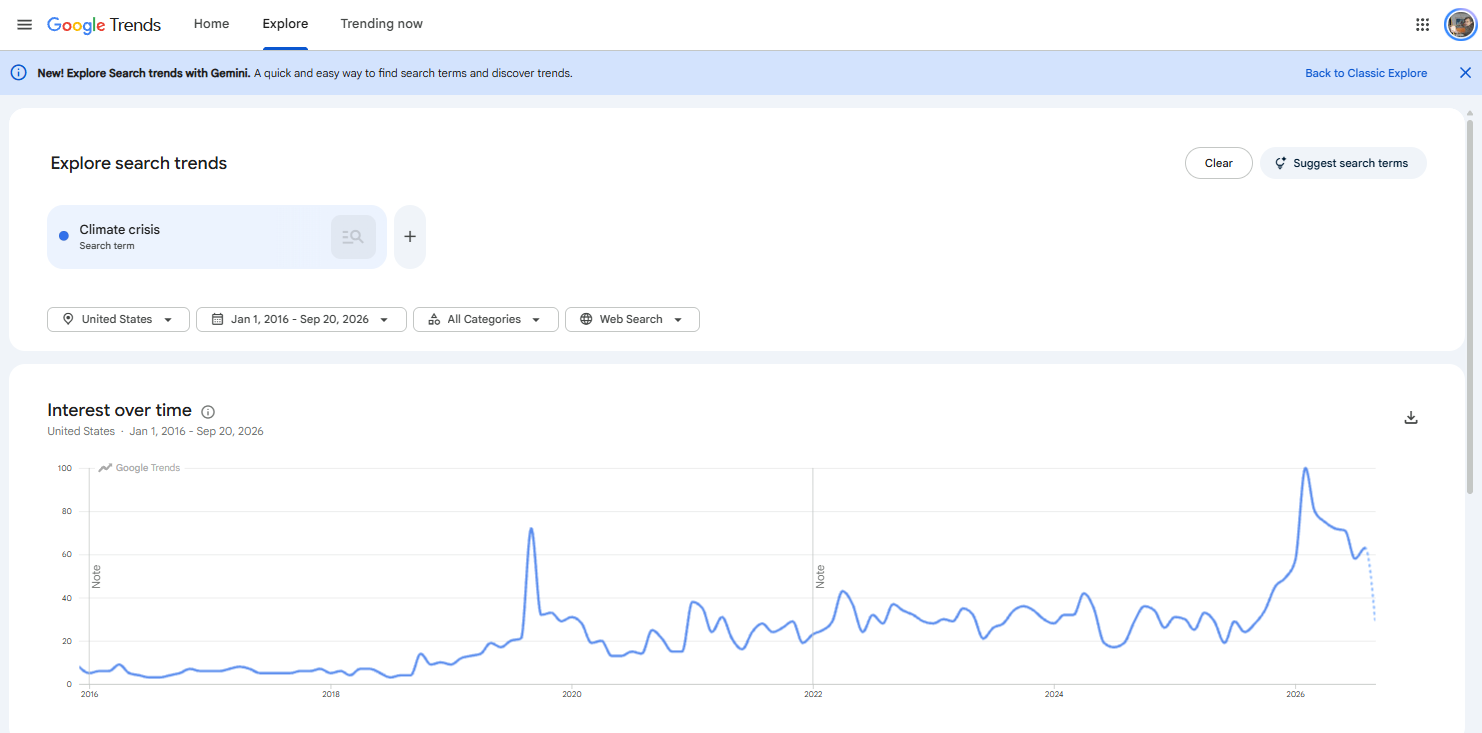
Both peaks in this graph are related to political events. The one in 2019 is connected to the “climate strikes” of that year; the recent one to the political demonization campaign we have been discussing here. Interpreting this result is left to psychologists, but it must be related to the way the human mind works.
Comparisons and conclusions.
The first thing to mention is that my results are compatible with those by Storani et al., 2025, in Scientific Reports. They measured something related: how much more engagement misinformation-linked posts get compared to reliable ones, across several platforms, from 2018 to 2022. They found a real but slow rise: estimates crept upward. Their data end three years before the spike of the past few years. If you’d asked their model to predict 2025, it would have extrapolated a gentle, continuing crawl — not a month where a word’s search volume jumps twenty-fold and remains high for a year. But so is the behavior of complex systems.
Then, these results confirm my (and Judith Curry’s) impression: climate science IS being demonized by specifically conceived and carried out political campaigns. One campaign after the other, it is perfectly possible that this field of science will be pushed outside the area of “respectable” science, as it happened to The Limits to Growth dynamics in the 1980s.
Clearly, the correspondence exists only within some limits. The people who created “The Limits to Growth” were a small band of mavericks who found themselves crushed by the powerful lobby of academic economists. Here, climate science maintains a large foothold in many universities and research centers. The attack is coming from a variegated band of people, most of them with dubious (to say the least) scientific qualifications. Yet, the propaganda techniques existing today are much more effective and refined than they were 50 years ago, so the final result remains uncertain.
There remains one point not related to data analysis. The people who conceive and carry out these campaigns: do they know what they are doing? Read Judith Curry’s post, and note how she is gloating about the political successes of her side. Yes, successes, but for the sake of whom? Perhaps those involved simply do not understand the risks they are creating for themselves, for everyone else, and for our descendants. But if they do understand them and continue nonetheless, then we must use an old and unfashionable word for their actions: evil. Here, polite euphemisms are no longer adequate.
We are navigating in a storm of memes over which humankind as a whole has no control. We are being pushed in a certain direction that might end on a secure beach, or on a sharp reef. Those (if any) who will survive the landing will know.
A more technical write-up of the methodology, with full statistics, is in progress.
If you wish to support my work with a contribution, you can do so at the “Donate Open” website. And thank you very much!
Politics and politics only is the resident evil that capture bonds the neotenous mind to the distortion. Willful ignorance in service of a political grievance is not the definition of evil.
When we accept how corrupt the liberal establishment is and how much its politically weaponized climate change, we can understand why political reactionaryism would exist. It's Not Real; it's engineered cultural programming.
Ultimately there's nothing that can be done about climate change anyway, so I don't see the structural harm in the denialist politics. The Elites are currently and proactively pulling the plug on the economic system under Trumpian war cover so that they can control its implosion as best as possible, which is also a best possible case scenario for climate change, so I don't understand your degree of antipathy towards the willfully ignorant denialists that are just cosplaying their low frequency politics like always.
Hey Thierry, I gleaned a juicy nugget from a Malcolm Nance interview yesterday. He said that there's a hill or mountain that the Saudi East-West pipeline traverses and the three pumping stations that were blanket fried (my characterization) by the Beam, presumably, we're all on the incline of the hill. Smart! Presumably they were spaced closer together than the stations on the flats. Nance has been truly dismayed that the Saudis didn't have air defenses for those three stations in particular, and especially because the drones that were supposedly used are defendable against with mere machine guns mounted to the ubiquitous Toyota trucks. And doubly dismayed by the lack of Saudi response to the catastrophic attack on their oil industry to say nothing of the US complete standing down in the face of the attack against their prize Bretton Woods 2 Treasury recycling oil protectorate. Welcome to the Non-Public Degrowth Agenda.
No need to reply.