


Stagnating Science and Disillusioned Scientists. A Personal Story.

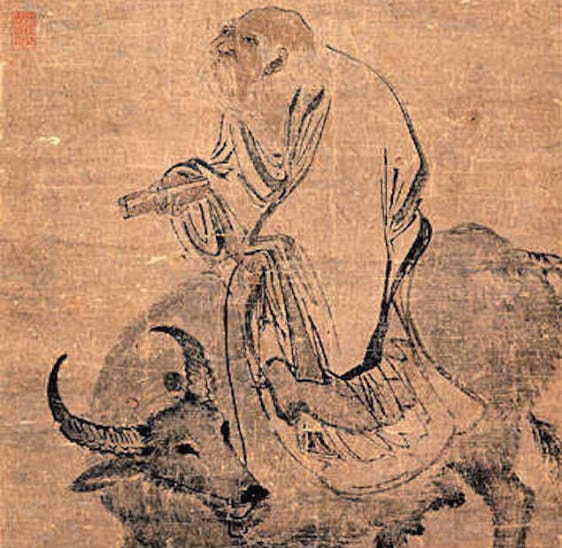
It is said that Lao Zi wrote down his “Tao Te Ching” just as an act of kindness for a border guard. He was a true philosopher, a lover of knowledge for the sake of it, and uninterested in worldly things such as money. These virtues, unfortunately, have been lost by modern scientists.
Snubbing off politely put suggestions
Seemed to be unheard of by the old man.
For he said: ‘Those who ask questions deserve answers.’
Bertolt Brecht, 1936
This post was inspired by a recent article by Tom Murphy, “Confessions of a Disillusioned Scientist,” where he tells the story of how he discovered that most science is not just useless but an evil force worsening the human situation. So much that he decided to quit. Murphy’s case is not isolated; a feeling of dismay runs through the very fabric of scientific research.
My career as a scientist parallels Tom’s experience, even though he is younger than me. I went through a similar crisis in the early 2000s, although I didn’t quit. Rather, I tried to re-orient my research toward something useful for people. I had some success at that, but I, and others who did the same thing, couldn’t reverse the general decline of science. So, let me tell you this story.
Up to the early 2000s, I was a reasonably successful scientist. I was studying high-temperature materials for gas turbines, a complicated field but also one that you can find fascinating. Close to the aerospace industry world, it was not the usual academic babbling; it was about creating real products for real industrial systems. I had a research group formed of brilliant PhD students and post-docs. I was leading projects with budgets of a few million dollars, and my life was a whirl of international meetings, conferences, reunions, audits, and the like. And I thought I was doing something good for humankind: we were working at making more efficient turbines to save energy and reduce the consumption of fossil fuels.
The first crack in this view of the world arrived for me with the attacks on the Twin Towers in New York in 2001, which told me that there was something deeply wrong with the way the world worked. Maybe a couple of years later, I had another shock when I attended a meeting in Stockholm, where we were proudly presenting the results of one of our international projects (*). We had been able to develop a material that improved the efficiency of gas turbines by about 0.5%. You may think this is not such an exciting result, but consider that gas turbines are a mature technology: they are optimized, overoptimized, and hyperoptimized. Even a slight improvement in their efficiency translates into significant financial gains. So, the 3.6 million Euros spent on the project provided a good return on the investment.
That day in Stockholm, I went looking at the panels where other researchers were presenting their results; I was struck by their narrow focus. Most of those top-level scientists were working hard to improve the already overimproved and there was no guarantee that what they were proposing was worth doing. Even our work, yes, it was a good result, but after having improved efficiency by 0.5%, what would we do? Start a new project to improve by 0.05%? Some people at the meeting were speaking about the “plane of the future” that would emit zero greenhouse gases. That would imply a few miracles; one was the even older canard of hydrogen that would require completely redesigning the world’s fleet of commercial planes. Not likely to happen soon.
That day, I experienced a minor Seneca collapse inside my mind. As a materials scientist, I was well aware of the mechanism of fracture in engineering. It starts small, then it goes through a tipping point, and it becomes a macroscopic crack that breaks the thing apart, whatever the thing is. What were we doing? What were we working for? Tom Murphy describes the sensation of running a rat race that you feel when you are involved with applying for international research grants and running them. You run, you run, you run, but you never get anywhere.
I didn’t decide to quit, as Tom Murphy did, but I gradually lost interest in a research field I felt had no future. So, I tried to re-orient my activity on sustainability and renewable energy. On this point, I was helped by the fact that even the European Union seemed to agree with me. They reduced their support for research on gas turbines, a task that was by now akin to studying how planes could be powered by hamsters running inside a wheel. I was also helped by being employed by a 2nd rate institution, the University of Florence. Not a bad university, but nothing like the superstar places such as Berkeley or Cambridge. Being stuck in the suburbs of science makes many things more difficult, such as gaining a foothold in the international old-boy networks that manage research financing. But it also allows more freedom, and you can change your research area without receiving too much flak because of the lost revenues for your institution.
In some years of work, I reconfigured my research group to work on sustainability, I attracted a few bright young scientists, and I obtained a few international and local grants andI gained some international renown in the field of system modeling. At this point, our President made me the managing director of sustainability for the whole University. It was an honor, no doubt, but overall, I soon found it was something like being named supervisor to the royal stables of the Celestial Empire. High-sounding, but not very useful.
Universities are bureaucratic structures whose only purpose is to perpetuate themselves (they are typical social holobionts). I happened to become director of sustainability in a moment of crunch in financing. The result was that everyone was desperately trying to stay afloat; there was no money left for flights of fancy. Most of our students seemed to see the university as akin to a session with the dentist. Something painful they had to go through, but the faster, the better. They liked the idea of sustainability, but they had no time for it.
Those years saw a rapid ossification of scientific research, a process that’s still ongoing. We are now in a moment in which it has become nearly impossible to get financing for any research that’s even remotely original or innovative. Then, the screening process of publication is managed by the old aunts of science: the reviewers working for scientific journals. They are engaged in a baroque process of verification that verifies nothing and only ensures that science does not progress anymore.
The coup de grace to the whole mess arrived with the COVID pandemic in 2020. Until then, the university had been a relatively friendly place, open to everyone, and where the door of my office was always open. After the COVID, our department became something akin to Macbeth’s Castle. A scary place where you couldn’t do anything, go anywhere, or see anyone without written permission from the department director. Even the lady at the reception, earlier on friendly and smiling, turned herself into a sort of kapo of Hitlerian memory, ready to insult and abuse you if you weren’t wearing your face mask the proper way.
And so I decided to quit. Not that it was a heroic decision. In Italy, we have mandatory retirement rules, so I just anticipated the unavoidable. In a sense, I have to be grateful to the tiny creature called SARS-Cov2 because the disaster it created made me hate my university enough that it was not a shock for me to leave. I am now happy, relaxed, and active. I keep writing scientific papers and books on the subjects I choose, the way I want.
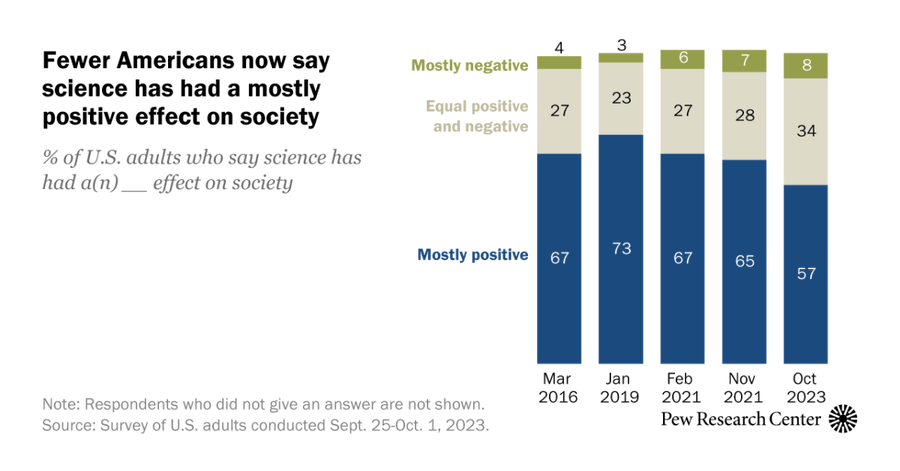
But the problems remain. Science has taken such a beating from the COVID story that it may never recover. I am continuously encountering people on social media who are completely convinced that all scientists are scammers working for big oil, big pharma, big defense, or the Lizard People from Aldebaran. And because of this, anything that a scientist says is false by definition. Unfortunately, these people are not completely wrong. It is not just ossification that plagues science nowadays; it is also plain, old corruption. The data below are for Nov 2023, from the Pew Research Center. People may not know the details of what’s going on in science, but they understand that something is badly wrong with it.
But it is even worse than that: even assuming that all scientists were competent and honest, what is science for, exactly? Tom Murphy describes the situation in these terms: “Our society approves of these institutions and rewards its practitioners, in part based on the misguided notion that this is where solutions to our problems will originate. Instead, science/technology is far more likely to produce the seed corn for another generation of ecological destruction.” And he is basically correct: science doesn’t have a “soul.” Without a soul, it is little more than a zombie that walks clumsily onward in search of brains to devour. Mostly, it is the brains of students and young researchers, but we all risk being devoured by the reckless attitude of scientists. Most of them seem to stop at nothing while trying to gain prestige and money from whatever they can sell to the public as a solution to the problems that they themselves created not long before.
I still think that, eventually, the zombies will not prevail and that the entity we call “science” will find its purpose again by returning to its origins when it was called philosophy. It means “love for knowledge,” and we could still recover this view. But it will take a long time and probably science will have to go through collapse before it can rebound and return in a new form. It is typical of complex systems. It is the way the universe renovates itself. And if the entire universe does that, it must be because it works well!
_______________________________________________________________
(*) The project I describe here was called ABRANEW. It was supported by the European Union, and ran from 2002 to 2007. You can find plenty of material about it on the Web.
See also:
How to leave your university and be perfectly happy.
_____________________________________________________________
From Tom Murphy’s “Do the Math” blog.
Confessions of a Disillusioned Scientist
Posted on 2023-12-05
By Tom Murphy
After a rocket ride through science, I am hanging up the gloves, feeling a little ashamed and embarrassed to have devoted so much of my life to what I now see as a misguided cause that has done more harm than good in this world.
The previous post details my views about the limits of science. In this post, I will focus more on my own reaction as a human participant in the enterprise.
As is so often the case, my trajectory, in hindsight, looks straightforward and linear. Halley’s comet introduced me to the sky in 1985–1986 at age 15–16, quickly leading to my building a 10-inch Newtonian telescope on a German equatorial mount (using plumbing parts from my plumber neighbor). Through this telescope, I saw all nine planets in one night (when there were nine), an individual star (supernova) 36 million light years away, and a quasar 2 billion light years away. I was a physics major at Georgia Tech and spent every other quarter at the Naval Research Lab working on optical communications for space. I had my pick of graduate schools, and chose Caltech for its idyllic setting, its relaxed, collaborative atmosphere, and access to “big glass.” Within a few months of starting, I had gone on observing runs to the venerable Palomar 200-inch telescope and the Caltech Submillimeter Observatory on Mauna Kea. What a dream I was living! Meanwhile, I enjoyed many outdoor adventures with fellow grad students, some of whom have become life-long friends.
I did not expect to stay in academia (the statistics were not encouraging to a middling student), and interviewed at a few “industry” jobs while also dipping a toe into “prize” postdoc fellowships and create-your-own postdoc adventures. I picked one from the “adventure” bucket, to start a lunar laser ranging project as a test of general relativity at the University of Washington. Abandoning my graduate expertise in infrared astronomical instrumentation was risky, but I saw this postdoc as a last hurrah in academia, deciding that I might as well have fun. I loved the people I worked with, and savored my time in Seattle. Unintentionally, this gutsy move looked very attractive to faculty search committees, two of which tracked me down based on the reputation of my graduate work and then put me on their short lists after learning of my new direction. One of these led to a tenure-track job at UCSD starting in 2003, where I kept the pedal to the metal on the lunar ranging project. During a 20 year career there, I was never turned down for funding my project, hit all the usual promotion steps at the expected times (tenure then full professor), and felt that I had “made it” by all traditional measures. Having written and reviewed a large number of peer-reviewed papers and served as panel reviewer for NASA and the NSF for far more proposals than I ever wrote, I knew the “game” quite well. I had a versatile set of powerful tools that I could bring to bear on what seemed like almost any problem. Science was, in some ways, the essence of my being, and I found plenty of reward in it—both intrinsically and societally.
So, what happened?
A Gradual Exit
My path away from science involved a number of key elements.
I became aware that some of the pillars on which modern life is based were necessarily temporary. Growth on a finite planet would have to stop—both in physical terms like energy, but also in economic terms.
Fossil fuels, upon which we are utterly dependent, would soon taper off, being a finite resource.
Fertilizer and agriculture critically depend on fossil fuels, so human population could experience a large correction later this century.
The Limits to Growth work from 1972—which I found to be insightful and credible—reinforced the plausibility of a mid-century major “adjustment.”
The turbulence of a transition this momentous could be so disruptive (resource wars, economies in ruins) that all my work testing general relativity might be lost and rendered meaningless (as well as all the things my colleagues work on).
Renewable technologies are not as easy as they sound: fossil fuels do things that the electricity from renewables has a hard time replicating, and the materials demands ramp-up extraction and its associated ills.
Biodiversity loss (extinctions, tragic population declines) spell an ultimate dire fate if we do not heed the warnings: we are obviously now powerful enough to destroy large swaths of the ecosphere and community of life.
Technology is what created the predicament, and constitutes an inappropriate response, as we will never master all knowledge and will inevitably create unintended consequences.
An energy substitute for fossil fuels is the last thing we need, as energy is what powers our expanding terminal encroachment on the living world.
Science is a narrow tool: powerful and tenacious like a pit bull, but having no intrinsic wisdom or context. It concerns itself with what we can do, not what we should do.
I now think a significant portion of my adult life has been mis-spent. Scientific institutions (and university STEM departments) are, to me, a sort of day camp for smart people. Our society approves of these institutions and rewards its practitioners, in part based on the misguided notion that this is where solutions to our problems will originate. Instead, science/technology is far more likely to produce the seed corn for another generation of ecological destruction.
For one thing, most people are working on efforts that either do not relate at all to our pressing concerns, or when they are, it tends to be more of a doubling-down on the kinds of hair-brained things that got us into this predicament in the first place.
Even so, almost nothing substantive happens. More papers get published each year, lots of press releases go out, and TED talks get made. These things are great for cluttering the front of the refrigerator, like purple horses in fingerpaint. Yet in my 20 years in academia, the halls never rang with triumph of a new major breakthrough. Okay, some people in my institution were part of the cast of thousands working to find the Higgs boson, which was completely expected and did nothing to rattle the cage—leaving an aftertaste of disappointment. The other big news during my astrophysics career was the first observation of gravitational waves from black hole mergers. The main surprise here was in the size of the black holes. But the merger sequence followed general relativity expectations perfectly: no seismic change to our understanding of the universe. It seems like a lot of (expensive) bustle for little gain, and what gains we do see often translate to a net loss to the community of life—so maybe I should not complain about the lack of furious progress.
Writing and reviewing countless grant proposals for many millions of dollars taught me that each (successful) proposal is a well-crafted fiction. I’m not saying that scientists are charlatans, but that the budgets, timelines, and promises are incommensurate with actual results. To some extent, this is okay: science is an exploration into the unknown, and it is silly to pretend that anyone can predict exactly the three year course a funded effort will take. But I know full well from my own grant history that the projected accomplishments were aspirational, and seldom are fully achieved. This is normal, and expected.
As I drifted away from a belief in science as the ultimate practice, I had a hard time seeing how I would continue to satisfy the expectations of my department and university. At the highest levels of academic review on campus, what matters is impact, and I felt I could probably manage to maintain some measure of impact in connection with concerns over planetary limits. But few of my departmental colleagues would understand the value of something so far from standard physics research, and most of the courses I taught would seem empty, or worse: propagating tools that appear to do more harm than good.
In short, I came to realize I was one of the bad guys. I like the saying that everyone is the hero of their own story. Part of me would certainly like to believe so, but no—I’m still a villain, if unwittingly so. The projects I worked on demanded copious energy, resources, and travel far out of line with care for the natural world. The result in no way helped the more-than-human world. I can say the same about virtually all science. It’s extremely focused on short-term, narrow-boundary benefits for humans at the ultimately-unaffordable expense of ecological health. I lament our society’s squandering of talent that presently pushes on the very things that make our situation more precarious.
I now find myself to be in an odd position: possessing well-honed skills in reductive, logical, quantitative analysis while recognizing the narrowness of those mental modes. I can “robot” with the best of them, but no longer see the appeal of always thinking like a bot, even though this form of thinking is revered in scientific circles. As one indicator, blog posts of mine that crunch the numbers—robot style—tend to get a lot more attention than ones that say to forget the numbers and take in the wider picture.
What’s It All For?
As a scientist at a university, I found myself asking: what is it we’re doing, here? Once we look past the self-important huffiness so common among my cohort, is science helping or hurting US? By US, I mean the entire community of life. We are nothing without the collective WE. Clever scientists might be able to spin a tale of how one day in the future their work might benefit the more-than-human world. But set against the harms we know come from the work today, the more likely case is more of the same: terminal damage.
I suppose an item I could append to the above list of factors contributing to my exit (thus dialing it up to eleven) is: Science, as it is practiced in our society, is a nearly perfect expression of human supremacy. It’s all for us (humans); it’s all about us. Most science is, therefore, in service to the Human Reich. I’m tired of being associated with that team.
Science is a fantastic tool: nothing better for ferreting out some kernel of truth in a narrow context. I would not want to see us abandon that capability. However, I would want to see science in service of improving—not destroying—the community of life: the more-than-human world. Unless we start prioritizing the whole, failure is practically baked in, given our tremendous capabilities at perpetrating harm.
Imagine what would happen if the National Science Foundation (NSF) were headed by people who have spent a lifetime embracing and practicing Indigenous ways and wisdoms. They could oversee scientific efforts to supplement our understanding of this complex world as one important and reliable input, but always with an eye to the guiding question: is this research likely to be a net help to the community of life, or a net harm? If in doubt, then maybe: don’t. Efforts aimed just at human concerns seldom do us any long-term favors, as the associated collateral damage to the ecosphere takes our living collective backwards.
Under such a scheme, science would assume a subservient role, and likely would be much smaller in scope. The squirrels and newts would applaud our efforts.
As I find myself more on the outside of “team science” these days (I would like to be accepted on “team life,” despite a steady record of crushing losses), I am reminded of a moving song by Dar Williams called The Great Unknown. I recommend listening to it or looking over the lyrics. It’s not a perfect fit, but it hits on some key themes.
Hits: 3964
Congrats Ugo! (btw Tom Murphy is still a great resource.)
Resisted for years calling myself a 'real scientist', but have to own up to doing some applied science years ago in UK ‘govt. science’. Early on I was keen on the public service ethos and the concept of science as an 'open' collaborative human endeavour; part of a wider requirement for an 'educated mind'. OK, Britain was not adjusted to losing the Empire, and I was acquainted with 'University politics' and our similar departmental stuff, and inevitable human failings, but self-respect and respect for others could at least co-exist with these aspects of the institutional environment. For example, I was lucky enough to have a short visitor spell in Canada in the very early days of mol. biol. when there was a brief call for a moratorium in order to consider the risks of genetic engineering. I was not in the race, but learned a lot from high-morale people. Can’t help feeling it had to do with the petroleum trajectory, but by 1981 science making financial profit became the big deal, and in the UK severely cut down the worth of public service science, even in areas that had been considered 'strategic'. It came in explicitly with Thatcher. The 1980s in the UK was a time of lamentable failures in 'Risk Assessment'. I came to realise few scientists could do risk analysis / assessment, and of those who could, even fewer, if any, could deal with the machine wherein they were cogs.
A case can be made for the intellectual poverty of science conducted without explicitly understanding the limits imposed by context and social environment. I have got round to reading an attractive and systematic expert approach to modelling 'realities', i.e. thinking about thinking; Erica Thompson’s ‘Escape from Model Land’, recently in ppbk. Ihttps://twitter.com/H4wkm0th
The West has devolved into a money worshipping cult, with few inhibitions on how we get it...The President of Stanford, a famous Alzheimers researcher, was forced to resign when it became clear that his research was fraudulent, and he rewarded researchers under him for producing the right fraudulent results...In the words of one researcher, this guy set back Alzheimers research 10 years...It's everywhere...
On another note, we spent a number of days in Florence a few years ago, and absolutely loved the city and the surrounding farmland...I would often have lunch in a little outdoor cafe where students and professors would gather in the afternoon...beautiful!