

Population Collapse: Approaching the Turning Point
It is not a question of food production. It is a question of food supply

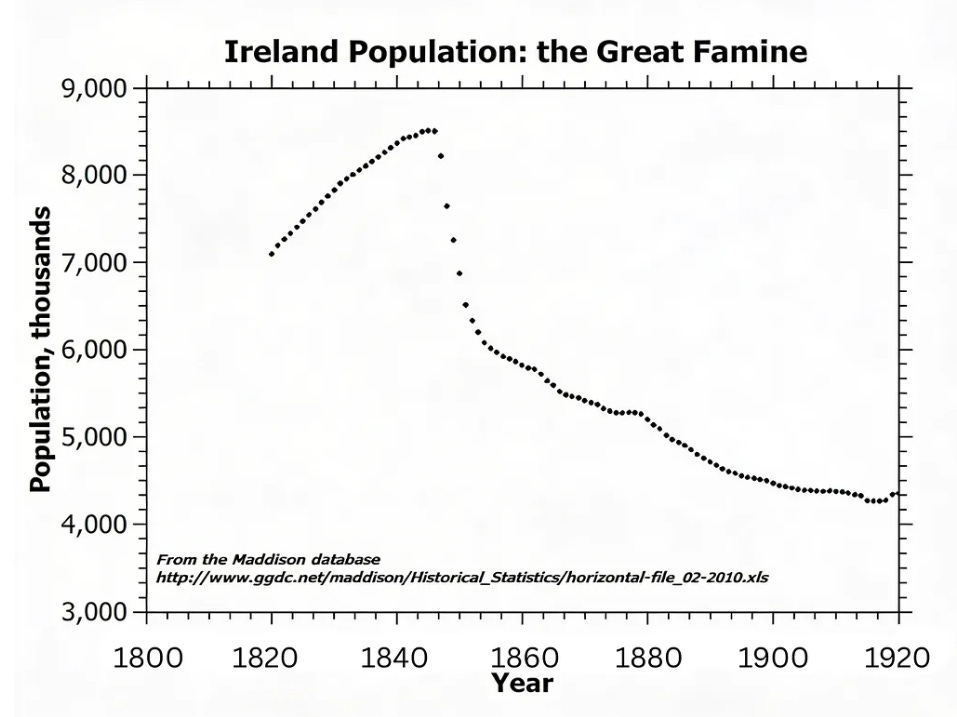
The collapse of the Irish population during the Great Famine of the mid-19th century remains one of the clearest examples of a “Seneca Cliff” in population dynamics. The Irish starved while there was plenty of food available in the world market, but they couldn’t bring it to their small island. It was a failure of supply, not of production. Is this the destiny of the larger island we call “Planet Earth”?
Today, it seems to most of us that famines are events of the past, nothing we should be worried about. Don’t we have those wonderful, high-yield genetically modified crops? And what about precision agriculture and precision fermentation? Wouldn’t those technological marvels keep famine away forever and ever?
And yet, we can’t brush this matter away. A point that I make in my book “The End of Population Growth” is that famines are not the result of problems with food production. The real issue is food supply. Paraphrasing Adam Smith: “It is not because of the benevolence of the farmer that you have food on your plate every day.” The farmer, and all the middlemen in between you and him, must be paid. No money, no food.

It is what happened to the Irish with the Great Famine of 1848. The failure of the potato crops in Ireland was the proximate cause of the disaster. But that didn’t mean that the Irish were condemned to starve to death. Many countries suffered from the potato failure, but none experienced such a terrible famine. There was enough food in the world’s market to replace the lost potato crops, but the Irish didn’t have the money to buy it. No money, no food.
It was not a destiny: it was a choice. The British government chose to let the Irish starve. The decision was not taken by an evil dictator prone to bouts of satanic laughter. It was the result of collective blindness and indifference, enhanced by ideological beliefs that saw markets as always self-correcting and heading for perfection. The kind of evil that’s most pervasive and most difficult to fight.
Now, how about our times? For many countries, the situation is not so different from that of Ireland in the mid-19th century: the domestic food production is not sufficient to feed theirpopulation. But, as long as these countries have dollars to buy food in the world’s market, the economic system will keep shipping food to them. Westerners have plenty of food in the aisles of their supermarkets, and even poor countries can have a trickle of food, nothing lavish, but at least something.
What we are seeing nowadays, though, is the breakdown of the global economic system. International treaties are becoming worth less than the paper they are written on. International law is becoming neither international nor a law, and military solutions are becoming the only kind of solutions to problems. The closing of the Strait of Hormuz is creating the kind of situation that may lead to a food supply breakdown. It is not a direct problem with food production, but the global economy needs oil to function, and plenty of oil is transported through the Strait of Hormuz. A serious economic crisis, or even a collapse, would lead to a food supply collapse.
In such a situation, it doesn’t matter what wonderful technologies can increase crop yield; the food won’t arrive on people’s plates. Things may get worse if governments will not just let people starve, but will actually use starvation as a strategic weapon. Iran was already threatened with starvation by Mike Pompeo in 2018; now, the fears of starvation for the Iranian people are growing. And it doesn’t seem that the current US government is more constrained by moral considerations than the British government was in the 1850s. The recent events show us that things that looked impossible not long ago are becoming perfectly possible, even unavoidable.
I know that it is easy to call wolf too early, Paul Ehrlich did exactly that with his book The Population Bomb in 1968. He was qualitatively correct, but his timing was wrong. When you deal with complex systems, prophecies of doom almost always fail. You cannot predict when something that must happen will happen. But you can be sure that when it happens, it will happen fast. So, in my book, one full chapter is dedicated to a quantitative evaluation of which countries could be most affected by a crunch in the world’s food supply.
The question of food supply risk is not easy to answer because most of the data dealing with food import/export use monetary or weight units, but do not consider the calorie content. For instance, you could think that Italy has an excess of food production because it exports wine and other expensive agricultural products, which generate a positive trade balance. But, of course, not even Marie Antoinette would have said that if the people don’t have bread, they can drink Chianti wine (BTW, she never said anything about eating cake in place of bread).
Just to give you an example of how things stand, according to FAOSTAT, Iran imports food for about 2,200 kcal/day/person for 86 million people. Considering that a person needs about 2500 kcal/day to live, it would seem that Iranians are almost 100% dependent on imports for their food. But most of the imported calories go into animal feed, so that the actual calorie deficit for Iranians is about 400-600 kcal/person day. It is enough, anyway, to create a serious food crisis if imports were to disappear because of a blockade, sanctions, or infrastructure damage caused by war.
About other countries, you can find details in my book. In short, Brazil, Russia, and the US are those in the best conditions: they produce fuels, they have a functioning agriculture, and large areas that may not be so badly hit by climate change. Conversely, some countries have fertile land, but they must import fuel, such as India and China. The worst situation is for countries affected by droughts and whose land is mostly arid. Iran and Saudi Arabia are at the bottom of the list, but even most EU countries do not do well. They all suffer from soil degradation, desertification, lack of water, and extensive cementification. And they do not produce much in terms of fossil fuels, either.
The problem is general. All countries that are food importers are at risk. A worldwide economic collapse would be Ireland’s famine at the global scale.
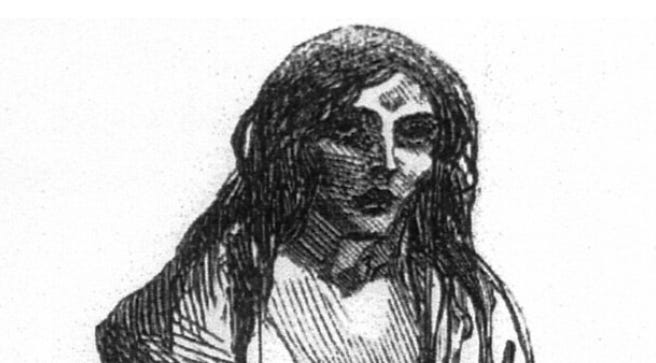
The face of the Irish Famine. Bridget O’Donnell, one of the victims.
Note added after publication (h/t Mark Kelly and Theodore Rethers ). What if the British HAD helped the Irish and avoided Ireland’s population collapse? It is an exercise of historical fiction, but I think something can be reasonably guessed from a comparison with the population trajectory of other countries. Basically, not having lost 3-4 million people in a few years, Ireland would have followed the same logistic trajectory that other countries followed, going through the demographic transition probably in the early 20th century. The population would have started going down and today Ireland would probably have the same population it has in the real world. Just an educated (maybe) guess.
You do not add to your discussion that Ireland had the fastest growing population in the world due to the introduction of modern market economies. In the preceding 50 years the population doubled from 4 to 8 million and many were forced to farm land not suitable for the production of their core crop. One then could argue that this was the main reason the famine effected this area the hardest. This sort of population growth was not seen in the rest of the world until the advent of modern fertilizers which made all areas more productive.
My understanding of the Potato-Blight Famine in Ireland is that English landowners had Irish workers growing wheat to feed the English armies, and that the Queen was advised that this natural order should not be changed by feeding the wheat to the starving Irish, whose own potatoes were dying from the disease.