

Population Collapse: Can It Be Avoided?
Understanding something is the first step to avoid it

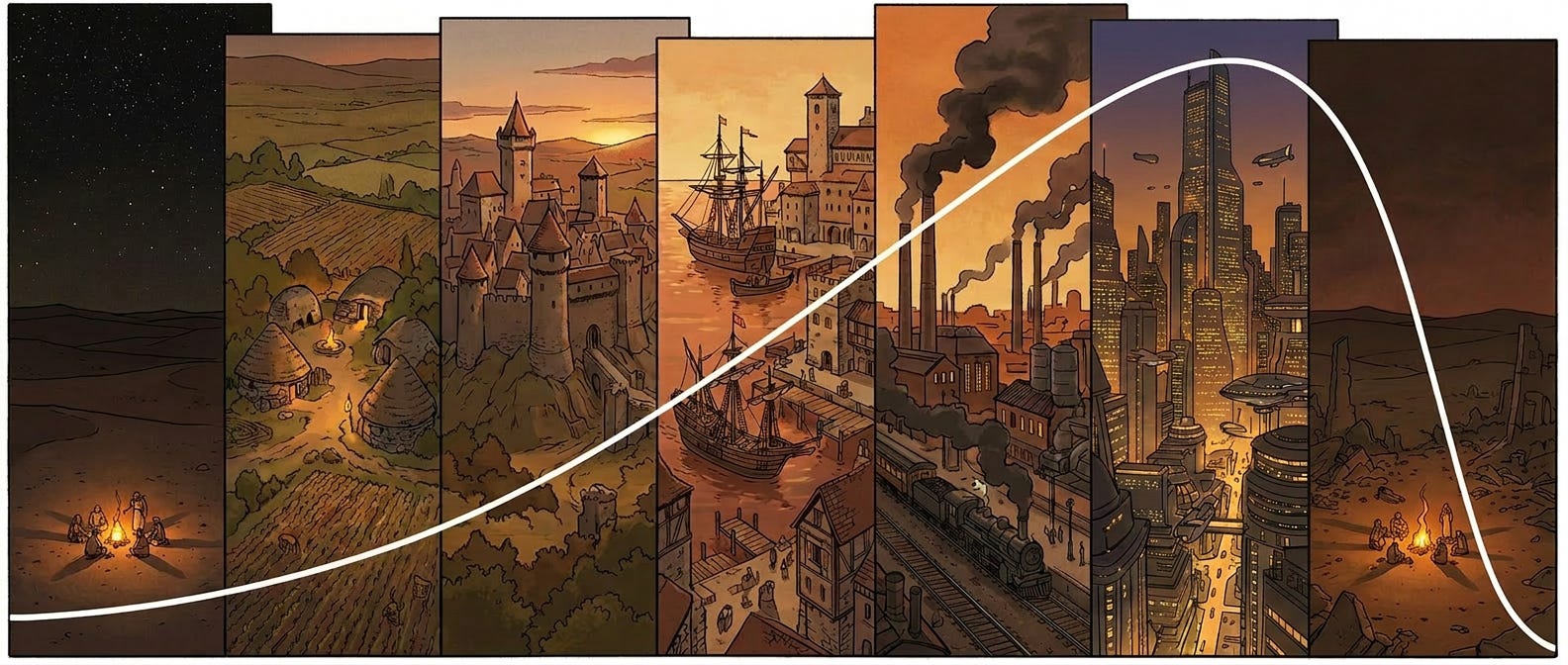
A qualitative interpretation of the trajectory of the human population on Earth. Many people, especially those who read the “Seneca Effect” blog, will feel that it is in agreement with the way they see the future. We are already too many, and a true collapse in the near future looks likely, if not unavoidable. But how? And when, exactly? And is it a disaster or an opportunity? This is a text version of the talk I will give on June 3rd in Belgrade for the presentation of the new report to the Club of Rome, The End of Population Growth, jointly organized by the Club and the World Academy of Arts and Science (WAAS)
The Seneca Effect is a reader-supported blog. It is, and will remain, free access, but if you like what you read here, you may consider becoming a paid supporter.
The idea that there are too many people on this planet and that this is leading us to collapse is relatively new in history, making inroads in the collective consciousness.
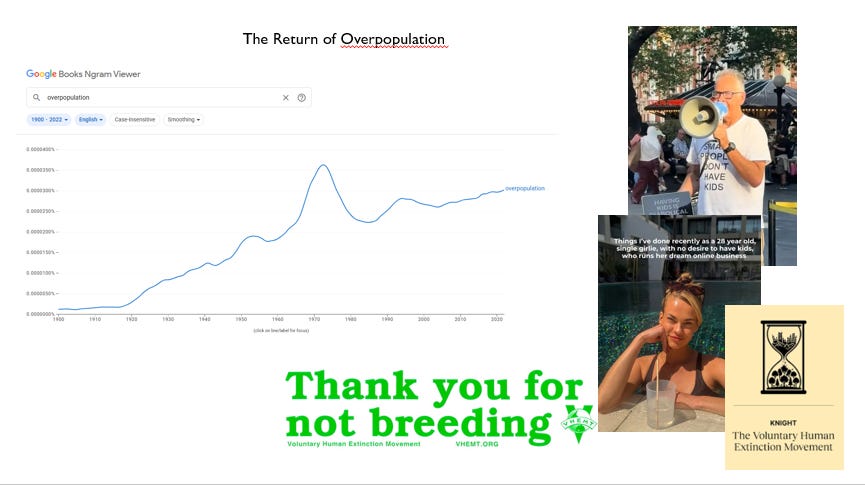
As you see from the Google Ngram data, worries about overpopulation peaked in the 1970s, then the concept went out of fashion. Now it is growing again. With it, there are appearing groups inviting people not to have children, praising childless couples, and preaching “voluntary human extinction.” Of course, not everybody agrees with this view, and the opposite attitude is also emerging: inviting women to have more children. Governments all over the world are supporting large families again.
But what is overpopulation exactly? How do we know that such a thing exists? Mostly, it is an intuition. The world “feels” crowded. The sheer number of human beings, more than 8 billion of them, is impressive, and the crowding of some areas is impossible to miss.
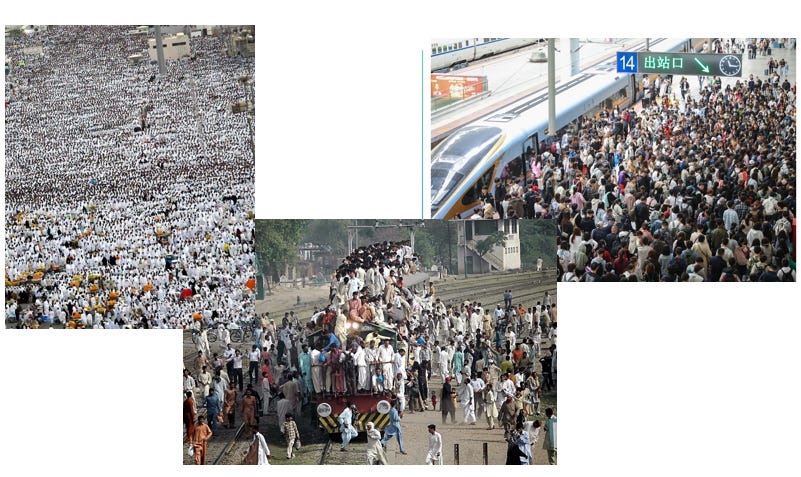
But, apart from impressive images, how do we define the concept of “too many people”? It depends on many factors, but I think some data are especially impressive. The encroachment of humankind into the space previously occupied by other mammals is one.
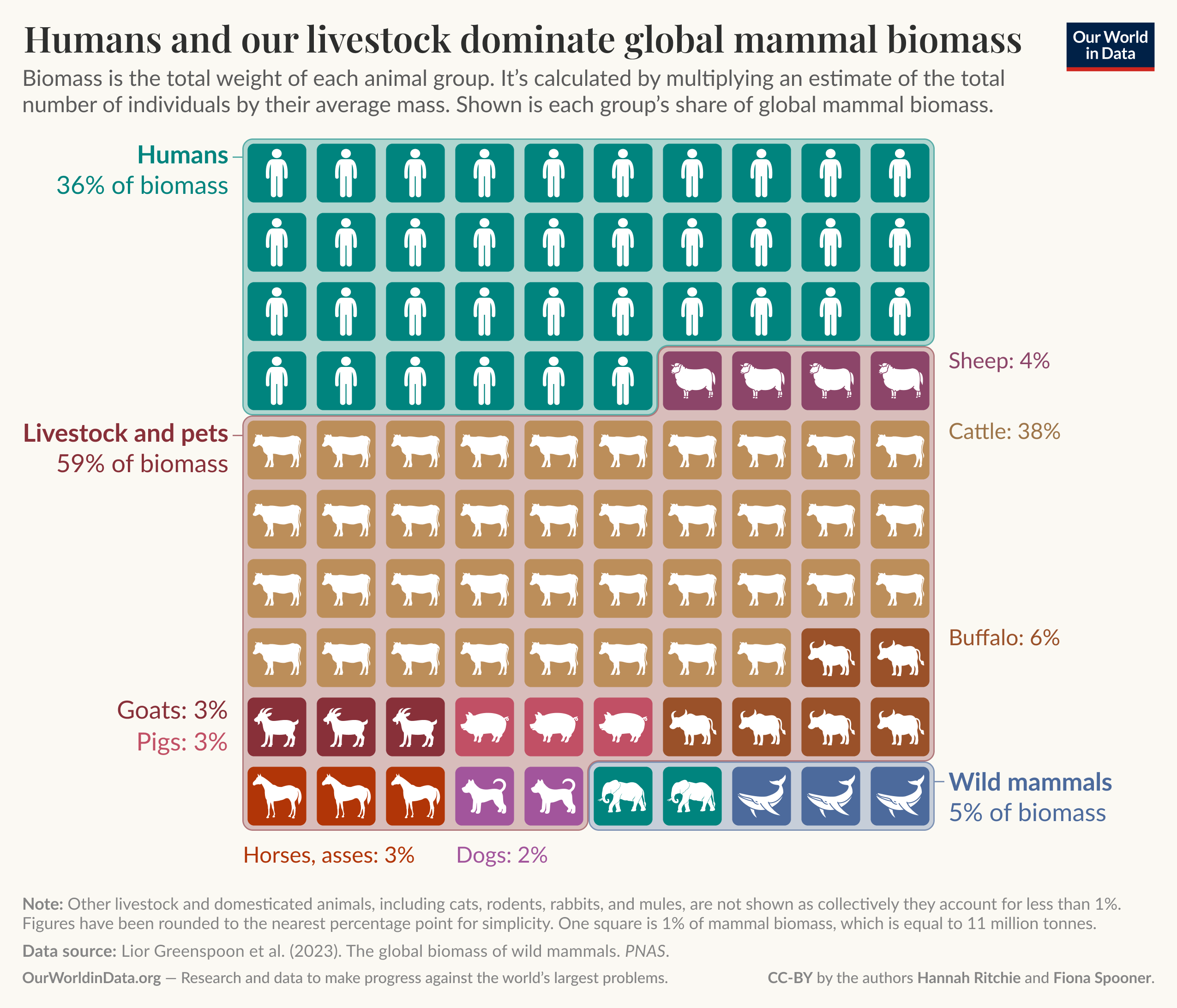
You can’t avoid being impressed when you discover that 95% of the world’s mammal biomass is either human or exists only because humans keep it alive. That doesn’t feel normal, especially considering that in the remote past the mass of humankind was negligible.
Interestingly, this gigantic increase in the human/domesticated biomass didn’t correspond to an equivalent decline in that of other mammals.
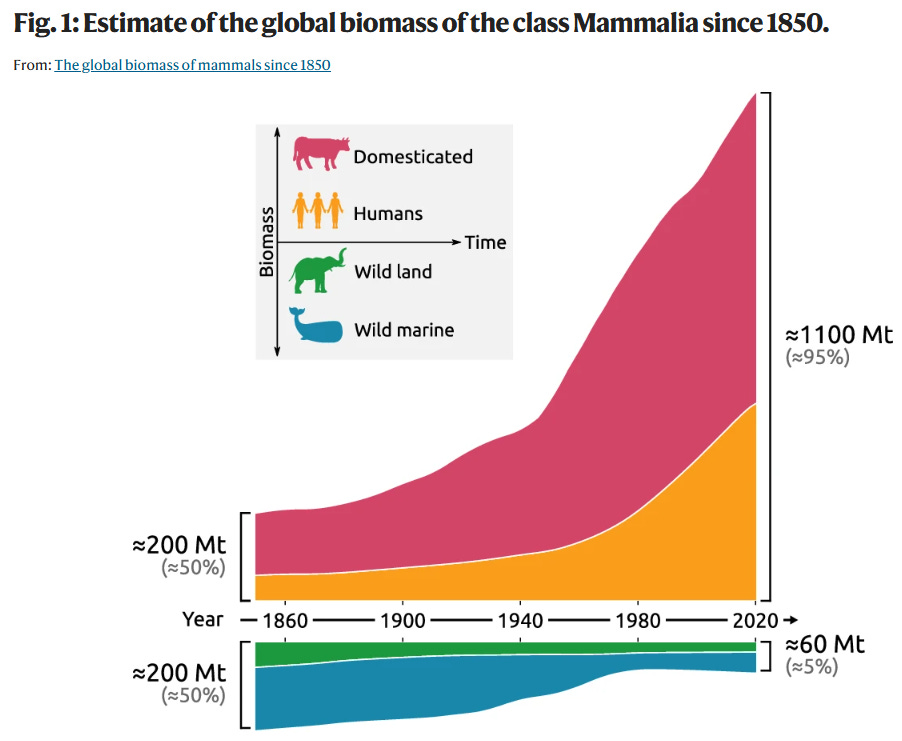
Greenspoon et al. Nature Communications, 16(1), 8338.
See also this image by Vaclav Smil.
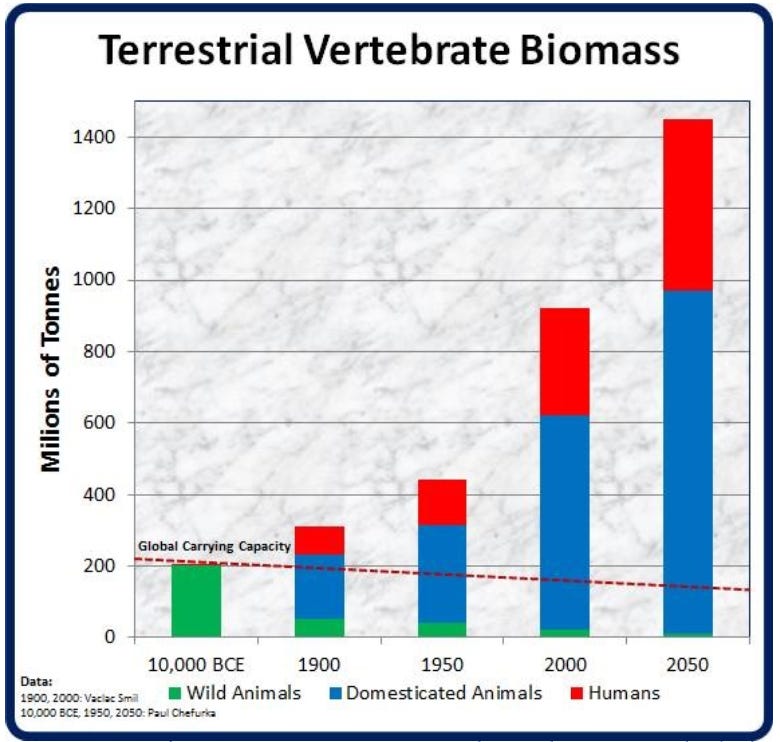
So, humans have managed to increase the total mass of mammals onthe planet. But note how the “Global carrying capacity” is decreasing. The numbers are uncertain, but it is clear that humans have reduced Earth’s carrying capability of the planet, mainly by deforestation.

There are other indications that Earth’s ecosystem is under stress. Let me show you some data about how humans are affecting climate.
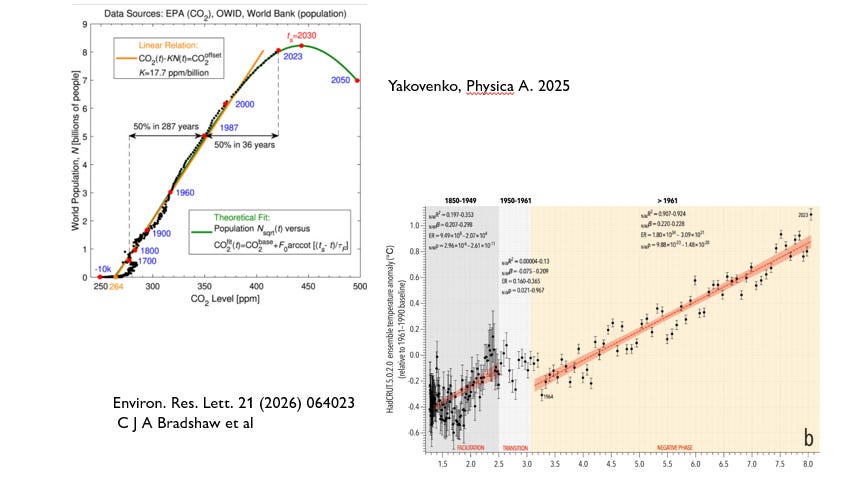
Here, you see how the human population is linearly related to the concentration of carbon dioxide in the atmosphere and to the temperature increase observed during the past century or so. CO2 is not the cause of the growing human population; rather, the reverse is most likely true. Humans are warming the planet.
Why is it happening? We can look at the situation in view of the theory of ecosystem development proposed by Eugene Odum in 1969. Here it is, in a simplified version. (Odum proposes that the ecosystem will reach homeostasis through damped oscillations, but it is a detail.)
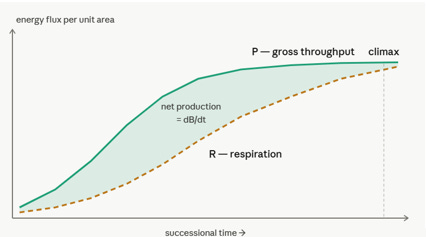
An ecosystem surviving on renewable resources evolves as a thermodynamic dissipating structure that reaches a condition of homeostasis. You see how it expands (P, the productivity, increases), but the expansion is checked by the limited resources (R, termed “respiration” by Odum). Both variables are flows, not stocks. The system accumulates stock as the difference between P and R. Eventually, the system doesn’t accumulate anything any longer; it just stays in a stable situation. That implies, however, that the energy source is renewable.
Now, let’s see Odum’s model reworked for a case in which the energy resource is finite and non-renewable.
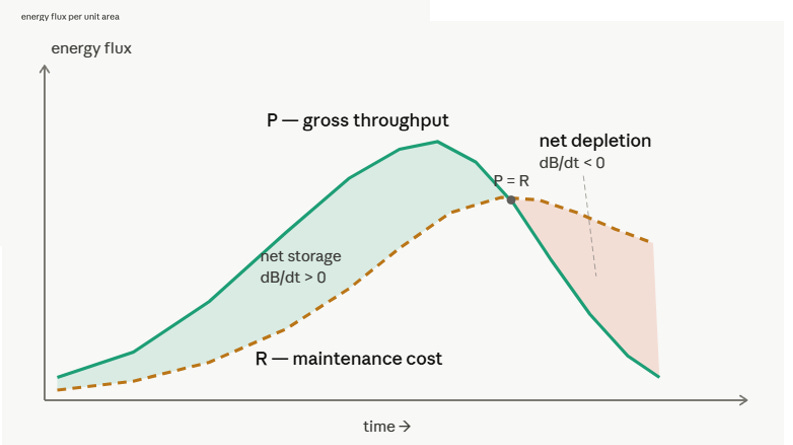
You can see curves that you may recognize as Hubbert-style, or Seneca-style. The system consumes the resource, accumulating it at the beginning, and then dissipating it. It reaches a maximum and then declines. And this is what’s happening to the fossil ecosystem that humans are dominating, so far. With their gradual depletion, we are carrying over a burden that cannot be satisfied any longer, and that’s damaging the whole ecosystem.
These are qualitative considerations, although based on thermodynamics. The point is to make them consistent with reality, that is, comparing the theory with the available historical data. So, let’s see how fast the human population is growing.
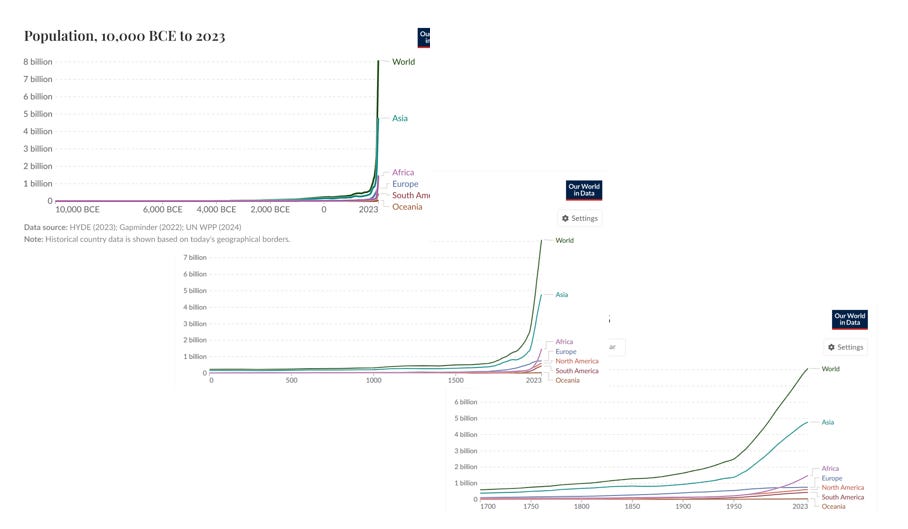
You see that the human population has been rapidly growing during the past few millennia, then it exploded during the past 2-3 centuries. Today, the growth rate has abated a little, but it is still positive. Does that indicate that we are reaching the peak predicted by Odum’s theory? Probably yes, but to understand when, we need to understand what generates these curves. Some physicists have recently discovered this phenomenon, and the result has been a flurry of scientific papers.
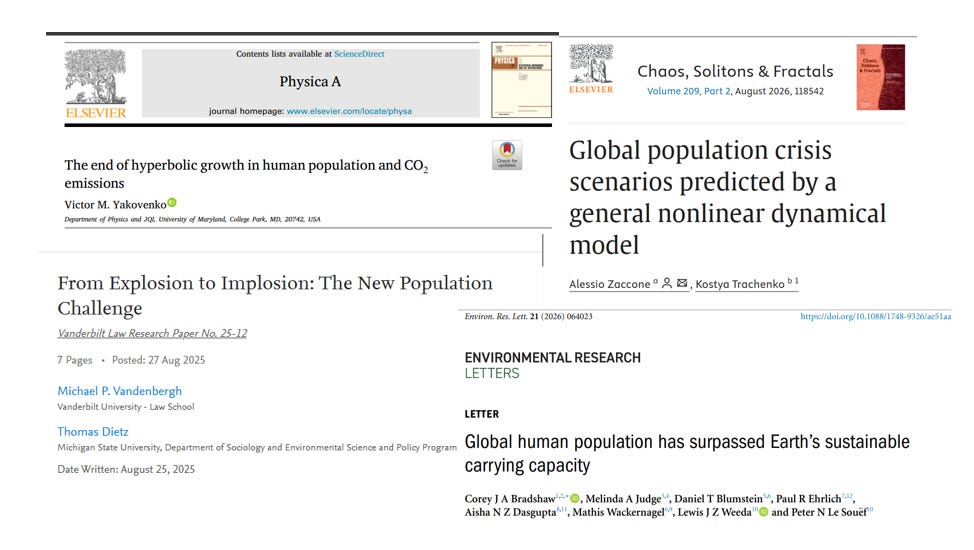
Give an experimental curve to a physicist, and you’ll make him or her happy for quite a while. I have no intention to go into the details. Just for your curiosity, some recent results by Viktor Yakovenko.
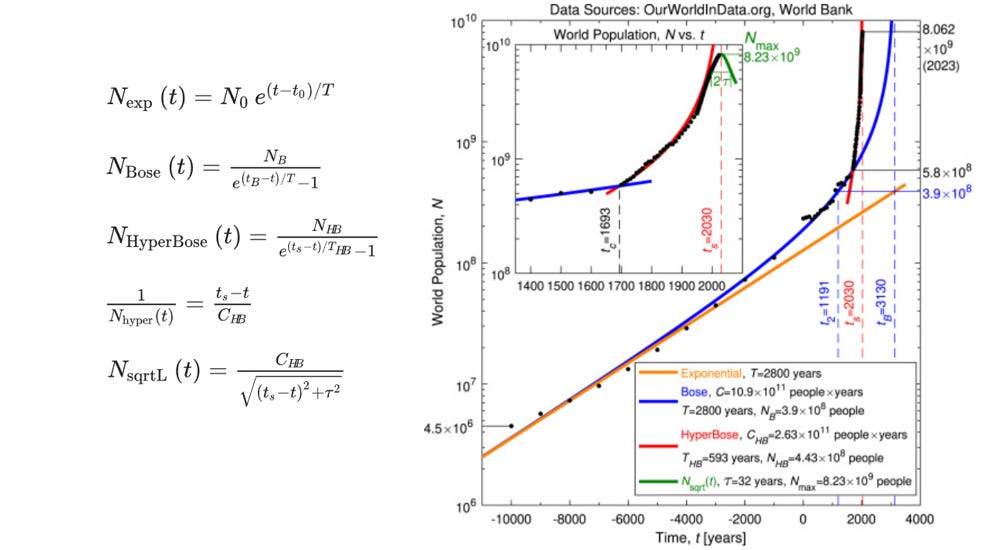
Note how the growth of the population has not been just exponential; it has been faster than exponential. That had been noted already in the 1960s, and the result was that the human population should have shot to infinity in 2026 if it had continued following the “Bose” curve. Evidently, it hasn’t (fortunately). Yakovenko proposes a “HyperBose” expression that goes up even faster. But the human population cannot reach infinity, and Yakovenko places the global population peak in 2030, at a total not very different from the current one.
Curve fitting is a nice game. It gives you some idea of where a certain system is heading, but not what factors lead it to do so. Hence, you have to use models that can take into account more data. The most common and most diffuse one is the “cohort-based” demographic model.
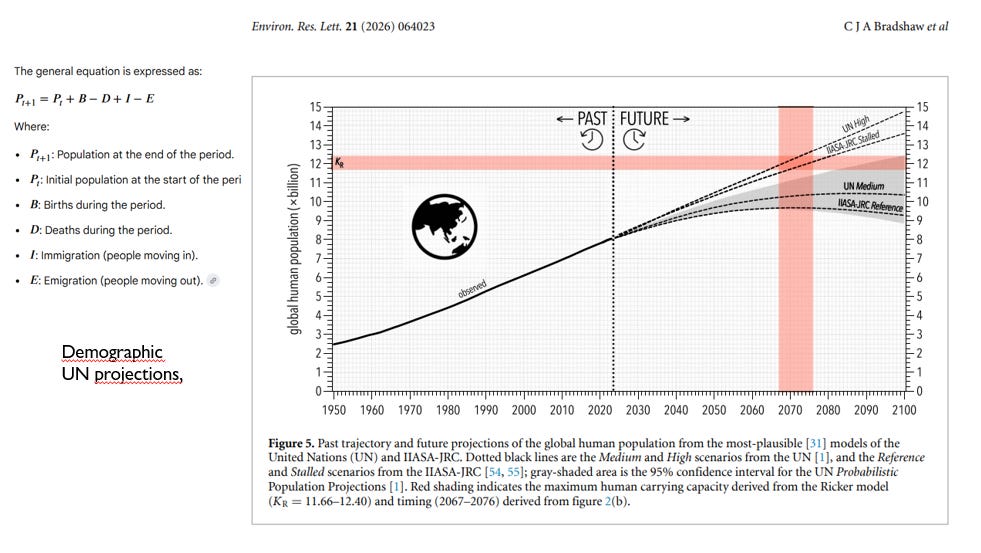
This model goes step by step, assuming that the population at a certain moment is the result of previous trends, taking into account that only some “cohorts” are young enough to be able to reproduce. It makes sense: the people alive today are the result of decisions taken by their mothers and fathers decades ago. So, the demographic models are based on assumptions about how many children will be born in the future, a parameter called “Total Fertility Rate” (TFR): the number of children per woman over a lifetime.
The TFR is a number that changes with time. The amazing thing that has happened during the past few decades is how fertility has collapsed, in particular in rich countries.
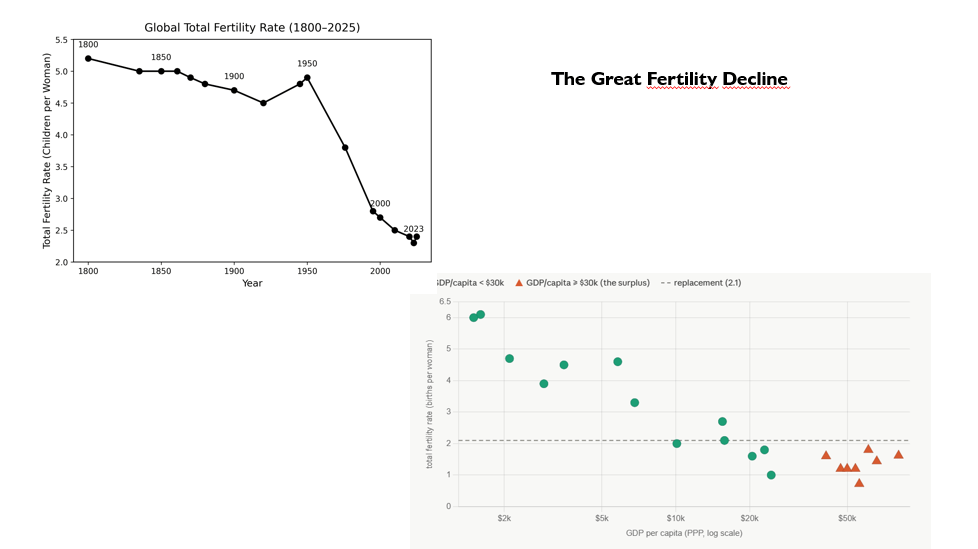
Why this decline? It is a long and complicated story that connects economic and social stress to environmental pollution, with plenty of uncertainties and debates involved. It is discussed in detail in my book. Let’s just say that it is a fact that fertility has gone down, and that is the reason why demographic models predict a future population decline. The children not born today will not be alive decades from now, and that will affect how many human beings will be around.
Now, let me tell you of another approach to understanding the future of population. The “System Dynamics” or “Stock and Flow” model techniques, the same ones that were used for the famous 1972 report to the Club of Rome, “The Limits to Growth.”
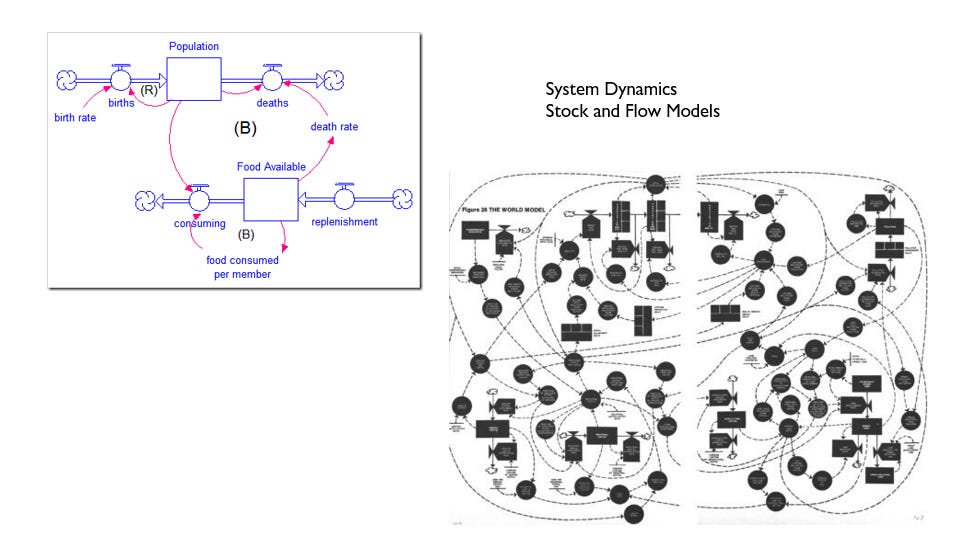
Here, too, it would take a lot of time going into the details. Let’s just say that these models take into account all the factors that, presumably, affect human population; for instance, the availability of food, industrial production, pollution, and others. It is more detailed than simple fitting or demographic models, which only take into account a single parameter: the population itself.
And here are the results of one of the first studies that attempted to put the numbers and the equations together; the 1972 report to the Club of Rome titled The Limits to Growth.
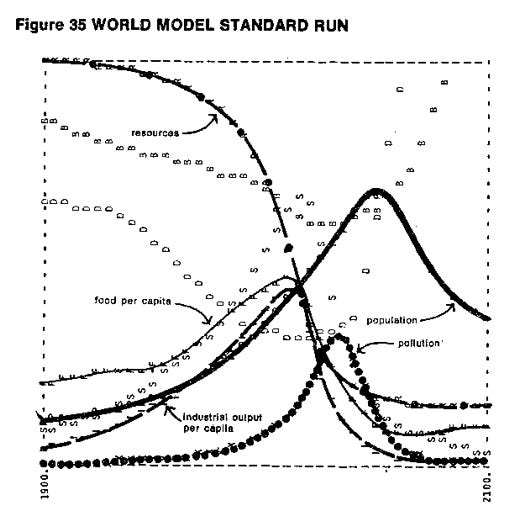
The results agree with the idea that population is soon going to peak, and then decline. The 1972 study was still a “beta” version, and the modeling of the population cycle was based on debatable assumptions. You can note how, in the figure, population keeps growing while agricultural production collapses; evidently not realistic. More recent versions led to a population peak closer to the “civilization peak.” Here is the same model computed in 2004.
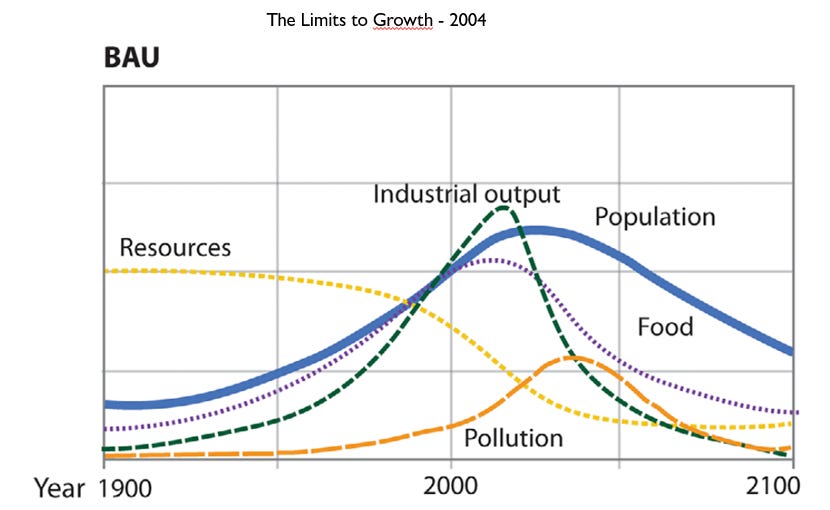
As you see, the human population peaks and starts declining around 2030, in agreement with the recent studies by curve fitting. Here is a more recent system dynamics study by Nebel et al. that arrives at similar conclusions.
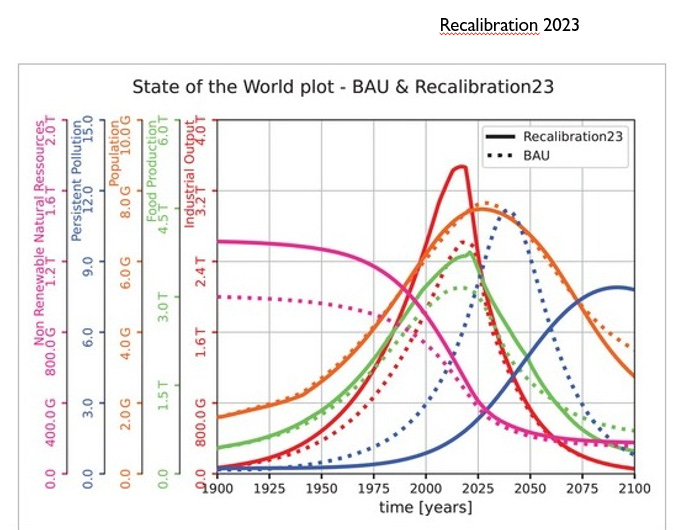
In this 2023 study, the world’s population should have peaked in 2025. It was probably a little too pessimistic, but considering the situation of the world today, it may turn out not to have been too wrong.
So, can we use these models for quantitative predictions? Let me tell you of a little game that I played using them to describe the Great Irish Famine that started in 1845.
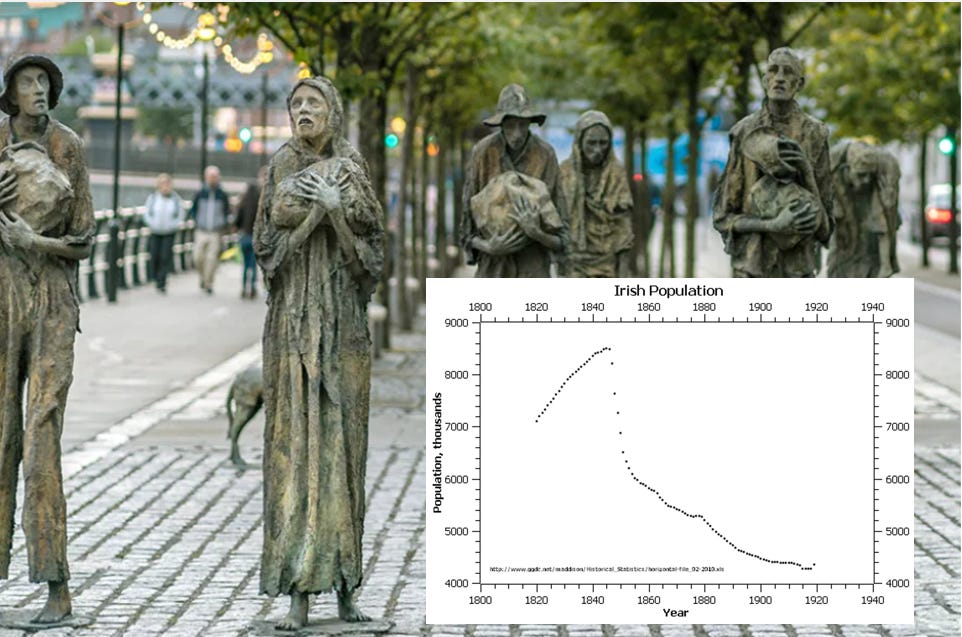
As you know, the famine was a tragic event that killed or forced to emigrate about half of the Irish population. The insert in the figure shows how brutal the collapse was, a typical “Seneca Collapse.”
The Irish were taken by surprise by the Great Famine, and the question is whether it could have been predicted and, perhaps, avoided. There had been other tragic famines before, so it was predictable that a new one could have struck any time. But suppose you are a demographer in Ireland in 1840. Suppose you have the same tools we have today: computers, models, data treatment systems, etcetera. Could you have predicted the famine? I played this game and showed the results in a paper that I published on Qeios.
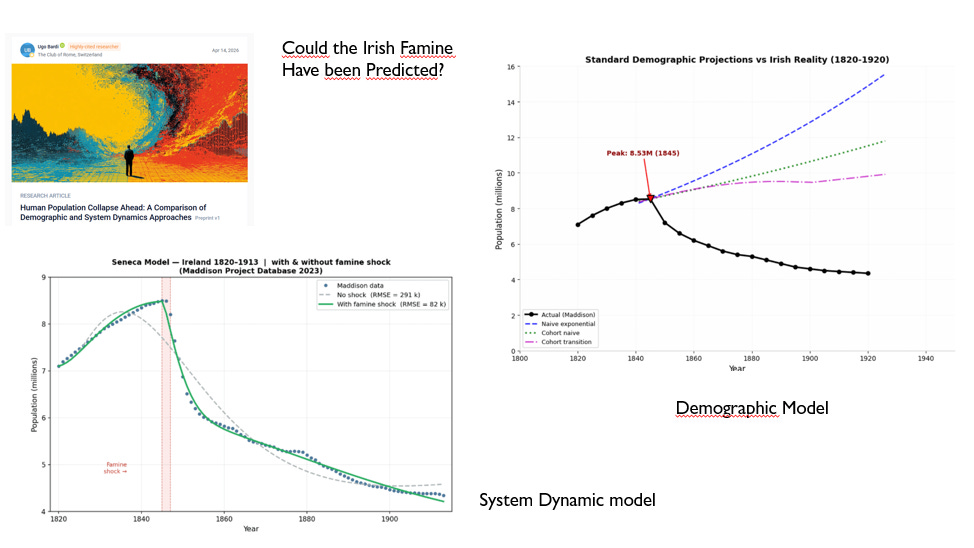
I tried to fit the historical data using two different models: a classic demographic, cohort-based one, and a dynamical model based on a simplified version of World3, the model used for The Limits to Growth studies. Basically, neither model could predict the 1845 catastrophe, but that doesn’t mean both models performed in the same way.
The demographic model, being based on past data, could only extrapolate the same behavior in the future. Even assuming a demographic transition in Ireland, the results always generate a certain degree of population growth. No collapse in sight.
For the “Seneca” model in its simplest form, the results are better, but the fitting of the curve is approximate. As you can see in the figure, it cannot generate the abrupt collapse that the famine brought to the Irish population. The only way I found to generate it was to assume an external blow, a sudden crop failure, and hence a reduction in food availability. That could fit the curve, but in 1840 you would never have been able to know that the fungus that killed the potato crops was to strike in 1845. You see how the population question is complex, wide-ranging, difficult, and sometimes highly stressful for the poor modeler.
In the end, there is a question that models cannot answer: what exactly causes the decline in fertility rate? On this point, there are several theories, and plenty of debate. At least four factors have to be taken into account: stress, socioeconomic factors, wars and epidemics, and chemical pollution. All three have some effect, but the main ones are clearly socioeconomic factors and chemical pollution. On the one hand, women tend to delay childbirth to optimize their social and economic position. On the other hand, shocking data are accumulating on the physical decline of human fertility, for instance in the declining number of sperm cells in human males and the collapse of testosterone levels. These factors are discussed in detail in my book.
Finally (but not really) so far, in this post I didn’t discuss how fertility varies in different countries. Whereas Western and Eurasian countries have nearly all TFR values below the replacement rate, the African countries are still growing.
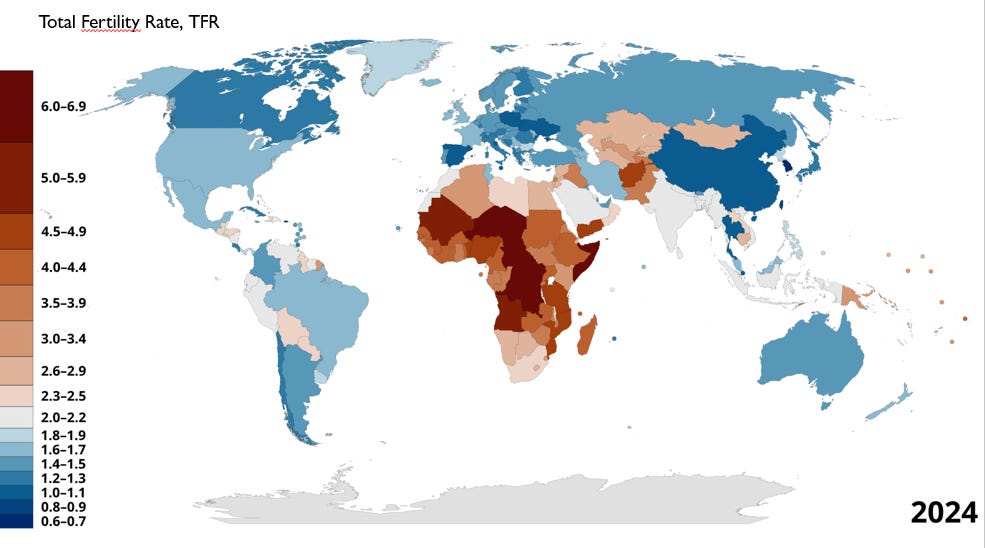
This is a temporary situation. Soon, even the African countries will show fertility rates below the replacement rate and a declining population. But for some time the imbalance will remain. With it, large-scale migrations are expected and, in part, are already taking place. You know the associated social and cultural problems involved.
It is a hugely complicated story that touches many of the elements of our world and our future. If you are interested in some specific aspects of the story, you can ask questions to my avatar that lurks on this site.

Just ask any question related to the book, and I (my avatar) will do my best to answer.
So, what about the future? Is the world’s population going to collapse as brutally as the Irish population at the time of the famine? We can’t exclude that. But a managed population decline may not be a disaster. On the contrary, it may be an opportunity to reduce the pressure on an exhausted ecosystem if we manage it well. The difference between a disastrous collapse and a beneficial decline is just a question of slope.
Unfortunately, the current situation does not seem to indicate that the world’s leaders are acting for the good of humankind. On the contrary, they seem to be doing their best to hasten the collapse. As always, the future will surprise us.
Hi Ugo, thanks again for a very interesting point of view. If you are going to speak to an enlightened audience perhaps I might suggest some points for the discussion (references on my substack "Testeronecollapse"):
1. For reproduction we need sperm which since 1950 is in accelerating decline, now by >2 percent per year, total loss must exceed 50 percent. Today's levels are still sufficient but specialists agree that from mid-century on there will be increasing problems with reproduction based on sperm decline alone.
2. For male development and sexual behaviour we need testosterone. Data are available since 1970 and especially in younger men point to an accelerating decline of 0,6-1 percent per year. Since sperm decline and testosterone decline share most causes also testosterone decline must have started ca. 1950 and must now amount to about 50 percent. This must already contribute to the decreased sexual activity which has been measured in many countries (D, F, UK, US, Australia) and to falling birth rates.
3. Decline of sperm and testosterone together correspond to a progressive and accelerating functional castration. We are halfway through; severe reproductive problems will start mid century, reproduction will then come to an abrupt Seneca cliff within two or three decades and castration will be complete by the end of the century. I doubt if existing population curves allow us to predict these biologically caused developments.
4. Since 500 million years in all vertebrates throughout evolution since the fish and reptiles sex determining genes, testosterone and testosterone driven brain circuits for sexual and aggressive behaviour are highly conserved and very similar . Whatever causes the decline in sperm and testosterone in humans will also affect the whole vertebrate world with similar consequences. In fact sperm decline has already been found in dogs, horses and cattle.
5. High (although also falling) reproduction rates persist in equatorial Africa, Middle East and Afghanistan. While Testosterone has always been higher in these regions there may also be less chemical pollution there.
I am confused. My whole youth, i was bombarded with articles and research about overpopulation and the fact that the earth can’t sustainably provide a decent lifestyle for all this people. That this will lead to political instability by workless youth, mass hunger, mass migration etc. During the last few years we are bombed with reports how the decline in population will lead to disasters … often, when you look deeper, it’s started with the fear of decline in birthrates by white women … but now also serious people are ringing the alarm … but oftzn out if fear for limits on economic growth and a threat on social security because it is funded by taxes on workers … so i would say: funding the social security and broader wellfare state by taxing wealth ( never in history so much wealth was available and the rich never contributed to society such a small amount), an economical model based on providing for the needs of people in stead of shareholders within planetary limits and controlled migration could offer solutions to reconcile both fears for an unsustainably high human population that exhaust the planet and fear that decline in population is a treat to our economy and collectif wealth