



In 2012, I noticed some evident similarity between the downfall of the Limits to Growth study of 1972 and the ongoing trends of demonization of Climate Science. I published my impression on the subject on my old blog, Cassandra’s Legacy. I am sorry to have to report that I was right. We are facing an unexpected situation: the more the disaster of global warming becomes clear, the more the idea is rejected, demonized, and ignored.
Up to now, we tended to believe that, at some point, global warming would have become so evident as to be impossible to ignore. Some huge event, some giant disaster, some massive impact would have brought people together to do something serious to stop it. But the opposite is happening.
The latest disaster was the giant Tibet flood. Even though the reasons are complex, it is impossible to deny its correlation with global warming. But, apart from the various attempts to explain it away as having nothing to do with temperatures, it is likely that it will be quickly forgotten. The idea that global warming is real and dangerous just doesn’t seem to stick in the average global consciousness, no matter what catastrophic event we witness.
Climate mostly goes unmentioned in traditional media. In social media, the noise of aggressive contrarian positions seems to be increasing. Some memes, such as that “CO2 is food for plants,” and hence more of it is a good thing, have been pushed so successfully that by now they have become accepted as an obvious truth.
It is worse than that. Climate science is being actively rejected and demonized. The US government is defunding research on Climate Science, firing climate scientists, censoring reports about climate scenarios, and the President has declared that climate change is a hoax. If you’d like to know how things are in other countries, I’ll just mention that the president of the Italian Senate recently declared that Italy’s climate will soon be as pleasant as that of the Caribbean Islands and that everyone should be happy about that.
In the post I published in 2012 (see below), I used an analogy. I compared the trajectory of modern climate science to that of an older scientific field, that of “world modeling.” It is the field that was started with a bang when the first edition of The Limits to Growth was published in 1972.
As we all know today, the results of the model used in The Limits to Growth study turned out to be fundamentally correct in their main elements. But after it was presented, the study went through a parable of initial acceptance, then harsh debate, and finally refusal and demonization. It seems to be a general law in science. New ideas generate a strong backlash, especially if their consequences may hurt some people’s profits.
In 2012, I thought I saw the start of the same trend with climate science. Now, nearly 15 years later, my impression is confirmed. Climate science seems to be going through the same parable of refusal and demonization that characterized world modeling in the 1970s and 1980s.
But is it true, or is it just an impression? Everyone of us has a different viewpoint and lives in a different Internet “bubble,” where the powers that be feed him or her with selected news and knowledge. So, how can we assess the trends of that huge entity called the “memesphere” in terms of beliefs toward climate science?
Unfortunately, the media, both traditional and social, are managed by private companies, for whom data are a financial asset. They have little interest and no legal duty to disclose their records. Nor are they compelled to make the analysis of their data easy for researchers. The result is that the scientific literature in this field is scant and scattered, especially in the field of climate science.
Yet, some studies do exist. A recent paper on how climate information (and misinformation) is diffused on the Web was published by Storani et al. It is a complicated story, but their attempt to disentangle “reliable” from “unreliable” climate information may have been successful.
They used a parameter called “engagement ratio.” They define it as the ratio of engagement from a given post toward “unreliable” (contrarian) or “reliable” (scientific) sites. This approach showed a generally rising trend for the skeptical position across platforms. It is an indirect measurement, but it does confirm the qualitative impression: the “skeptic” viewpoint is gaining ground in social media.
This is a table prepared by Claude on the basis of the data from Storani’s paper
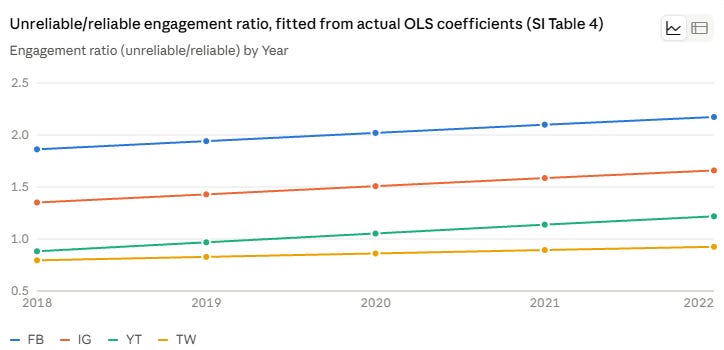
In the Graph, FB, IG, YT, and TW stand for Facebook, Instagram, YouTube, and Twitter. These data have to be taken with some caution, but the trend is clear, and the results are statistically sound.
Note how, on Facebook, the ratio is higher than 2. It means that the engagement toward “contrarian” sites is more than twice that on “scientific” sites. Facebook users, apparently, are largely more interested in content that claims to debunk climate science than the opposite. On Twitter, instead, the ratio is reversed, but it is moving toward parity.
The contrarian position has increased its diffusion by about 20% on Facebook and more than 30% on YouTube. Clearly, climate science is becoming less and less popular. We shouldn’t try to extrapolate these data into the future, but the basic concept is confirmed: climate science may be going through the same process that, decades ago, condemned The Limits to Growth to neglect and ridicule.
This is a systemic failure of the very element that makes us what we are: our minds. But nobody ever said that humans behave rationally, as we are proud to think we do.
Is there a way to invert the trend? In principle, it is not impossible. “The Limits to Growth” is seeing a return of interest that’s slowly eroding the still common perception that it was “wrong.” But can we climb back to restoring climate science to its status as a serious and valid field of study? In the long run, yes. But it will likely be too late to avoid the full force of Global Warming hitting all of us.
__________________________________________________________
Tuesday, December 11, 2012 — From “Cassandra’s Legacy”
Climate Science: the same destiny of “The Limits to Growth”?

Studies of resource depletion, such as “The Limits to Growth” of 1972 were attacked and demonized in the 1980s, and then consigned to the dustbin of “wrong” scientific ideas. Now it is the turn of climate science to be attacked and demonized. Two parallel stories unfolding at different times.
In the 1950s, the mineral depletion problem and the climate problem started to be recognized. In 1956 Marion King Hubbert published the first study that examined worldwide oil depletion; suggesting the model that today takes his name; the “Hubbert Model”. At about the same time, in 1957, Roger Revelle coauthored with Hans Suess the first paper that noted that the concentration of carbon dioxide in the atmosphere was increasing as a result of the combustion of fossil fuels and pointing out the related climatic effects.
Both climate studies and oil depletion studies dealt with complex, non linear systems, so that quantitative estimates of future trends became possible only with the development of digital computers, starting in the late 1960s. The first general circulation model (GCM) was developed at NASA’s NOAA in the late 1960s. The first world model that examined the world’s economic system in light of resource depletion was published by Jay Forrester in 1971, with the title “World Dynamics”. One year later, in 1972, the more detailed study “The Limits to Growth” appeared. These events marked a rapid growth of two new fields of research: “Climate Science” and “World Modeling”.
Already the 1972 study, “The Limits to Growth,” had identified the main elements and the behavior of the world system. Here is the basic result from that study.
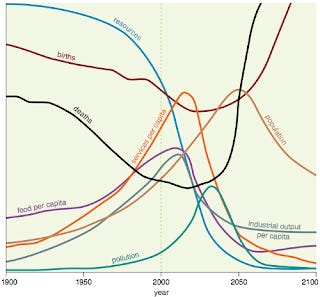
As you see, the model had already identified the “tipping points” of the system, where the gradual depletion of natural resources and the increase in pollution would lead to the collapse of industrial and agricultural production and, later on, to the collapse of population. The choice made to build this model were to “aggregate” most of the variables involved, that is, to lump them together to limit the unavoidable uncertainties when dealing with single variables. Lacking sufficient data to build a very detailed model, the approach of “The Limits to Growth” study was heuristic and oriented to the understanding of the system’s behavior, rather than to making exact predictions.
On the other side of simulations, climate scientists found themselves facing the high complexity of the world’s climate, for which they often lacked sufficient data. The result was that climate modeling grew together with a substantial experimental effort dedicated to measuring the parameters of the system. Several of these parameters required extensive studies to be understood and quantified. With time, models grew in sophistication, just as the data in input became more detailed and reliable. Perhaps because of this very sophistication, the models had troubles in addressing the question of “tipping points”, abrupt changes that could result from enhancing feedbacks within the climate system. The result has been a tradition of presenting the results of climate models as smooth and continuous curves. Here are, for instance, the curves for the temperature rise in the first IPCC report in 1990.

The results of the simulations haven’t changed very much in the latest IPCC report, in 2007. Now, here is the difference between the two fields of research: World modeling, with its vision of collapse, seemed to provide a more immediate and more worrisome threat than the smooth curves of climate science. This difference had consequences.
We know what happened to the iconic study of world modeling: “The Limits to Growth” of 1972. It appeared threatening enough to many people that it underwent a series of political attacks in the 1980s that moved it to the dustbin of the “wrong” scientific theories. The problem was not just the demonization of a single study, but the fact that an entire scientific field was cast in bad light, and that led to the nearly total disappearance of research funds in the area. Only in recent years are we seeing world modeling laboriously trying to re-emerge as a legitimate field of study.
The problem with climate science, however, is that its vision of the problem has gradually become more and more dramatic. With the Northern Ice Cap on its way to complete melting, drought, floods, and hurricanes, the question of abrupt climate change can’t be ignored any more. Scenarios that take tipping points into account start to look even more worrisome than those provided by world modeling in the 1970s.
So, it may not be a coincidence that we are seeing a reaction against climate science very similar to the one seen in the 1980s against world modeling. Apparently, people do not like to see threatening scenarios, and many lobbies feel that such studies are bad for business. As a consequence, a concerted effort is being carried out in order to demonize climate science and climate scientists in the eyes of the public and to make the whole story look like a joke or, worse, a purposeful hoax. If anything, the present attacks against climate science are more aggressive and violent than any attack against world modeling has been. Today, demonization technologies are much better known and refined than they were in the 1980s. The “Climategate” fabrication, for instance, is a true masterpiece in how to deceive the public.
So, what we are seeing are two parallel stories unfolding at different times. It is not impossible that climate science will go the same way as world modeling did in the 1980s: demonized and ridiculed by a concerted and well-financed political attack and subsequently removed from the pool of legitimate fields of study. If that happens, we may very well lose a couple of decades before realizing that studying climate science was important. By then, it will surely be too late.
Perhaps, however, the recent wave of symptoms of climate change, from hurricanes to melting ice caps, will make the problem so clear that it will spare climate science from the fate of demonization that befell world modeling. However, the anti-science campaign is still going on, and we have already lost a lot of time. Is it too late? Only time will tell.
If you wish to support my work with a contribution, you can do so at the “Donate Open” website. And thank you very much!
One problem with the "Limits of Growth" report is the illustration you show above: It predicts a resource depletion during this century. Because this has not happened the two leading Swiss journals (Tages-Anzeiger, Neue Zürcher Zeitung) and the big German journal WELT stated recently that the report has now been falsified and is not anymore valid.
However the text of the report - in contrast to the illustration - says that new resources will be found and therefore resource depletion will not be critical in the nearer term. At the same time it maintains that pollution will be the limiting factor (mentioning also CO2) and that population will begin to decline in this century. These original predictions are still correct: Endocrine disruption by chemical pollution already impairs human and animal reproduction while climate change, droughts, food and water scarcity and violence will kill millions if not billions.
We were deeply impressed by the "Limits to growth" report and when the established political parties did not react we founded the Swiss Greens in 1983. The media ridiculed us as well meaning or dangerous sectarians. I was in the national parliament at the time and by 1990 I came to realise that our effect was zero and the game already lost. ¨
As a reaction with some physicians we founded a salon orchestra playing the historic salon music which was played on the sinking Titanic and in the concentration camps during arrivals and gassings. We played in many historic Swiss hotels to much success - a desperate, covert and funny form of protest - a selection of recordings is here: The late and world famous penicillin researcher Prof. Klaus Neftel at the first violin, me at the cello: https://www.youtube.com/watch?v=QpJ-U9tiD2o&list=PLqWzBqQokFVkj_j8GEq35SToQ5Iiw5526&index=2)
A generation later we have to ask: What does matter now? Even if we go full electric and net zero CO2 the warming will accelerate for decades and centuries and more than the IPCC admits, carbon capture is as ineffective as Hitlers "Wunderwaffen", chemical pollution will go on and forever chemicals are there forever anyway. Perhaps rats will survive or the bacteria that can live in boiling water, as long as there is water left.
I am a "green" of the first hour but in this sense I think that "Green politics" is just a fraud. To be honest it really does not matter if we go vegan or behave like Trump and we may enjoy life as we can.
Of course I would be glad if anyone could prove me the contrary.
So, what's the solution? That's the response I have consistently heard when discussing the two subjects with well educated people. With the use of fossil fuels, the industrialized world has been able to solve almost every major problem for most people since World War 2. It's all most people alive today know or have experienced. Hurricane Harvey caused massive flooding in the Houston, Texas area several years ago. If only Tibetans shared in American know-how and greatness, a massive remediation effort would already be underway. In this respect, the limits to growth (and energy supplies) and the psychology of climate change are linked, and as long as the part of the world that "matters" can remediate climate issues with everything from air conditioning to levees to energy-thirsty helicopters and heavy machinery, most people will wait for "solutions" rather than seek underlying causes. As Ugo points out, some people profit from climate disasters. Even the aura of a solution, such as the Tesla, makes some people very rich.