


It was a town of wide extent and dense construction, yet one with a portentous dearth of visible life. From the tangle of chimney-pots scarcely a wisp of smoke came, and the three tall steeples loomed stark and unpainted against the seaward horizon.
H.P. Lovecraft, “The Shadow Over Innsmouth” (1931) (Image from Lovecraft Fandom)
Where is everybody? It is the question I asked myself this summer, while driving along a mountain road in Tuscany. It was evening; the winding road went through dark woods that often opened up into agglomerations of houses, some very small, some relatively large. One thing struck me: everywhere, most windows were dark, most driveways were empty.
By day, it is not easy to notice the emptiness of these places. But at night, the lack of lights tells the story. It reminded me of Innsmouth, the fictional decaying town described by Lovecraft. Innsmouth is supposed to be a waterfront town, while these are mountain villages. But I had the sensation that some Deep Ones were peering at me from dark rooms.
But no, no evil aliens living there. I knew some of those places; I had walked around there during the day. Empty, yes, but not decaying. These houses were reasonably well maintained and showed no sign of crumbling down. Just that sensation of emptiness. Something was missing: people.
To give you some idea of what these places look like, here is an image taken from Google Maps. These homes were probably built in the 1950s or earlier, during a period of economic growth. They seem to be in relatively good shape, but there is no trace of human occupation. All windows are closed shut. The sign on the gate on the left says “Vende” (“For Sale”).
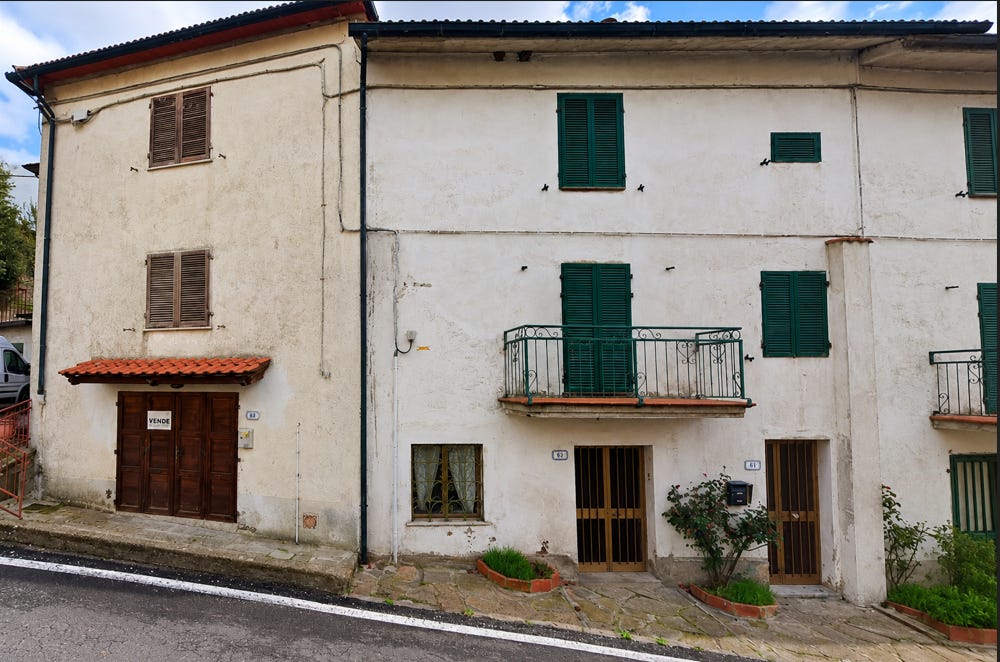
Interestingly, this is the only “For Sale” sign I could notice. If you look at one of the several Web-based real estate agencies, you’ll find several expensive villas listed in the area, but none of these smaller homes. Likely, their monetary value has gone negative: owners still have to pay the property taxes and a minimum of maintenance. You wouldn’t want to have one, not even as a gift. Probably the owners still maintain these homes hoping for better times in the future. But if nothing changes, you should soon start seeing these buildings crumble down and the place look more and more like Lovecraft’s Innsmouth.
I visited one of these places several times, just to acquaint myself with it. Then, I explored what was known about it. I found that it used to host about 120 residents in 2001. Probably there were many more in earlier times. Now, about 60. I found an estimate that there are about 80 separate housing units there. One-third of them are officially occupied. More realistically, in practice, no more than about 20%.
The village used to be a renowned sanctuary during the Middle Ages. It still has a relatively large church, but it seems to be always closed. There used to be a coffee shop and a grocery store, but not anymore. The closest place where there are functioning shops is another village about two km away. It is a little larger; they even have a post office there — but it is not obvious that these shops will survive for long. A public transportation system still exists, but unless your life happens to fit its timetable, you need a car. Those who can’t drive a car are stuck there. For an underage boy or a girl, it must be hell.
Make a little effort to imagine what this place was like in the 1950s and 1960s. With the expanding population of the time, families had moved there in newly built apartments to find space to live at a low cost. Most of the men were probably going to work every morning in the larger settlements, where there were factories. Or in the mines of the area. Probably there was some public transportation system specifically created to transport workers to and from their homes. During the day, the village must have been lively: full of women and children. I couldn’t find evidence that there was a school — possibly yes, although not in a specific building.
Now, imagine what it is like to live there today. Empty apartments, old people, no children. In summer, if you ask a young man or a girl you meet in the streets. “Are you from here?” the answer is normally, “I was born here, but now I live in town. I am here just for the summer.” In September, they are all gone. Only the elderly remain.
People need to meet people. But there have to be people around. Imagine how hard these people were hit by the COVID measures. One year ago, I saw old people still wearing face masks in these places. That seems to have disappeared for good now, but I think the fear and the suspicion still linger. I could never find their ancient church open, but I am sure the stoups are dry.
What do these people do? Not much, except watching TV. If they are a little younger, maybe they play with Facebook. Outside, it rains. Once, it used to snow in winter, but not anymore. Their children call once in a while from wherever they are — towns in Italy or in Europe. Not much news to be told.
Now, I am moving into a speculation of mine, but I think that much of the madness we are seeing in the world today is the result of people living in isolation.
Being old, isolated, and far from your relatives, you are forced to see only what you can see on TV. And TV shows you a world populated by monsters, evil people who envy your freedom and your lifestyle. They wear turbans, have dark skin, practice strange religions. They want to steal what you have, to invade your country, and chase you out. You should be afraid, very afraid.
And you are afraid. It is like being in Innsmouth: the Deep Ones are out for you.
Now, do you wonder why the people who promise to chase out foreigners get voted into power in Western countries? Could the progressive emptying of communities like this be changing politics as well as demography? There is some evidence that it does. It is not certain, because loneliness can also lead people simply to withdraw from politics. But that, too, favors extreme political views.
_______________________________________________________________________
Why the population is declining in industrialized countries is described in detail in my book
Similar considerations regarding East Germany have been proposed by Uriel Fanelli (in Italian).
In the US, the big concern is the "housing crisis." Not enough housing to go around.
I see it differently. I see it as a centralization crisis. As rural and exurban economies hollow out, people migrate to big cities for both economic and cultural opportunities. There's plenty of housing, if the economy were better distributed.
But centralization is consistent with oligarchy and corporate consolidation.
It shouldn't take more than a few minutes to actually see that parties like AfD in Germany have their biggest support among the younger cohorts.
It's not old people voting far right out of fear, but young people who see themselves being replaced in their own countries so the GDP can grow a few more percentages.