

Are we on the Edge of Collapse? Impressive Data from a Recalibration of World3
Staring at the Cliff right in front of us.

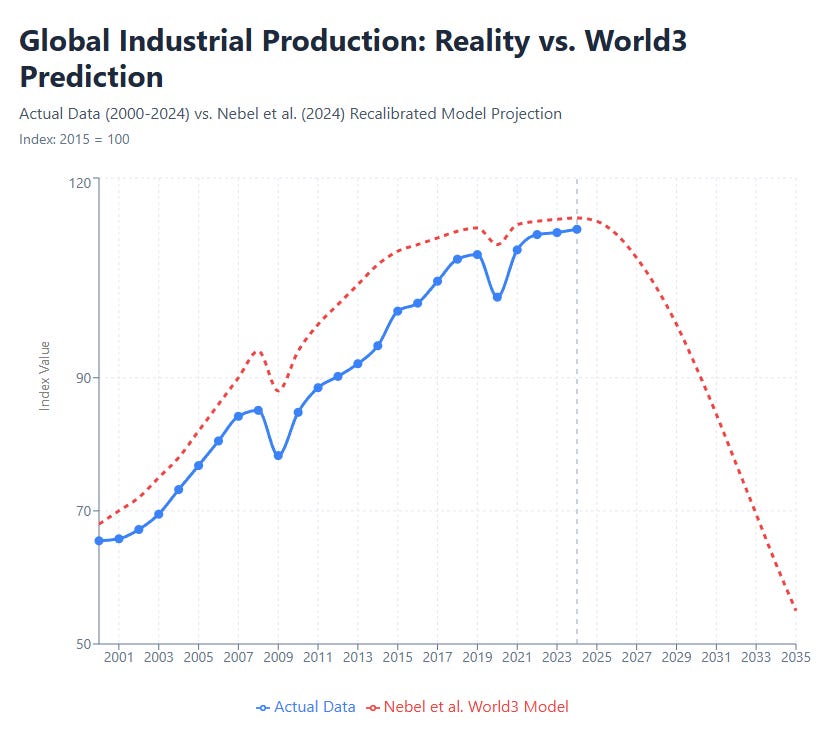
One more Seneca Cliff coming soon? If so, we are in for a rough fall. Graph prepared by Claude on the basis of the data by Nebel et al.
I always say that models are not predictions; they are qualitative illustrations of what the future could be. But as the future gets closer to the present, models can start being seen as predictive tools. It is the weather/climate dichotomy, so aptly exploited to confuse matters by politically minded people in the discussion about climate. Right now, we are getting close to the point that we could forecast a collapse in the same way as we can forecast the trajectory of a tropical storm.
So, you remember how “The Limits to Growth” generated a long term forecast in 1972. Here it is
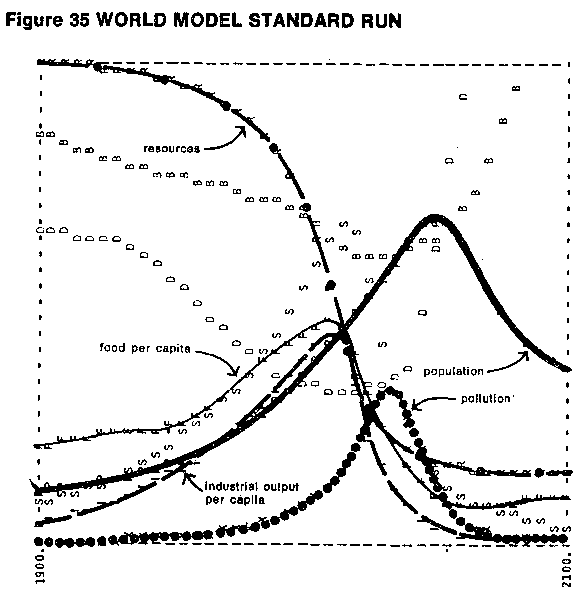
The start of the collapse of the industrial production (here calculated in per capita terms) was supposed to be at some moment between 2010-2020. A little too early, because we passed that moment. But that calculation was made more than 50 years ago, and you it is legitimate to think that it needs some readjustments. That was what Nebel et al did in a recent paper; they recalibrated the same model (word3) on the basis of the available real-world data. And here is their result.
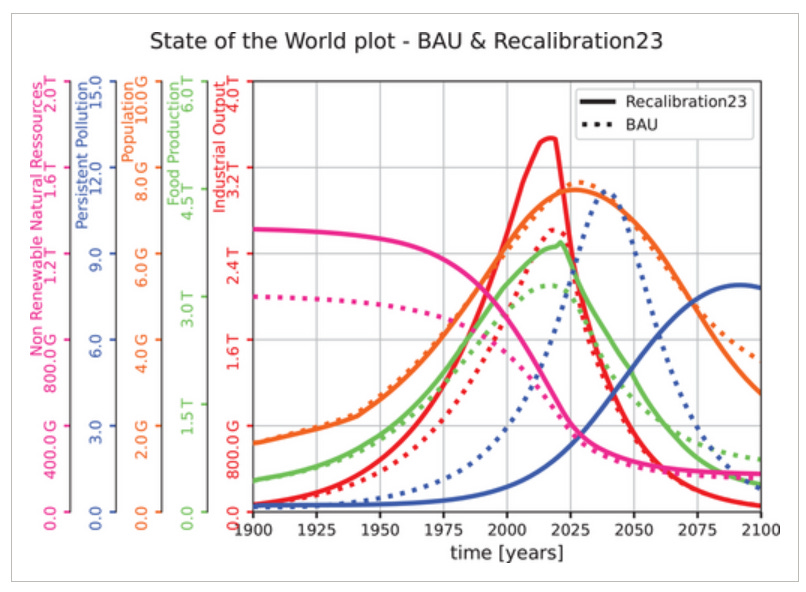
Note the red curve, industrial production. Are we facing the abyss? At first, it looks unlikely, but I compared Nebel’s data with the real-world ones for industrial production, and I had Claude plot them together. The result is shown at the beginning of this post; let me reproduce it here again:
Do pay attention to the other curves of Nebel et al.’s paper. Agricultural collapse will be at about the same time as the industrial one. Population should start collapsing a few years later. Pollution will reach a peak around 2080 at levels some three times higher than the current ones. If this is a good prediction, we are in for a rough ride, a VERY rough ride.
But never forget: even hurricanes may change their trajectory at the last moment, and there are reasons for optimism. Listen to Sabine Hossenfelder, for instance. I think that before making this clip, she smoked something really strong. But who knows? She might be right.
Development of nuclear fusion has priority in China and as the country with most scientists and engineers, will be first to use bring it online which indeed might be before 2050.
Resource depletion of the nonrenewable variety is unavoidable but can be delayed by making products "lasting for life and longer" instead of unsatisfactory crap people want to replace after a few months. Designing that isn't allowed unless "just hobby" - the profit model is "holy".
Western diets could be classified under "nutrient deficient caloric crap" as well, and one of the results is ~60% of Western populations suffering from chronic disease. Winners: "big pharma oligarchs" and industrial (pesticide controlled) agriculture that destroys natural soil fertility.
From that perspective the trajectory can be changed fast enough but it would require elimination of those profiting from the wasteful system, thinking they can survive a collapse with enough wealth and start all over again.
Sabine Hossenfelder failed to do some basic AI enquiries unless she's offering to show us she can float by pulling on her shoe laces? AI tells us:-
Fusion requires Tritium particularly in the most commonly studied fusion reaction involving deuterium and tritium (D-T). Currently, global stockpiles of tritium are very limited. Estimates suggest there are approximately 25 to 50 kg of civilian-use tritium available worldwide, all sourced from nuclear fission reactors.
Due to its short half-life of approximately 12.3 years, the existing tritium reserves are constantly decreasing, making it essential for researchers to find sustainable production methods. A single commercial fusion reactor might require around 10 to 55 kg of tritium annually, depending on the design and energy output. Estimates indicate that a typical 1 GW fusion reactor could consume around 250 kg of fuel annually, with half being tritium.
But effective breeding in a fusion reacator requires a steady source of fast neutrons, typically provided by fusion reactions themselves, which can't be scaled up due to there not being anywhere near enough Tritium to fire up even a tiny 1GW reactor for a few months !! .... ooopps!
In other words enjoy the peak of everything and be humble.